



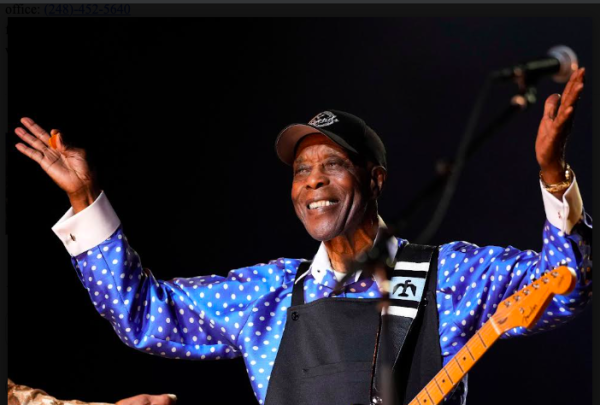
Radio City Music Hall brought generations of musicians together to honor one of the most influential guitarists in American music. But the October 1 celebration was more than a birthday tribute. With Buddy Guy still commanding the stage and Bobby Rush bringing his own remarkable history into the room, the evening became a reminder of how far the blues has traveled—and who made that journey possible.
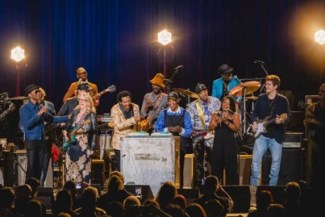
Buddy Guy’s 90th birthday celebration at Radio City Music Hall began not with a wall of amplifiers but with three musicians sitting down together. Guy, Derek Trucks and Isaiah Sharkey opened with John Lee Hooker’s “I’m in the Mood,” a relatively understated beginning for an evening filled with some of the world’s most recognizable guitarists.
It established something important from the start. However many musicians had come to pay tribute, Buddy Guy was still the reason everybody was there.
The October 1 concert, appropriately titled Buddy’s Got the Blues: A 90th Birthday Concert Celebration, arrived a few months after Guy’s July birthday. But the occasion was larger than an anniversary. It was a celebration of a man whose playing helped reshape electric blues and influenced generations of musicians who would carry that sound into rock, soul and popular music around the world.
And at 90 years old, Guy was not simply sitting back to receive applause. He was still playing.
Three Generations, One Stage
The evening brought together an extraordinary lineup, including Christone “Kingfish” Ingram, Robert Randolph, Kenny Wayne Shepherd, Ally Venable, Joe Bonamassa, Eric Gales, Samantha Fish, Shemekia Copeland, Jimmie Vaughan, Billy Gibbons, Susan Tedeschi, Derek Trucks, Gary Clark Jr. and John Mayer.
Each represented a different connection to the blues. Some came through traditional Chicago electric blues, others through Southern rock, gospel, soul or the guitar-driven rock music that Guy helped inspire.
Watching the performances through published concert footage, what stood out was not simply the number of accomplished musicians sharing the stage. It was how differently they approached a musical language that Buddy Guy had helped shape.
The younger guitarists brought their own interpretations, their own phrasing and their own experiences. Yet much of what they played could be traced back to the musicians who came out of the American South and transformed Chicago into one of the great centers of electric blues.
Guy was among the most important of them.
From Louisiana to Chicago: The Making of Buddy Guy
Long before the Grammy Awards, sold-out theaters and generations of guitarists lining up to honor him, Buddy Guy was a young boy growing up in a sharecropping family in Lettsworth, Louisiana.
His earliest attempts at making music came on a homemade stringed instrument. There were no grand stages or international audiences waiting for him. There was simply a young man discovering that a guitar could express something words could not.
In 1957, at 21 years old, Guy made his way to Chicago, joining the migration of Southern Black musicians who were helping transform the city’s musical identity.
Chicago offered opportunities that Louisiana could not. Guy entered a musical world populated by figures such as Muddy Waters and Howlin’ Wolf, eventually recording for Chess Records and establishing himself among the city’s remarkable generation of electric blues musicians.
But Buddy Guy was never interested in simply following the rules.
His guitar could whisper one moment and explode the next. He bent notes until they seemed almost human, attacked the strings with startling intensity and developed a stage presence that made audiences feel as though anything might happen.
That approach did not always fit comfortably within the expectations of the recording industry. At Chess, Guy’s more aggressive playing was sometimes restrained in favor of a conventional blues sound. Onstage, however, he continued developing the unpredictable, emotionally charged style that would become his trademark.
You can hear the influence in Jimi Hendrix, Eric Clapton and Stevie Ray Vaughan, three very different guitarists who recognized something extraordinary in Guy’s playing.
His importance was never simply about speed or technical ability. It was about the feeling behind the notes, the willingness to take chances and the belief that a guitar should communicate something deeply personal.
The musicians gathered at Radio City were not merely honoring an extraordinary career. In many ways, they were playing music that Buddy Guy had helped make possible.
But there is another side to that history, one that becomes especially important when considering the experiences of the Black musicians whose work inspired so much of modern rock and blues.
And Bobby Rush knows that side firsthand.
Bobby Rush Remembers
Bobby Rush was among the musicians invited to celebrate Guy’s remarkable milestone. At 92 years old, Rush brought more than another legendary name to the stage. He carried memories of a music business that looked very different when he was coming up.
When I interviewed Rush in September, our conversation repeatedly returned to the difference between being heard and being seen.
He remembered playing early gigs in Blue Island, outside Chicago, where audiences wanted to enjoy his music without looking at the Black musician performing it.
“The people wanted to hear my music, but they didn’t want to see my face,” he told me.
His job was to play behind a curtain.
When I asked when that barrier finally broke, his answer was immediate.
“It didn’t break. They just took me out from behind the curtain.”
That statement has stayed with me.
There is something deeply revealing about an audience embracing a musician’s sound while refusing to acknowledge the person creating it. It also speaks to the complicated history of the blues as the music traveled beyond Black communities and found enormous popularity among audiences around the world.
Rush has never forgotten those early years.
He told me about entering the juke-joint world as a teenager, sometimes making himself appear older so he could get work. On one occasion, he drew a mustache on his face, only to have Muddy Waters notice it beginning to run.
Rush can still laugh about that youthful attempt to fool the adults around him.
The curtain in Blue Island is a different kind of memory.
Yet Rush does not approach the blues as something that must remain frozen in the past. During our conversation, he emphasized that musical traditions have to evolve. The presentation can change while the human experience underneath remains recognizable.
A younger guitarist does not have to reproduce a seventy-year-old recording note for note to respect the blues.
What matters is the feeling, the honesty and an understanding of where the music came from.
That philosophy helps explain why the Radio City celebration mattered.
If Rush’s memories revealed the barriers that an earlier generation of Black blues musicians faced, Guy’s career demonstrated how far their music ultimately traveled.
At Radio City, those two histories came together.
When the Tribute Turned Into a Conversation
One of the evening’s most meaningful moments arrived when Bobby Rush joined Buddy Guy onstage.
Here were two men, 92 and 90 years old, who had spent much of their lives helping bring the blues to audiences around the world.
They moved through songs including “Chicken Heads,” “I Just Want to Make Love to You,” “Boom Boom,” “Garbage Man Blues” and “How Blue Can You Get?”
The performance offered something different from the carefully arranged tributes surrounding it.
Rush and Guy did not need to demonstrate their importance. Their shared experience was already present in the music. What emerged was a conversation between two veterans who understood the blues not only as an art form but as a life they had lived.
There was humor, familiarity and the kind of musical understanding that comes from decades of performing.
It was also a reminder that longevity means something different when an artist continues creating rather than simply revisiting past achievements.
Guy announced during the concert that Eric Clapton, who had been scheduled to appear, was unable to perform because of illness.
The evening continued with John Mayer singing Otis Redding’s “I’ve Got Dreams to Remember” alongside Susan Tedeschi. Guy later joined Mayer for Johnny “Guitar” Watson’s “A Real Mother for Ya.”
The assembled performers closed with “I’m Your Hoochie Coochie Man” and “Got My Mojo Working,” two songs deeply connected to the musical tradition that had brought everyone together.
For a celebration filled with remarkable guitarists, the greatest statement may have been the simplest one.
The musicians were not there to compete with Buddy Guy.
They were there because of him.
More Than a Birthday
During my interview with Bobby Rush, he recalled that his father was a preacher who pastored two churches. Yet despite the long and sometimes uneasy relationship between blues and religion, the music was never forbidden in their home.
“He never told me to sing the blues, but he never told me not to sing the blues,” Rush said. “So that gave me a green light in my house.”
That small memory says something important about the blues.
It was never simply a style of guitar playing or a collection of familiar twelve-bar progressions. It came from families, churches, farms, communities and the difficult experiences of people trying to make lives for themselves.
Buddy Guy’s journey from rural Louisiana to Chicago carried much of that history with it.
So did Bobby Rush’s.
Their careers took different turns, but both men helped ensure that the music survived, changed and reached audiences their predecessors could scarcely have imagined.
And neither seems particularly interested in being treated as a museum piece.
Guy has continued recording and performing into his tenth decade, with plans for more music still ahead. Rush remains active on the road, appearing at the King Biscuit Blues Festival in Helena, Arkansas, just nine days after the Radio City celebration.
That may be the most encouraging part of the entire story.
At 90, Buddy Guy does not need an evening of guitar heroes to establish his importance. His influence can already be heard in countless recordings and in the playing of generations of musicians who followed him.
But the celebration offered something more valuable than recognition.
It brought the past and present together without pretending that the story was finished.
Two men who helped carry the blues through some of its most difficult and transformative decades were still standing, still playing and still finding something worth saying.
The younger musicians surrounding them were not simply preserving an old sound. They were discovering what they could do with it next.
And somewhere beyond that Radio City stage, another young guitarist was listening.
The music was still moving.
And so were Buddy Guy and Bobby Rush.
Find more on Buddy Guy here: https://www.buddyguy.net
Check out Bobby Rush here: https://www.bobbyrushbluesman.com
Photos by Matt Ramirez / MSGE