


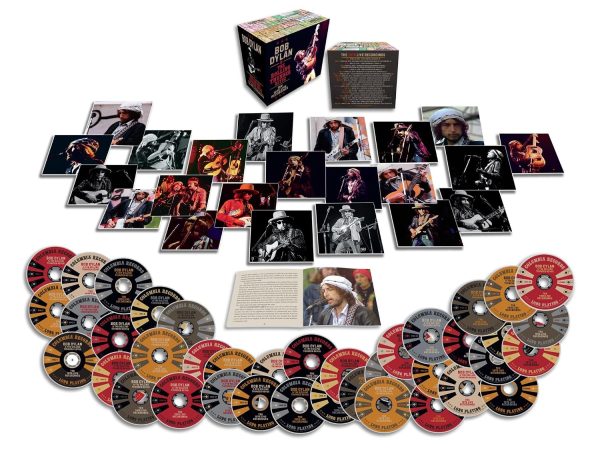
In 1965, Bob Dylan challenged assumptions about how long a hit single could be with the six-minute “Like a Rolling Stone.” In more recent years, he has been helping to challenge assumptions about how big a CD box could be.
Over the last decade, he has issued The 1966 Live Recordings (36 discs), The 1974 Live Recordings (27 discs), and The Rolling Thunder Revue: The 1975 Live Recordings (14 discs). And now his label has released a follow-up to that last box, The Rolling Thunder Revue: The 1976 Live Recordings, which preserves 22 shows on 39 CDs. The box comes with a photo-rich 56-page booklet containing notes by critic Mikal Gilmore; Steve Berkowitz, who produced the compendium; and T-Bone Burnett, who played guitar and piano and sang on the tour.
The set delivers 381 tracks, all but a handful of which have not been available before. (Nine of the performances previously appeared on 1976’s Hard Rain LP, which includes four songs from a Fort Worth concert and five from a first-rate Fort Collins, Colorado, show that aired once as a TV special.) If you listen an hour a day, it will take you one long month to audit every disc in the box. Or you can make yourself a giant pot of coffee and work your way through the whole thing in one marathon session of more than 31 hours.
Caffeine notwithstanding, you might get sleepy, but if you’re a serious fan, you probably won’t get bored. This concert series is permeated with hard-edged performances, high emotions, and classic material. It happened while Dylan’s marriage—which ended about a year later—was on shaky ground. It also came a little more than a year after the release of his remarkable comeback album, Blood on the Tracks, and only a few months after the issuance of its excellent follow-up, Desire.
The band on this tour featured some of the same folks who played on that latter LP. In addition to Burnett, they included Scarlet Rivera (violin), Rob Stoner (bass), Steven Soles (guitar, vocals), and Howie Wyeth (drums, piano). Also on hand were longtime Dylan associate Bobby Neuwirth (guitar, plus vocals on a few tracks), David Mansfield (steel guitar, mandolin, violin, dobro), Mick Ronson (guitar), and Gary Burke (percussion).
The concert series, which found Dylan playing more electric guitar than in the 1975 shows, included venues in the South and Southwest. It lasted from April 18 to May 25, 1976, and the box features nearly everything from the tour. (No professionally made recording apparently exists of a final show in Salt Lake City.) Though a producer’s note acknowledges that the sonic quality varies, these are mostly well-made soundboard recordings.
The shows feature many of Dylan’s best-known 1960s and early 1970s songs, often in versions that differ radically from the studio recordings. (One example: Dylan reinvents “Lay, Lady, Lay,” the romantic Nashville Skyline ballad, as a bawdy rocker with such new lyrics as “Forget this dance, let’s go upstairs, let’s take a chance, who really cares?”). Also here are assorted curiosities, such as “Seven Days,” which Dylan has never recorded in the studio; “Railroad Boy,” an old British ballad that he performed with Joan Baez; and “Vincent Van Gogh,” a previously obscure song about the painter by an American filmmaker and educator named Robert Friemark.
That latter number, incidentally, shows up 19 times, which is not an anomaly here; Dylan’s set lists for these shows didn’t change much, resulting in a compendium that contains numerous versions of many of its songs. For example, the box includes 17 readings each of “Shelter from the Storm” and “Idiot Wind,” 19 of “Mr. Tambourine Man,” and 11 of “Stuck Inside of Mobile with the Memphis Blues Again.” “Blowin’ in the Wind,” meanwhile, turns up 19 times.
How many versions of that song must one man hear before he sleeps in the sand? That depends on the listener, and if this box seems excessive to you, you can opt for a two-CD or three-LP release that’s limited to the 22-song Forth Worth show. A main reason why Dylan’s label released this entire concert series appears to be that these recordings would lose European copyright protection if they weren’t commercially issued by the end of this year. (Similar concerns ostensibly prompted issuance of several of Dylan’s previous boxes.)
That said, there are several good reasons to opt for the full package, at least for those who are rabid fans. For starters, it’s selling for only about $4 per disc.
Also, Dylan sometimes performs a song in dramatically different versions at different shows. Listen, for example, to the readings of “Tangled Up in Blue” from New Orleans and Fort Collins, Colorado. The former is a solo acoustic rendition that largely echoes the familiar studio recording, but the latter, which clocks in at more than nine minutes, completely reimagines the song—albeit not all that successfully—as a hard rocker. “Isis,” which clocks in at less than three minutes in a Houston venue, runs about three times as long in a punchy Corpus Christi, Texas, performance two days later.
Plus, while many songs show up repeatedly, many others surface only once or twice on the tour. Among these are Hank Williams’s “Weary Blues from Waitin’” and the traditional “Dink’s Song,” “Spanish Is the Loving Tongue,” and “Will the Circle Be Unbroken.” Also played just a time or two each are “A Hard Rain’s A-Gonna Fall,” “If You See Her, Say Hello,” “It’s All Over Now, Baby Blue,” “The Times They Are A-Changin’,” “Tonight I’ll Be Staying Here with You,” “Visions of Johanna,” and quite a few other classic Dylan originals.
Finally, there are guest spots that vary from show to show. Joan Baez dueted movingly with Dylan on a nightly basis, and Roger McGuinn apparently contributed to some numbers throughout the tour, but Willie Nelson, for example, guests on only two songs in Houston, while Joni Mitchell contributes vocals on just one in Fort Worth, and Ramblin’ Jack Elliott joins the proceedings only in Fort Collins.
All in all, this is a fascinating tour document, loaded with incendiary performances as well as some equally effusive gentle ones. The program does raise a few questions, though. For example, why did Dylan perform such non-originals as “Vincent Van Gogh” and the old folk song “Gotta Travel On” 19 and 18 times, respectively, while rarely or never serving up some of his most famous original tunes? The legendary “Like a Rolling Stone” appears only once and countless other classics don’t show up at all.
As the saying goes, the Lord works in mysterious ways. So does Dylan.