The 5th Dimension’s original lineup has been compared to the Mamas and the Papas, whose songs it occasionally covered. Both were vocal groups, both featured male and female singers, both achieved major commercial success, and their heydays overlapped.
But important differences explain why the Rock and Roll Hall of Fame inducted the Mamas and the Papas in 1998 while the 5th Dimension (whose founding lineup lasted until 1975) has never even been nominated. The Mamas and the Papas had strong countercultural ties and a great songwriter in John Phillips, and their music contained elements of folk and rock. The 5th Dimension, on the other hand, relied on outside writers for its hits, often featured brassy, show-tune-style arrangements, and leaned more toward pop and easy listening. Suffice it to say that the Mamas and the Papas would never have recorded anything like the 5th Dimension’s “Love Medley,” a wedding of Jackie DeShannon’s sappy “What the World Needs Now Is Love” and a butchered cover of the Beatles’ “All You Need Is Love” that sounds like something from a Broadway production.
Don’t write the group off, though. Yes, the original 5th Dimension had significant shortcomings, but there are also two big reasons why it topped Billboard’s pop chart twice in 1969, made the Top 40 an additional 18 times between 1967 and 1973, and won multiple Grammys. First, the band consistently tapped excellent composers, most notably Jimmy Webb and Laura Nyro but also such folks as Harry Nilsson and the team of Burt Bacharach and Hal David. Moreover, all five of its members were fine vocalists.
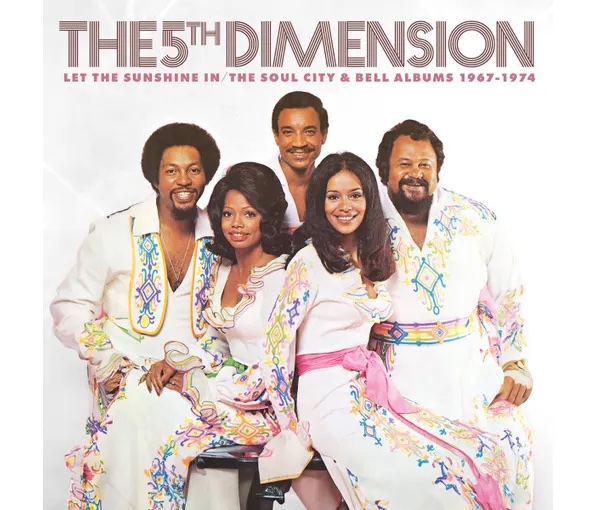
Casual fans will likely be satisfied with one of the group’s many single-disc anthologies, but anyone who takes a deep dive into the 5th Dimension’s catalog will find that its hits were far from its only high points. The place to go treasure hunting is Let the Sunshine In—The Soul City & Bell Albums (1967–1974), a six-CD set that features remastered copies of 10 LPs, plus 25 bonus tracks, including non-album singles and previously unreleased material.
An accompanying 44-page booklet unfortunately lacks discographic information. However, it does feature an interesting new oral history of the band that incorporates reminiscences from original members and primary lead vocalists Florence LaRue, Marilyn McCoo, and Billy Davis Jr. Also joining in the conversation are others who played a role in the 5th Dimension’s story, such as Bacharach, Webb, and singer Johnny Rivers, who signed the band to his Soul City label before they achieved success.
Among the bonus numbers on the CDs are two from the group’s earliest days, when its members billed themselves as the Versatiles, and after listening to the recordings in this box, you might consider that moniker more appropriate than the 5th Dimension. The band tackles everything from Cream’s “Sunshine of Your Love,” Traffic’s “Feelin’ Alright” and Johnny Rivers’s “Poor Side of Town” to Bobbie Gentry’s “Ode to Billie Joe,” Tim Hardin’s “Misty Roses,” and the Association’s “Never My Love.”
The box makes for an occasionally bumpy ride but one with many satisfying waypoints. All the famous numbers are here, including the two chart-toppers, “Wedding Bell Blues” and the Grammy-winning “Aquarius/Let the Sunshine In (The Flesh Failures),” plus “(Last Night) I Didn’t Get to Sleep at All,” “One Less Bell to Answer,” “Up, Up and Away,” and “Stoned Soul Picnic.” Also featured is a hits-dominated 80-minute concert set that proves the group could be just as impressive on stage as in the studio.
Also Noteworthy
David Box, The David Box Story, Vol. 2. David Box and Buddy Holly both hailed from Lubbock, Texas. They played strikingly similar brands of rock and roll, and Box, who was heavily influenced by Holly, briefly performed with his backup group, the Crickets. And they had one more thing in common: both died in airplane crashes, Holly in 1959 and Box in 1964.
Of course, there is one big thing the two don’t have in common: Holly is revered as a rock and roll pioneer and remains a household name nearly seven decades after his death. Box, meanwhile, is virtually unknown.
But that situation might be starting to change, as it should. A 2002 album called The David Box Story collected 32 of his recordings and garnered a positive reception. Then came this larger second volume, which underscores the size of his talent as a singer, songwriter, and guitarist. Disc One of the two-CD set features 31 tracks, including many excellent Box originals and covers of Holly’s “Raining in My Heart” and “Peggy Sue Got Married” (the latter with the Crickets). A second disc adds home demos, acetates, and all of Box’s other remaining known recordings.
A copiously illustrated 48-page booklet adds interviews and commentary from those who knew Box.
Released about a decade ago, this album has just secured a new U.S. distributor and is now easy to find. Louis Jordan, Rocks. The latest entry in the Bear Family label’s Rocks series features saxophonist, singer, songwriter, and bandleader Louis Jordan, whose R&B and jump blues recordings in the late 1940s and early 1950s helped usher in the rock and roll era.
His impact on the rock era comes across loud and clear on this set, which draws nearly all its material from 1948 through 1957. The program includes the R&B chart–topping “Saturday Night Fish Fry” and other commercial successes such as “Tear Drops from My Eyes.”
This is by no means a comprehensive look at Jordan, whose recording career spanned five decades and included 18 No. 1 R&B hits, most of which aren’t here. Still, the set—which comes with an informative 36-page booklet—captures some of his most raucous, hard-rocking material. It will whet your appetite for more.The Stanley Brothers & The Clinch Mountain Boys, Man of Constant Sorrow: The Singles Collection 1946–1958. “We play the Stanley Brothers many, many times,” said Bob Dylan on his Theme Time Radio Hour. “You can’t go wrong if you see a Stanley Brothers Record…if you see a record with their name on it, it’s got to be good.”
That’s true, and you’ll find many of those records collected on this two-CD anthology, which features backing on some tracks by the brothers’ band, the Clinch Mountain Boys. The album includes 58 A and B sides from the brothers’ seminal bluegrass singles on the Rich-R-Tone, Columbia, and Mercury labels. Carter sings lead and plays guitar while Ralph contributes banjo and tenor harmony vocals.
Most of the material, such as Carter’s “Man of Constant Sorrow” and Ralph’s “Pretty Polly,” is self-penned. But the set also includes material from other country songwriting giants, among them Bill Monroe, whose sound the Stanleys emulated and with whom they briefly performed.
______________________
Jeff Burger’s website, byjeffburger.com, contains more than four decades’ worth of music reviews and commentary. His books include Dylan on Dylan: Interviews and Encounters, Lennon on Lennon: Conversations with John Lennon,Leonard Cohen on Leonard Cohen: Interviews and Encounters, andSpringsteen on Springsteen: Interviews, Speeches, and Encounters.




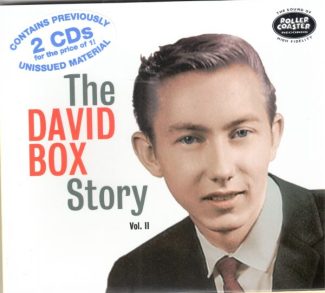 David Box, The David Box Story, Vol. 2. David Box and Buddy Holly both hailed from Lubbock, Texas. They played strikingly similar brands of rock and roll, and Box, who was heavily influenced by Holly, briefly performed with his backup group, the Crickets. And they had one more thing in common: both died in airplane crashes, Holly in 1959 and Box in 1964.
Of course, there is one big thing the two don’t have in common: Holly is revered as a rock and roll pioneer and remains a household name nearly seven decades after his death. Box, meanwhile, is virtually unknown.
But that situation might be starting to change, as it should. A 2002 album called The David Box Story collected 32 of his recordings and garnered a positive reception. Then came this larger second volume, which underscores the size of his talent as a singer, songwriter, and guitarist. Disc One of the two-CD set features 31 tracks, including many excellent Box originals and covers of Holly’s “Raining in My Heart” and “Peggy Sue Got Married” (the latter with the Crickets). A second disc adds home demos, acetates, and all of Box’s other remaining known recordings.
A copiously illustrated 48-page booklet adds interviews and commentary from those who knew Box.
Released about a decade ago, this album has just secured a new U.S. distributor and is now easy to find.
David Box, The David Box Story, Vol. 2. David Box and Buddy Holly both hailed from Lubbock, Texas. They played strikingly similar brands of rock and roll, and Box, who was heavily influenced by Holly, briefly performed with his backup group, the Crickets. And they had one more thing in common: both died in airplane crashes, Holly in 1959 and Box in 1964.
Of course, there is one big thing the two don’t have in common: Holly is revered as a rock and roll pioneer and remains a household name nearly seven decades after his death. Box, meanwhile, is virtually unknown.
But that situation might be starting to change, as it should. A 2002 album called The David Box Story collected 32 of his recordings and garnered a positive reception. Then came this larger second volume, which underscores the size of his talent as a singer, songwriter, and guitarist. Disc One of the two-CD set features 31 tracks, including many excellent Box originals and covers of Holly’s “Raining in My Heart” and “Peggy Sue Got Married” (the latter with the Crickets). A second disc adds home demos, acetates, and all of Box’s other remaining known recordings.
A copiously illustrated 48-page booklet adds interviews and commentary from those who knew Box.
Released about a decade ago, this album has just secured a new U.S. distributor and is now easy to find.
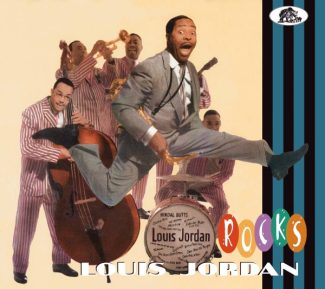 Louis Jordan, Rocks. The latest entry in the Bear Family label’s Rocks series features saxophonist, singer, songwriter, and bandleader Louis Jordan, whose R&B and jump blues recordings in the late 1940s and early 1950s helped usher in the rock and roll era.
His impact on the rock era comes across loud and clear on this set, which draws nearly all its material from 1948 through 1957. The program includes the R&B chart–topping “Saturday Night Fish Fry” and other commercial successes such as “Tear Drops from My Eyes.”
This is by no means a comprehensive look at Jordan, whose recording career spanned five decades and included 18 No. 1 R&B hits, most of which aren’t here. Still, the set—which comes with an informative 36-page booklet—captures some of his most raucous, hard-rocking material. It will whet your appetite for more.
Louis Jordan, Rocks. The latest entry in the Bear Family label’s Rocks series features saxophonist, singer, songwriter, and bandleader Louis Jordan, whose R&B and jump blues recordings in the late 1940s and early 1950s helped usher in the rock and roll era.
His impact on the rock era comes across loud and clear on this set, which draws nearly all its material from 1948 through 1957. The program includes the R&B chart–topping “Saturday Night Fish Fry” and other commercial successes such as “Tear Drops from My Eyes.”
This is by no means a comprehensive look at Jordan, whose recording career spanned five decades and included 18 No. 1 R&B hits, most of which aren’t here. Still, the set—which comes with an informative 36-page booklet—captures some of his most raucous, hard-rocking material. It will whet your appetite for more.
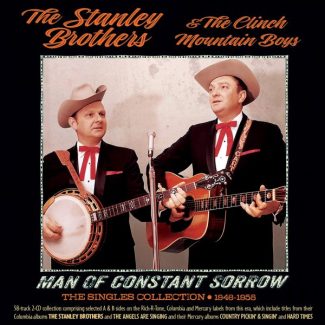 The Stanley Brothers & The Clinch Mountain Boys, Man of Constant Sorrow: The Singles Collection 1946–1958. “We play the Stanley Brothers many, many times,” said Bob Dylan on his Theme Time Radio Hour. “You can’t go wrong if you see a Stanley Brothers Record…if you see a record with their name on it, it’s got to be good.”
That’s true, and you’ll find many of those records collected on this two-CD anthology, which features backing on some tracks by the brothers’ band, the Clinch Mountain Boys. The album includes 58 A and B sides from the brothers’ seminal bluegrass singles on the Rich-R-Tone, Columbia, and Mercury labels. Carter sings lead and plays guitar while Ralph contributes banjo and tenor harmony vocals.
Most of the material, such as Carter’s “Man of Constant Sorrow” and Ralph’s “Pretty Polly,” is self-penned. But the set also includes material from other country songwriting giants, among them Bill Monroe, whose sound the Stanleys emulated and with whom they briefly performed.
______________________
Jeff Burger’s website, byjeffburger.com, contains more than four decades’ worth of music reviews and commentary. His books include Dylan on Dylan: Interviews and Encounters, Lennon on Lennon: Conversations with John Lennon, Leonard Cohen on Leonard Cohen: Interviews and Encounters, and Springsteen on Springsteen: Interviews, Speeches, and Encounters.
The Stanley Brothers & The Clinch Mountain Boys, Man of Constant Sorrow: The Singles Collection 1946–1958. “We play the Stanley Brothers many, many times,” said Bob Dylan on his Theme Time Radio Hour. “You can’t go wrong if you see a Stanley Brothers Record…if you see a record with their name on it, it’s got to be good.”
That’s true, and you’ll find many of those records collected on this two-CD anthology, which features backing on some tracks by the brothers’ band, the Clinch Mountain Boys. The album includes 58 A and B sides from the brothers’ seminal bluegrass singles on the Rich-R-Tone, Columbia, and Mercury labels. Carter sings lead and plays guitar while Ralph contributes banjo and tenor harmony vocals.
Most of the material, such as Carter’s “Man of Constant Sorrow” and Ralph’s “Pretty Polly,” is self-penned. But the set also includes material from other country songwriting giants, among them Bill Monroe, whose sound the Stanleys emulated and with whom they briefly performed.
______________________
Jeff Burger’s website, byjeffburger.com, contains more than four decades’ worth of music reviews and commentary. His books include Dylan on Dylan: Interviews and Encounters, Lennon on Lennon: Conversations with John Lennon, Leonard Cohen on Leonard Cohen: Interviews and Encounters, and Springsteen on Springsteen: Interviews, Speeches, and Encounters.