



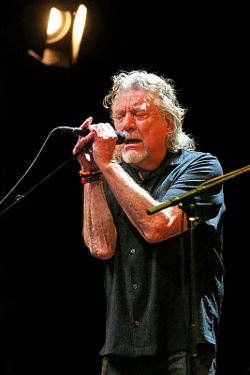
On the final night of the Up the Sharp End tour, Plant and a remarkable band found new life in old songs—and a different kind of power in the Led Zeppelin catalog.
The Chicago Theatre | Chicago, Illinois | October 15, 2026
For much of Robert Plant’s concert at the Chicago Theatre, something unusual happened: people sat still and listened. Not because there was nothing worth getting up for, but because there was so much worth hearing. Even when the material was unfamiliar, the room seemed unwilling to break the spell. By the time the night ended, I had witnessed one of the most remarkable blends of folk, blues, and rock I can remember seeing on a stage.
Plant and Saving Grace brought the Up the Sharp End tour to a close in Chicago on October 15. Anyone expecting a polished trip through the Led Zeppelin years would have missed the point. This was an adventurous six-piece ensemble bringing its own identity to traditional songs, American roots music, British folk, and a handful of Zeppelin favorites that sounded as though the band had discovered them anew.
And make no mistake: Robert Plant is still Robert Plant. The familiar gestures, that unmistakable presence, and the ability to lift a phrase until it hangs in the air are all there. But what impressed me most was not how closely he could recreate the singer he was fifty years ago. It was how fully he inhabited the music he wants to make now. His voice had strength when he called for it and restraint when the song needed room. He looked comfortable, engaged, and genuinely happy sharing the stage.
The band deserves to be named, because calling these players Plant’s backing musicians does them a disservice. Suzi Dian stood beside him on vocals and accordion; Tony Kelsey handled guitar; Matt Worley moved among banjo, guitars, and an assortment of other stringed instruments; Barney Morse-Brown brought the cello; and Oli Jefferson worked a compact drum and percussion setup off to the side. Together, they could make the Chicago Theatre sound enormous without ever treating volume as the point.
Jefferson especially deserves credit. From where we sat, his setup looked almost too small for the room, yet the pulse never disappeared. He held everything together with a light touch and a steady sense of where the songs were going. Morse-Brown’s cello supplied warmth and a dark, resonant foundation that a conventional rock bass might have missed. Kelsey gave the music both edge and delicacy, while Worley seemed to have another instrument and another texture ready every time the songs took a turn. At one point his playing took on an almost sitar-like quality, a striking little passage that showed how far this group can travel without leaving the stage.
The evening moved easily from Plant’s own “Down to the Sea” and “Win My Train Fare Home (If I Ever Get Lucky)” into roots material ranging from the traditional “As I Roved Out” and the gospel-shaded “There Ain’t No Grave Gonna Hold My Body Down” to “Higher Rock.” Nothing felt like a museum piece. You could hear the kinship between songs that came out of different countries, generations, and traditions. Saving Grace formed around musicians near Plant’s home on the Welsh borderlands, and that connection between the old music of Britain and the blues and gospel of America came alive in Chicago.
My own family has Welsh roots, so those Celtic shades struck a personal chord. But you did not need that history to hear it. There was a weathered, almost ancient character to the arrangements, alongside rhythms rooted in the American South. The music did not draw a hard line between folk, blues, gospel, and rock. It showed how much they have been borrowing from one another all along.
Then there was Suzi Dian. If anyone arrived thinking she was simply there to harmonize with the famous man at center stage, she changed that impression quickly. The blend of their voices was one of the night’s great pleasures, sometimes gentle and sometimes haunting. But her performance of Gillian Welch’s “Orphan Girl” was something else altogether. Plant stepped aside, the other musicians gave her room, and Dian held the theater with a voice that needed no grand gesture. The rest of the band seemed content to stand back and listen. So were we. It was one of those moments that makes an audience forget to move.
Of course, Zeppelin was in the room, too. “Ramble On” was an early reminder that these songs are not fixed objects. I have always connected it with J. R. R. Tolkien’s imagined world, but this arrangement made that mystical quality even stronger. The strings, accordion, and restless rhythm gave it a wandering, almost otherworldly atmosphere. It was recognizably “Ramble On,” yet it felt like it had come around a bend in the road and found another landscape.
“Four Sticks” and “Friends” fit this sound more naturally than some might expect. “Babe, I’m Gonna Leave You” brought its own surge of drama. What impressed me was the way Kelsey and Worley approached passages that, in another band, would have been an invitation to imitate Jimmy Page. They did not have to. Their acoustic interplay supplied tension, release, and flashes of fire on its own terms. These were not stripped-down Zeppelin songs so much as songs rebuilt from the roots up.
Plant also knew how to manage the room. Between songs he was funny and quick with the audience, at one point encouraging people to sit and settle in, and at others asking for quiet when the music turned delicate. In a setting this intimate, even casual conversation could cut across an arrangement. He wanted us to hear the small things. That request made sense once you listened to how carefully the musicians were listening to one another.
The encore brought one of my favorite moments of the night. On “Going to California,” the bright, mandolin-like shimmer against the acoustic guitar seemed to spread into every corner of the theater. Without the weight of a conventional rock arrangement, the song’s beauty and its ache came forward. The musicians filled the room with sound, but there was still air between the notes. That is harder to achieve than simply playing loud, and the Chicago Theatre’s acoustics made it extraordinary.
Rather than ending with a predictable arena-rock sendoff, they closed with “Everybody’s Song,” the Low composition that also appears on Saving Grace. It was the right final statement: a song from outside the familiar Zeppelin story, performed by a group that plainly has no interest in staying trapped inside it. The audience had come to see a legend, but we had heard a band.
Walking out of the Chicago Theatre, I was not counting how many songs had come from Led Zeppelin records. I was thinking about Dian’s voice, Jefferson’s understated groove, the cello running underneath those melodies, and the remarkable acoustic conversations between the strings. I was thinking about how completely the unfamiliar songs had won the room over. I have been to a lot of concerts, and very few have left me feeling quite this way.
Plant is still the golden god, perhaps with a little more gray. But the important thing is that he is not trying to live inside the image. At 78, he is following the music wherever it leads, bringing the old songs along and allowing them to change. On the final night of this tour, that curiosity made the past feel alive—and the present feel even better.
Find more details and tour dates here on his website: https://www.robertplant.com
Enjoy some of our previous coverage here: Show Review: Robert Plant and Alison Krauss at Merriweather
photos by Chad B. Cubberly