



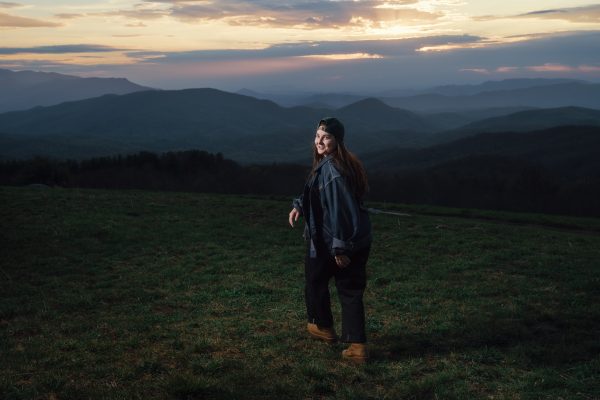
Katie Pruitt: Songs for the Time We Have
Katie Pruitt wrote more than 60 songs while working on Fools For the Fleeting, her third album for Rounder Records. She kept ten. Somewhere in the cutting, a subject emerged: the beauty and damage people carry around, and the difficulty of staying connected to one another when so much of modern life encourages the opposite.
“My first record was kind of about coming out and identity and accepting myself,” Pruitt says. “I think my second record was a lot about going inward and kind of stopping negative thought loops.” This time, she wanted to look outward. “Now I think on this third record, it’s more about wanting to be tethered to the world around me and wanting to be connected in an age where we all feel very unconnected.”
The album arrives at a time when musicians are expected to spend as much energy maintaining an online presence as making music. Pruitt finds the contradiction hard to ignore. Artists need to get out into the world to find inspiration, she says, yet they are also told to keep posting or risk disappearing from view. The result is a balancing act between being visible and having a life worth writing about.
“There’s an intentionality that comes with it,” she says. “I think a lot of artists right now are trying to figure out how to connect with their fans in a way that doesn’t involve algorithms.”
A Nashville Kind of Family
Pruitt has found that connection in Nashville, where she lives and where the independent music community remains a tangible part of everyday life. Her recent appearance at Grimey’s record store was more than an album-promotional stop. She could talk about the new record, meet listeners, and stand among albums by friends and musicians she admires.
“My Grimey’s in-store,” she says, recalling the owner, Mike Grimes, greeting her with a hug. “It’s like the cornerstone of the independent Nashville music community.”
She remembers the March 2020 tornado that damaged the Basement East, another gathering place for Nashville musicians. Grimes was the first person she saw walking down the street that day. The memory still carries emotion because it illustrated how people in a music scene look after one another when trouble arrives.
“You know, it’s emotional to have been through a lot with your community,” she says. “And then they just consistently, we consistently show up for each other. And that’s what a community does.”
Pruitt spent the first years of her adult life in Athens, Georgia, before moving to Nashville. High school had given her close friends, some of whom remain in her life, but it had also been a confusing time. She was a closeted teenager in the South who did not feel safe telling even her closest friends she was gay. Leaving Georgia helped her find the nerve to come out and shed an identity that had followed her for years.
She hopes younger people now have more opportunities to see their experiences reflected in music and popular culture. Still, she doesn’t want listeners to stop at a label. On “Little Boxes,” she considers how social media can make identity useful for discovering an artist while also reducing that artist to a few identifying facts.
“Once people discover me, I don’t want them to just stop at the fact that I’m a lesbian who writes songs,” she says. “I’m a multifaceted person with layers.”
Her songs take in family, mental health, grief, spirituality, and the business of letting people go. Her sexuality is part of her life and work, but it isn’t a substitute for either. Pruitt wants listeners to get to know her through the music as they might get to know a friend.
That sense of fellowship extends to AmericanaFest, where she recently took the stage as an emcee as part of the Americana Awards. Pruitt had been nominated for an Americana Award in 2020, when the awards did not take place, so the later invitation felt like a belated celebration. She was particularly pleased to announce the Emerging Artist nominees and see Ken Pomeroy receive recognition she believes she deserves.
Pruitt appreciates Americana’s willingness to speak plainly about the world. “It’s a very outspoken corner of the music world,” she says. Indeed, she feels lucky to be part of a community where difficult subjects have a place in the music.
What a Song Remembers
Pruitt’s musical education began well before the record deals and touring. In high school, she and her friends burned CDs for one another, sometimes identifying the tracks in Sharpie on the discs. She listened to Dave Matthews and discovered other musicians through friends and YouTube videos. Watching Brittany Howard perform with the Alabama Shakes, she remembers thinking she had to learn how to do what Howard was doing. Later, seeing the Tedeschi Trucks Band in Athens, she watched the musicians’ pedal boards while everyone else danced.
On the title track of Fools For the Fleeting, Pruitt’s voice has a depth she attributes partly to age and experience. The recording was cut live, allowing her singing and the band to move together. At the end, a powerful note gives way to a softer, more vulnerable sound. The shift reflects the dynamic range she has worked to develop, and the willingness to let a performance expose a little uncertainty.
Pruitt’s songwriting process is rarely effortless. Some songs stall halfway through; others require her to force a second verse out of an idea that seems to have run dry. She keeps working because the process helps her understand herself and the world around her. Perhaps the unfinished songs are part of that education, too: they mark the places where she was still searching.
She describes songs as time capsules, preserving an emotional moment while allowing the person who returns to it to have changed. She wrote “Out of the Blue” (2019) about the first girl who broke her heart. Now, singing it, she sometimes thinks about a more recent ex, or about people who once occupied an important place in her life and have since become strangers. The song hasn’t changed, but its reach has widened.
The same is true of songs about her parents. She can return to lyrics written when their relationship was more difficult and recognize how much has improved. The old hurt remains part of the record, but so does the distance she has traveled since writing it.
“I’m grateful that I wrote this song and that we had a conversation about it,” she says of one such experience. “And now we’re in a very different place.”
At recent shows, Pruitt has stepped into the crowd during an encore to sing unplugged, with the audience joining her. She likens the experience to gathering around a campfire. Those are the moments she expects to remember, not whether a social media post went viral. For a songwriter whose work records the passage of time, the present is worth paying attention to.
“Songs are like time capsules, you know, and we can go back in time and sort of revisit a mental or emotional place that we were once in.”
Find more information on Katie Pruitt’s website here: https://katiepruitt.com
Enjoy some of our previous coverage here: REVIEW: Katie Pruitt “Mantras”