


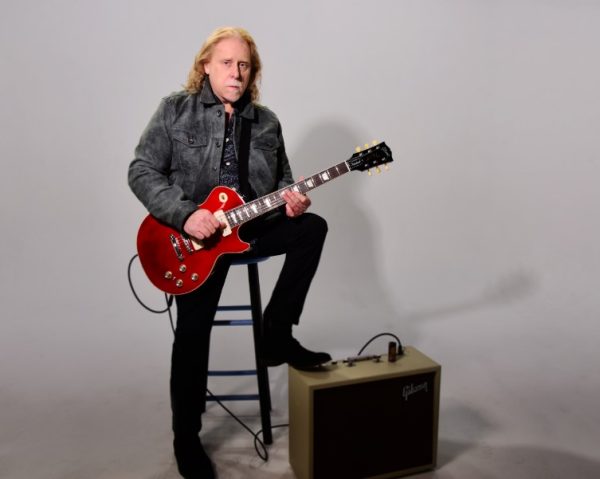
Warren Haynes photo by Shervin Lainez
Warren Haynes on The Creative Goals Behind ‘Dreams & Songs: A Symphonic Journey’
On September 18th, 2026, Warren Haynes, the Grammy Award-winning vocalist, songwriter, guitarist, producer, and Gov’t Mule frontman, released a very special live album, Dreams & Songs: A Symphonic Journey. It captures performances that happened in 2019 in Haynes’ hometown of Asheville, North Carolina, where he brought to life songs from across more than 30 years of his career alongside the Asheville Symphony Orchestra. Songs were selected for their creative fit from across Haynes’ work with Gov’t Mule, Allman Brothers Band, The Dead, and his solo albums, and Haynes performed with rock ‘n roll improvisors Oteil Burbridge on bass, John Medeski on organ and keys, Jeff Sipe on drums, as well as others. The album was later mastered by Bob Clearmountain.
Warren Haynes first became drawn into the conversation between rock and orchestral music when he joined the Jerry Garcia Symphonic Celebration tour, and as his knowledge increased, he hoped that someday he’d undertake an orchestral experiment with his songs. With very specific goals in mind, he found his opportunity when the Asheville Symphonic Orchestra reached out, and they settled on a retrospective approach. Captured between two nights, and including a sense of the crowd’s presence on the recordings, the performances on Dreams & Songs are energetic and haunting in the new light they shed on these songs. I spoke with Warren Haynes about the project just as he was heading out on a current tour with Ziggy Marley.
Americana Highways: The shows that we’re getting to hear that make up Dreams & Songs originally happened in 2019. How far ahead of that did you have to start preparing for those events and for recording them?
Warren Haynes: The whole story goes all the way back to ten years ago, when I did the Jerry Garcia Symphonic Celebration. I’d gotten a call from the Jerry Garcia estate saying that they wanted to do his music with a symphony and they wanted to know if I was interested in being the first featured artist. I said, “Yes, I would love that, I’d be honored.” So, I did a couple of tours that way, and worked with all the arrangers, and immersed myself in that world for a couple of years. It was during that period of time that I thought that it would be fun to do something with my own music, I just didn’t know what that was going to be.
So, then, when I got the call from the Asheville Symphony Orchestra saying that they would like to do something together, my wife and I were talking about it, and I said to her, “I’m not sure what it’s going to be.” She said, “What about doing something retrospective, like what you’ve been up to the past 30 years.” I thought, “Yeah, that’s a cool idea!” Once that came into play, I started reaching out to different arrangers, and choosing the material, and thinking about a wish list of who the band would be, that sort of thing. When it started out, it was going to be a studio recording.
AH: Oh, wow, I didn’t realize that!
WH: Yes, absolutely. When I was talking to Don Was, who was going to produce the studio sessions, we realized that we were not going to be able to have the band and the symphony recording at the same time. That it was technically not feasible to make that happen. For me, that negated the whole concept. That took the inspiration away, for me. My whole impetus was to be inspired by hearing the symphony playing this music, and sing and play accordingly. So, Don said, “Why don’t we make it a live record?” I said, “Yes, that would be much better. That’s a great idea!” Thankfully, everything fell in place, and everyone was available.
We did two nights at the Thomas Wolfe auditorium, rehearsed a day or two before that, and there was a lot of rehearsal involved. It was one of those things when we were the right amount prepared, and the right amount not prepared. There was an element of chance, as well, which in my experience always works out great. [Laughs]
AH: I did see that you, and also the other rock musicians involved, wanted to be able to have the freedom to improvise, which is an amazing choice, maybe even a little terrifying.
WH: That was really important to me. I wanted it to be a big part of the overall picture, maybe even more so than the way it’s been approached in the past when artists have combined their music with symphonies. It goes back to the Garcia experience, as well, realizing that I had to be able to feature that in what I do, and it was such a welcome challenge.
One of our key ingredients was Rich Daniels, our conductor, that we discovered about mid-way through the first Garcia celebration tour. At that point, I was using not only a different symphony every night, but a different conductor every night. One night, we used Rich, and struck up a kinship that began based on the fact that he’s also a Jazz saxophone player. So he understands the world of improv. From that point forward, we started using Rich all the time, and he had so much to do with the communication between our world and the world of the symphony.
AH: Do you think that the lack of room to improvise is something that keeps rock and blues musicians from approaching orchestral music? Orchestral music must seem pretty rigid by comparison.
WH: Right, it’s not flexible at all!
AH: What convinced you that the worlds could be bridged, back when you first agreed to do the Garcia tour?
WH: I was definitely nervous in the very beginning, but with each day I got better and better at navigating that world. But the pay-off is so great, because to be able to hear your music done in that magnificent way is worth the learning experience. I also wanted to find a way of creating something unique, which to my knowledge had never been done exactly that way before.
AH: I think you accomplished that with this album, for sure.
WH: Thank you.
AH: This album is big, too! It’s 16 tracks long, and it’s a big statement and a large body of work. I appreciate that there is some video, as well, for audiences to get a feel for the event.
WH: I don’t think there’s going to be a DVD, but we’ve made available four or five tracks of video so far. Everything was filmed, and there’s a making-of video. Even the low-pressure version that we’ve put together is pretty insightful.
AH: To do all of this, new arrangements needed to be created for these songs, and you worked with a group of all-star arrangers, didn’t you? Were they people who were on the Garcia tour?
WH: Some were, and some weren’t, probably about half-and-half. For the Garcia Symphonic Celebration, I had reached out to some friends in that world who I trusted a lot more than I trusted myself, to get suggestions. I reached out to people who’d done stuff with symphonies before, and we put together a list, and started listening to the works that these people had done. We started asking, “Who would be great for these two or three songs, and who would work for these two or three songs?” That’s what it ended up being. We had about eight arrangers, and each did two or three songs.
AH: Were there particular reactions from the arrangers when you approached them? Were they excited about it? Did they know it would be a live event?
WH: Not all of them knew it would be live yet. I had phone conversations with all of them. I would send them the band arrangements, in some cases, and in some cases the studio version or select live versions that I really liked. They were working off of that. They would then send me demos, but they were keyboard demos of the orchestration. So that meant that I didn’t actually sound what it was really going to sound like until we got to rehearsal!
AH: Wow, the size of that must have seemed so big when you finally heard all the instruments together! Did you hear that in the venue?
WH: Yes, we rehearsed in the venue. We made a couple of little changes there, but for the most part, we just rolled with what those guys had done. And they all were great, and brought their personalities to the pieces.
AH: That’s a lot of trust!
WH: Yes, but that was part of it, especially for someone like me, who knows so little of that world. But that was jumping in with both feet!
AH: There’s an element of excitement to something, if you haven’t heard it very often, that might help with your own performance on the night, I imagine. You can have a spontaneous reaction. It’s like a first take energy.
WH: Right, and that’s a really good point, because it’s something that we all kind of thrive on. With improv, if the first take’s good, it’s probably the right one. Being inspired by hearing what the symphony is doing, and not knowing in advance what it is going to sound like, is a big part of how I reacted from a singing and playing stand-point. With each rehearsal, I would learn a little bit more about what they were doing, from section to section. By the time that we got to the second show, I think it was the right time to feel just enough comfort, and just enough apprehension. [Laughs]
AH: Are you glad that it was only two shows? Would you have done more?
WH: In hindsight, I probably would’ve done a third show, since we kept getting better. But when we went into the studio, and listened to the performances, between the two, we were satisfied with everything that we’d done. I’ve done some symphonic shows since then, which were not the same song selections, and not the same musicians, and it continues to grow in its own. But when I compare the later stuff to that stuff, there’s just something exciting and fresh about those two nights that I’m just glad that we captured.
AH: The sound quality on this album is also really great. Was that something that took some special preparations?
WH: I think that’s mostly due to Bob Clearmountain, who mixed it, and did such a fantastic job. The recordings were good, but they weren’t without challenges in a technical way. But Bob was just so great at what he does that he was able to bring it all together. They do record the symphony in that room quite a bit, so it’s a good room for an orchestra, so to speak. But I love the fact, also, that he included so much of the audience! With a lot of symphonic recordings, the audience is very tame, but this wasn’t that kind of audience. He really included the audience mics a lot into the recording, and I think that you get a sense of being there, but it also feels a little more rock ‘n roll, you know?
AH: Absolutely, I enjoyed that inclusion, too. Do we hear the show in actual track order on the album?
WH: Yes, but the vinyl and the CD are a little different. In order to accommodate vinyl, with time limitations, I had to change the sequence a little bit. But the CD and the digital are the order of the show.
AH: It feels like that, and I can appreciate the choices that you made for the setlist, in terms of how it flows. That must have been a consideration, both for the live event, and for the album.
WH: Yes, in this case, I would look at both of those as being the same objective. Like closing the first set with “Terrapin Station” and opening the next set with “Whippin’ Post.” Having “Dreams and Songs” open and close the show, all that stuff. I wanted the setlist to be similar to a normal setlist, but also to be similar to when you go and see a symphony, that has movements, and takes you through different time periods.
AH: In a way, this was an opportunity for you to think that way.
WH: Absolutely, it forced me to think that way, in a good way.
AH: How did you decide on using the piece “Dreams & Songs” for this performance? I think it impacts the show a lot.
WH: “Dreams & Songs” was a song that I wrote that was on a Gov’t Mule record, and coincidentally, Don Was had been the producer on that recording. He had brought up “Dreams & Songs” as a title for this project, and I said, “Wow, I love that.” That’s what inspired me to open and close with it, and cut it in half like that.
AH: The lyrics seem so perfect for the show.
WH: It’s autobiographical, for the most part, and it ties into the whole Asheville experience. When Don brought that up as a title, I thought, “That just kind of sums up the whole thing.”
AH: Something that has resonance is that the whole event opens with a guitar part at the beginning of that song, and that’s the rock side of things. I think that really sets the stage and shows how this performance is a bit different.
WH: Yes, because I think most, if not all of the people in the audience didn’t really know what to expect. So it establishes what it is, and of course, it changes quite a few times over the course of the program. For me, it was really important to find something that justified me doing this project in the first place. I’ve never been a huge fan of marrying rock, or pop, or jazz music with an orchestra just for the sake of doing it. I’ve always felt that some songs worked, and a lot of songs didn’t.
I think that carries over to my music, and probably anybody else’s, from the vantage of my personal taste and standpoint. So, the concept gave me the opportunity to pick from a lot of different catalogs that I’m associated with. Which then allowed us to only pick songs that we felt worked really well.
AH: It sounds like you wanted it to be a creative development for you to do this, and a new experience for you, and for the audience. That’s certainly a different thing than just sticking two types of music together.
WH: Yes, absolutely. That was a huge concern for me. As an example, I wouldn’t want to take just any album I’ve ever been a part of, and do the whole album with a symphony, because I would feel that there would be songs that worked and songs that didn’t work.
Thanks very much for chatting with us Warren Haynes! Find more details here on his website: https://warrenhaynes.net/
Enjoy some of our previous coverage here: REVIEW: Warren Haynes “The Whisper Sessions”