


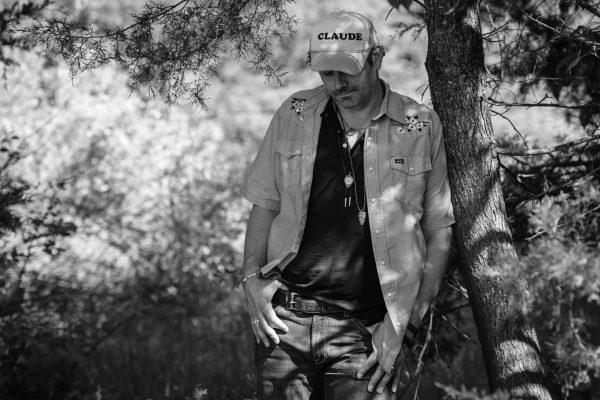
Lyal Strickland photo by Jym Wilson Photography
Lyal Strickland on The Quest for Personal Honesty and Shooter of Truth
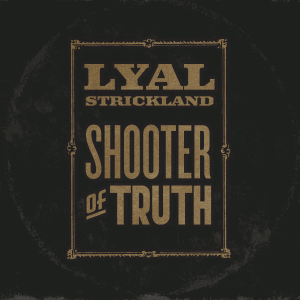
Ozarks-based singer/songwriter Lyal Strickland is returning with new album Shooter of Truth, his first studio album in ten years, on October 16th, 2026. It follows his 2025 live EP, Ghost Light at The Gillioz, and 2016’s Preservation. That gap in releases has been extremely eventful for Strickland who met his wife, married, and had two children during that period of time, and also continued to support his family’s cattle farm and other family businesses. Always writing to some extent, Strickland faced the bigger problem of a creative crisis in search of personal honesty. That makes for a fascinating story in itself, but that’s not even as fascinating as the songs on Shooter of Truth where Strickland channels that honesty into pent-up expressions of his life and times.
Ranging from spare and haunting to full-band and anarchic, the songs on Shooter of Truth actually bring into focus things that audiences have loved about Strickland’s music from the start—their directness and the potent distillation of their emotions into imagery and turns of phrases that everyone can relate to. This new album also seems to let the air of daily life into the songs in a way that’s even more striking, making for a memorable return from Strickland. I spoke with Lyal Strickland about the long journey into these tracks, and more generally about the climate and atmosphere surrounding creative work, and how that interacts with the rhythms of life.
Americana Highways: I know there have been some sweeping life-changes for you in recent years that all plays into the story of how and why you’ve created this new album. It’s a whole landscape, isn’t it?
Lyal Strickland: I met my wife after I toured the Preservation album. I had a really rough year, and decided I needed to take a break. One of the last shows was a local NPR thing, and I met my wife that night. She said, “You’re gonna want to date me.” And she was right. She usually is! I met her at the very end of that, we dated for a couple years, Covid hit, and then we had our first child, and our second. She started her own dance studio, and we got that off the ground. I had stuff on the farm, and cattle to take care of. Initially, it was just a break, and it turned into life.
I was not wholly in the right emotional place, I guess. I always said that I was 80% happy, but the 20% was killing me. Looking around me, there should have been nothing to complain about. I had a beautiful family, roof over my head, beef in the freezer, nothing to complain about. Everything should’ve been good, but I was pretty severely depressed, and I had to work through that. Once I started playing and writing again, things really filled out. It was a weird lesson to learn about what you need to do to keep yourself whole.
AH: It’s so frustrating that so true that a balance in life is not something that you can learn from anyone else. You can compare yourself to other people so endlessly, and it makes sense to look to people who you respect, but in the end, you can have an equation that’s just not the same as anyone else’s.
LS: Yeah, and when I was younger, there were older musicians and stuff. I would ask, “What’s the secret to a long career? How do I keep this going? What tour routes do you take? Are you pressing vinyl?” All the stuff. These older dudes would say, “If you have to do it, you have to do it. All that other stuff is secondary.” As a 25-year-old, all that was not a satisfactory answer. It was so vague.
But coming back to it, it makes sense. It’s like, “Oh, you just have to do it.” It’s like going through a resignation process, it seems like. “This is what I’ve sort of dedicated myself, and tricked myself into, falling down this music hole. Now it’s a part of me.” It sounds just as disingenuous when I say it, as it did when those older musicians said it! But it makes a lot more sense now.
AH: You’re one of them now. You’re the knowledgeable, more experienced musician.
LS: [Laughs] Yeah! It’s like a hoard of zombies.
AH: When you were telling about the circumstances of your family, it stood out to me that the past ten years have involved meeting your wife, both being business owners, including the ranch and the dance studio, and having two kids. Being business owners is so hard in any context, and then you want to add a business of being a musician/singer/songwriter. That’s three family businesses. And then there’s all the personal stuff.
LS: Two years ago, we actually opened a coffee shop in my hometown with my mother. We’ve closed it now, but it’s still a venue. I was just casting nets, trying to fill that void. I was not in the best mental state for quite a while, and my wife kept encouraging me, saying, “Quit all this auxiliary stuff, and just focus on the cattle, and the music. That’s what you love, that’s where your heart is.”
AH: What eventually turned that engine over and made it possible for you to write again? Do you know? I heard there was a specific return and a lot of writing followed.
LS: I’ve always been a bit of a batch writer, and I’ve always wished I was one of those folks who can sit down and write a song at 9AM every day, but that’s not me. I kind of stew. Things ferment a little bit. I’d been writing fairly consistently during that break. I might write four, five, six, songs in a week. I won’t say those were “junk” songs, but they weren’t my songs. They were the sort of songs that I’d give to a publishing house for someone else to sing. So I just threw them away and I’ll let someone else grab those songs from the ether.
So I went down to Folk Alliance, South-West Regional. It was not my finest moment as a person, actually. I hadn’t been playing for a while, and I saw all my friends from the road, who I hadn’t seen in a long time. I was in a hotel, with music everywhere, and I could walk to my room, and I pretty much drank myself into oblivion on the second night. I just made an absolute ass of myself, it was embarrassing. I couldn’t even play in a song circle.
It was a weird thing. I went back to my room, and when I woke up the next morning, I had two glasses of water sitting out, and a note on the night stand that said, “Listen to the voice memos.” I listened to them, and I had a couple of songs that I’d apparently written and recorded when I was still in a stupor. I thought, “There’s no way these are any good.” And they were pretty good. “Shooter of Truth” is actually one of them, where I got the album title. It was a moment where I thought, “Oh no, these are pretty brutal, lyrically, for the people in my life, and for myself.” I think I had gotten into a pattern where I was censoring my writing before it ever got to the page.
AH: Yes, that’s so common. You might even describe it as a major modern problem in writing.
LS: I was worried about what my daughters would think, or my wife would think, or my friends and family. That’s just no way to write. You start editing before you even get it on the paper, and it’s not going to be honest. I kind of made myself a bargain that weekend that every day I was there I wouldn’t let myself drink any coffee before I’d written two songs, then I’d write two more songs after. The deal was: “Write the songs. Throw them away if you think they are too honest, later on. But on the front end, just get it out.” It was a very cathartic process, and I think I wrote nine or ten songs, and I think about half of them ended up on the album.
AH: A lot of people feel like just getting themselves into a different spot, physically, helps at times. That may have been involved here, also.
LS: Bad views from hotel rooms, that’s my absolute thing. I hate it when I get into a hotel and it’s a nice one! If there’s a beautiful view, I say, “Man, I’m not going to be able to write anything here!” I need to see the back side of a building, or a parking lot.
AH: You’ve been doing music since you were quite young. And you’re still living in the same town. Does that create a weight of expectation or difficulties as you try to develop and grown up, have a family of your own?
LS: You grow up, and your whole life, everyone tells you that it’s not a real job, not a real career. Your teachers, counsellors in high school, and stuff. They’ll let you get away with it in college a little bit, playing for beer and pizza. Once you’re out of college, it’s, “Look, it’s time to get a grown-up job.” When you stick with it, even the people around you, that are closest to you are kind of befuddled by it, that you’re still doing it. Even once people accept it, trying to get through to people what it looks like is hard. The job isn’t just the two hour show, the job is two hours before when you load in, and sound-check, and making sure you’re tight on all your songs.
During the set break, it’s not a break, you’re talking to people, and you’re talking to people after the show. Sometimes that’s a way of getting a story that you really have to write. Also, why was band practice four hours, if the set is only two hours? Well, it’s camaraderie. Everybody has to get space, it’s a little more esoteric than going to work at nine and leaving at five. You have to breathe it, and if you don’t breathe it, you can’t do it. It’s a performance.
AH: There’s not a clock for getting into the right headspace, and sometimes it’s really evasive. Especially working with bandmates, and friends, and being understanding about their needs, too. They have to find that combination, too.
LS: It’s been difficult being married, and then moving into fatherhood, as well, trying to move into that space, too. I used to get really inspired by film, and I might spend all day watching movies, and write two or three songs at the end of the day because I’d taken all that stuff in. There’s just not that time anymore, and because I’m back out on the road again, I really try to carve out the time that I am at home to be very present with my daughters. It doesn’t leave a lot of time for songwriting, but that kind of worked out for me because I’m a batch writer. I can put it off, and think, “I bet there’s a time a few months from now when I’m sitting in a fifty-dollar hotel in Cincinnati, or wherever, and write the next album.”
AH: I think in your case, that’s probably true! What was your process on Shooter of Truth once you knew that you had an album?
LS: I thought, “Oh shit, this stuff is actually good.” It was like I had finally cracked open the little egg that was inside of me and written some honest material. I thought, “Let’s get back to this. Let’s go through the motions. I’ve got to get a studio date booked. I’ve got to polish these songs up. We’ve got to start performing these so I can get a feel for where they live sonically.” Then I thought about when I had my last album out, and it was, “Oh my God, that was 2016! It’s been almost ten years.”
In 2024, I had that first batch, then I got back out playing a full schedule within a three-or-four-hour radius of home. That’s when the Gillioz show happened, which was kind of a godsend. I didn’t know how I was going to fund a new record, and that was all paid for. It was like a flare gun saying, “I’m still here! And I’m still doing stuff!”
AH: I love that release. The emotion really comes across. I think it’s a great idea to capture special live shows.
LS: The only downside of that record was that it was such a listening audience, so I didn’t get to do my usual banter, and stories, and stuff. But it was a very fun project to do.
AH: I really like the variety of sounds that we hear on this album, whether it’s more stripped back and raw, or whether the electric guitar is coming in. The transitions feel gentle, though.
LS: There is always a big pressure, when you’re getting in the studio, to make it very polished and have big production, or to keep it as close to how you perform it live as possible. I think it’s really necessary, when you’re recording, to service the song. If you go through, and record a song, then put a bunch of stuff on it that the song really needs to become its own, and then it doesn’t fit with the rest of the album, just don’t put that song on the album. That song still needs what it needs. Just make sure it’s placed with its friends.
AH: That’s very song-forward of you. That might leave you with a little stack of songs.
LS: There’s plenty! There’s a whole stack of songs, though not recorded per se. There’s a book called Big Magic [by Elizabeth Gilbert] and there’s a thought in there that ideas are somewhat conscious entities to themselves, in that they want to come to some sort of tactile fruition.
So if you don’t do something with it, that idea will move on, and someone else will do something with it. They will write that same book, or same song, or create something almost identical, since the idea is just in the ether.
There are lots of songs [of mine] that have gotten written, and been thrown away, or gotten written, but buried in voice memos, that someone else will write one of these days, if it doesn’t come back around. That’s part of the exercise.
Thanks very much for chatting with us Lyal Strickland. Find more information here on his website: https://lyalstrickland.com/
Enjoy some of our previous coverage here: Song Premiere: Lyal Strickland “Birds” (feat. Rachel Laven)