



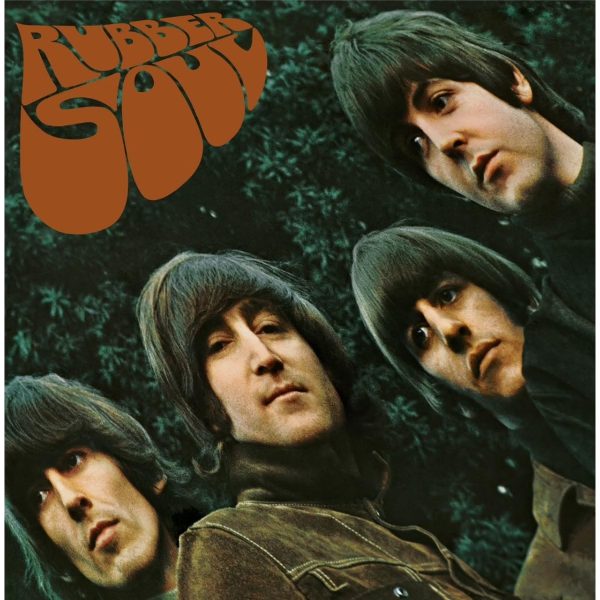
Revolver, a 1966 album that received box-set treatment in 2022, arguably represents the biggest and most significant artistic leap of the Beatles’ career. Rubber Soul, its immediate predecessor, is not far behind in that regard, however. Portions of this chart-topping sixth Beatles album exhibit such an advance from its own predecessor, the Help! soundtrack, that it’s hard to believe a mere four months separate their release dates.
Rubber Soul, which appeared in December 1965, marks a new degree of maturity in the group’s music and famously helped inspire the Beach Boys’ Brian Wilson to create Pet Sounds. It introduces new instruments to the Beatles’ toolkit and finds them making more use of recording technology than on earlier LPs. Though they created the record over a mere 15 (non-consecutive) days, they reportedly labored longer over each number than they had in previous sessions. As John Lennon wrote, “Rubber Soul was the first album where we took over control completely, and we’d learned a lot by then.”

The record—only the second from the Beatles to exclusively feature original material—also evidences a new level of songwriting sophistication, with more complex melodies and more imaginative lyrics. The album includes an abundance of now-classic numbers.
Lennon contributed such tunes as the sentimental “In My Life”; “Nowhere Man,” with a lyric about disconnection; “The Word,” with producer George Martin on harmonium; and the evocative “Norwegian Wood (This Bird Has Flown),” with George Harrison on sitar. Among Paul McCartney’s songs are “Michelle,” which incorporates some French lyrics, and the acoustic-guitar-based “I’m Looking Through You.” Harrison provided the frenetic “Think for Yourself” and the Byrds-influenced “If I Needed Someone,” and Ringo Starr garnered his first songwriting credit (shared with Lennon and McCartney) for the country-styled “What Goes On.”
Though the program clocks in at just 36 minutes, it also makes room for Lennon’s “Girl” and “Run for Your Life” and McCartney’s “Wait,” “Drive My Car,” and “You Won’t See Me.” That last song, incidentally, is the only one of the set’s 14 tightly written numbers to exceed three minutes, which it does by just 20 seconds.
A new “Super Deluxe” edition of Rubber Soul enhances this landmark album, most notably by delivering upgraded sound and previously unheard session material.
The first of its four discs contains the original 14-track UK LP in a new stereo mix by Martin’s son, Giles, who also helped create box sets devoted to Fab Four albums such as Abbey Road and Sgt. Pepper’s. The record sounds fantastic, with more depth and better stereo separation, thanks partly to de-mixing technology developed for Peter Jackson’s essential 2022 Beatles film, Get Back.
A second disc, which features the original mono master of the British LP, is perhaps the least exciting part of the package. You might be interested in it if this is how you first heard the album, but the differences between the mono and stereo versions aren’t exactly large. They include such things as slight variations in track times due to deviations in fade lengths and a more prominently mixed cowbell on the stereo rendition of “Drive My Car.”
Disc Three, which gives a sense of how focused the Beatles were in the studio and how much fun they had there, is where the proceedings get most fascinating. Here’s where you’ll find 26 tracks’ worth of session material, 22 of which have not been previously released. (The other four showed up on Anthology 2 and Anthology 4.) There are instrumental backing tracks for 10 songs that underscore the strength of the music, and there are demos, such as Paul’s “We Can Work It Out,” where the singer is accompanied only by his own guitar. Another demo features Lennon’s intimate solo performance of a previously unheard number called “Little Girl.”
Here, too, are such interesting oddities as the first takes of “I’m Looking Through You,” which sounds remarkably like the final version; “Norwegian Wood,” known then simply as “This Bird Has Flown”; and “In My Life,” which prominently features Starr’s drumming. Some of the tracks include snippets of conversation, and there’s one nearly eight-minute recording called “Beatle Talk” where you can hear the guys fooling around in the studio.
Also on Disc Three are the mixes of “Day Tripper”/ “We Can Work It Out,” the double-A-side hit single, that first surfaced on the 2023 reissue of The Beatles 1962–1966. That the group could leave songs this good off an album shows what a wealth of original material they had in their repertoire.
A fourth CD contains the American version of Rubber Soul, which adds two acoustic-flavored gems: McCartney’s “I’ve Just Seen a Face” and Lennon’s “It’s Only Love,” both from the British version of Help! However, it omits four excellent tracks from the UK edition of Rubber Soul, all of which turned up stateside on Yesterday and Today.
The anthology’s CDs are packaged in a slipcase that also holds an oversized, well-illustrated hardcover book. It includes a new foreword by McCartney, comments about the album by Lennon, and insightful essays about the record and each of its songs by Kevin Howlett, a BBC radio producer who has written extensively about the Beatles. The book is a welcome bonus in a laudably expanded edition of one of the rock era’s most important albums.
*****
Note: Rubber Soul is also newly available in a five-LP “Super Deluxe” vinyl edition and in two-LP and two-CD versions that deliver the new stereo mix plus the disc with the sessions, demos, and single. In addition, you can buy a one-LP or one-CD edition that contains only the new stereo mix. Yet another option is a Blu-ray audio disc (which the box arguably should have included) that contains a hi-res version of the new stereo mix, a Dolby Atmos mix, the single, and videos for “Day Tripper” and “We Can Work It Out.” Alas, however, there is no surround-sound version.
______________________
Jeff Burger’s website, byjeffburger.com, contains more than five decades’ worth of music reviews and commentary. His books include Dylan on Dylan: Interviews and Encounters, Lennon on Lennon: Conversations with John Lennon, Leonard Cohen on Leonard Cohen: Interviews and Encounters, and Springsteen on Springsteen: Interviews, Speeches, and Encounters.