



Some debut albums, such as those from the Beatles and Bob Dylan, barely hint at the greatness to come. Others, including the first LP from Moby Grape, suggest the huge promise of an act that soon fizzles. Still others, such as John Prine’s debut album, introduce a fully formed major talent who goes on to deliver many additional superlative records.
Elvis Costello’s first LP, 1977’s My Aim Is True, belongs in this third group. Though it rose no higher than No. 32 on Billboard’s Hot 100, it ranks among the best debut albums of the rock era and garnered lots of critical praise. Melody Maker’s Allan Jones, for instance, lauded the record’s “general excellence” and said it includes “enough potential hit singles to stock a bloody juke box.” Indeed, its urgently delivered punk-rock music, literate and witty lyrics, and nuanced vocals leave no doubt of Costello’s artistic strengths, which have imbued his dozens of subsequent releases.
He made the album, which Nick Lowe produced, in six four-hour sessions in a relatively primitive studio. Its program, whose theme can be summed up by the Rolling Stones song title “(I Can’t Get No) Satisfaction,” features frenetic music and venomous, sardonic, sneeringly delivered lyrics about politics, religion, and, especially, sex and romance.
Several of the album’s songs now rank as classics. They include “Miracle Man,” “(The Angels Wanna Wear My) Red Shoes,” and “Mystery Dance,” whose opening might remind you of the other Elvis’s “Jailhouse Rock.” Another high point, which appeared as a single in the UK and was added to the U.S. release, is the chilling “Watching the Detectives.” But the best track might be “Alison,” an atypically gentle ballad whose beautifully crafted lyrics include the album’s title and such memorable lines as “I heard you let that little friend of mine take off your party dress” and “I don’t know if you were loving somebody / I only know it isn’t mine.”
Quotable lyrics are omnipresent throughout the rest of the LP. “(The Angels Wanna Wear My) Red Shoes,” for example, begins: “Oh, I used to be disgusted, and now I try to be amused.” And in “Watching the Detectives,” Costello sings, “She’s filing her nails while they’re dragging the lake” and “Though it nearly took a miracle to get you to stay / It only took my little fingers to blow you away.”
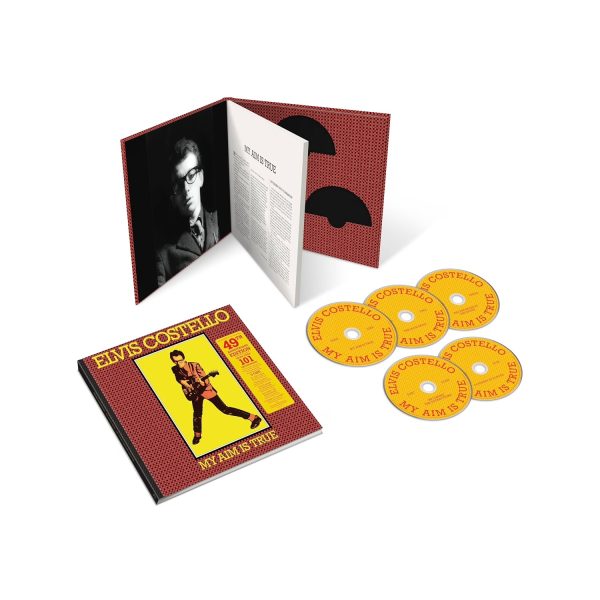
My Aim Is True has been reissued before. A 1993 release added nine bonus tracks, and two-disc editions, in 2001 and 2007, respectively included 13 and 35 outtakes, demos, and live cuts. But those reissues seem puny alongside a new 49th anniversary edition. (The always idiosyncratic Costello says he opted for a 2026 release date because he thought the idea of a 50th anniversary release was “preposterous” and “just too straight.”) The five-disc set, which has a playing time of nearly five hours, contains 104 tracks, 57 of them previously unreleased.
Disc One features a remastered copy of the original album (including “Watching the Detectives”). The second and third CDs add 45 home and studio recordings, most of them with Costello accompanied only by his own guitar. Among them are “Radio Soul,” a demo version of “Radio Radio,” which is a standout on Costello’s sophomore album, Armed Forces. Also featured is a cover of Bob Dylan’s “Knockin’ on Heaven’s Door,” one of five tracks with Flip City, Costello’s first significant band. Here, too, are outtakes such as “Radio Sweetheart” and “Stranger in the House” and alternate readings of many of the songs that wound up on My Aim Is True.
A fourth CD collects nearly two dozen fired-up radio and concert performances from 1977 and 1978, plus two interview snippets. The disc mostly finds Costello backed by the Attractions, the band he would feature on many subsequent releases. It include versions of several songs from My Aim Is True, such as “Alison,” “Watching the Detectives,” and the angry-sounding “I’m Not Angry”; a cover of “Whole Wide World” by fellow Stiff label artist Wreckless Eric; “Pump It Up,” and “Lip Service” from Costello’s sophomore release, 1978’s essential This Year’s Model; and “I Just Don’t Know What to Do with Myself,” which offers early evidence of his admiration for songwriter Burt Bacharach.
The box devotes its fifth and final disc to an hour-long 2007 San Francisco concert that reunites Costello with his pre-Attractions band, the California-based Clover, which backed him (uncredited) on My Aim Is True. (The group included future Doobie Brother John McFee.) This enthusiastically delivered and well-recorded show offers versions of every song on that album, plus covers of Lowe’s “(What’s So Funny ’Bout) Peace, Love, and Understanding”; “Love Has No Pride,” by Libby Titus and Eric Kaz; and “Mr. Moon” and “Love Has Gone,” both by Clover lead vocalist Alex Call.
The box’s 72-page, oversized hardcover book constitutes a considerable bonus. Featuring lyrics to every song and dozens of photos, it also includes copious notes by Costello, who offers serious competition to Pete Townshend and Bruce Springsteen for the title of most loquacious and introspective rock star.
Costello reminisces about his early years, when he knocked on the door of Stiff Records, left a demo tape, and “never expected to hear from them again, except to perhaps receive another rejection letter.” He chronicles the making of My Aim Is True, discusses his musical influences, and comments at length on every disc in the box. He also talks about the evolution of specific songs, revealing, for example, how the lyric and melody of “(The Angels Wanna Wear My) Red Shoes” came to him near the end of a train ride and that a “beautiful checkout girl at the local supermarket” inspired him to write “Alison.”
This is an artfully assembled and endlessly fascinating box that belongs in the collection of any Costello fan.
Also Noteworthy
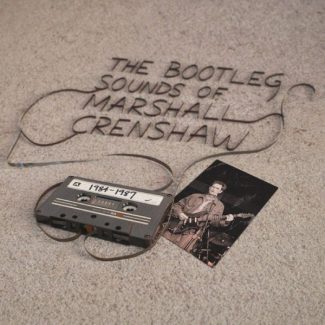
Marshall Crenshaw, The Bootleg Sounds of Marshall Crenshaw. This odds-and-ends collection from Marshall Crenshaw consists of previously unissued material. The pop-rocker recorded it between 1984 and 1987, during the making of his third and fourth albums, Downtown and Mary Jean & 9 Others.
It’s a mixed bag. Several early-rock covers, including Jackie Wilson’s “Reet Petite” (performed live), Buddy Holly’s “That’ll Be the Day,” and Gene Pitney’s “Town without Pity,” likably demonstrate Crenshaw’s penchant for early rock. His own “They Never Will Know,” “The Distance Between,” and “This Is Easy,” meanwhile, evidence his strong pop sensibilities, though these catchy readings add little to the versions on Downtown and This Is Easy. Ditto a live reading of “Try,” a song that featured on 1983’s Field Day.
Crenshaw scrapes the bottom of the barrel with an excerpt from “All Ever Wanted,” a duet with co-writer Kirsty MacColl, that fades out after a minute; a 30-second “Vocal Test”; a 23-second electronic train wreck called “Synsonics Go Berzerko!”; and an instrumental version of “Little Wild One” that pales alongside the reading on Downtown.
The best of this album’s recordings would have worked well as bonus tracks on expanded editions of several of the singer’s early studio LPs. As presented on The Bootleg Sounds of Marshall Crenshaw, however, the material feels like a hodge-podge of vault picks, and the inclusion of some obvious filler doesn’t help.
______________________
Jeff Burger’s website, byjeffburger.com, contains more than four decades’ worth of music reviews and commentary. His books include Dylan on Dylan: Interviews and Encounters, Lennon on Lennon: Conversations with John Lennon, Leonard Cohen on Leonard Cohen: Interviews and Encounters, and Springsteen on Springsteen: Interviews, Speeches, and Encounters.