



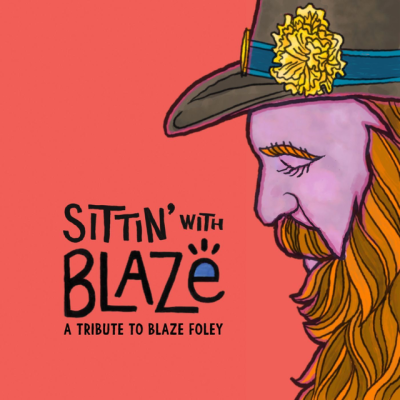
It’s About the Fucking Songs: Sittin’ With Blaze Shows What’s Great About Tribute Albums
A new Blaze Foley album came out last week, no mean feat for a songwriter who died in 1989.
Sittin’ With Blaze: A Tribute to Blaze Foley brings together artists from across generations to interpret the revered Texas songwriter’s work, including Lucy Dacus, John Moreland, Phosphorescent and Joshua Ray Walker, alongside Lucinda Williams.
I have always had a soft spot for tribute albums. This One’s for Him: A Tribute to Guy Clark, Enjoy Every Sandwich: The Songs of Warren Zevon and Looking Into You: A Tribute to Jackson Browne are among my favorites. Some tribute albums are terrific. Some are uneven. Some feel like everybody involved showed up because somebody they could not say “no” to asked them to. But the best of them remind us of something that can get lost amid everything else we talk about when we talk about music—the voice, the production, the performance, the personality, the mythology.
It’s about the fucking songs.
Foley’s biography can easily overwhelm his music. He knocked around the Austin songwriting scene, where he became a friend and running mate of Townes Van Zandt. He drank hard, lived rough and cultivated—or at least acquired—a reputation as an eccentric and an outlaw, the kind of character who generated stories almost as quickly as he wrote songs. When he recorded two nights at the Austin Outhouse in late 1988 for a live cassette, he planned to donate part of the proceeds to a homeless shelter. He was shot and killed before the planned release party, at 39; for years afterward, the only way to buy Foley’s music was from his friend Lost John Casner, who sold copies from the trunk of his car around Austin. It’s a life that practically begs to become legend.
But Foley’s songs lived on. Merle Haggard recorded “If I Could Only Fly.” John Prine recorded “Clay Pigeons.” Lyle Lovett recorded “Election Day.” Other singers carried Foley’s songs to audiences he never reached, including listeners who had no idea who wrote them.
Now it is happening again. Sittin’ With Blaze reaches back to Foley’s fabled mid-1970s “tree house” recordings, spare early demos recorded in Georgia and later released as Sittin’ by the Road. The new album puts those songs in the hands of more than a dozen contemporary artists.
I came to Sittin’ With Blaze knowing many of the singers. I left wanting to hear more from Dylan Earl, Angela Autumn and a few others I wasn’t aware of. That’s the fun of a tribute album: discovery can run in either direction. You can come for the songwriter and discover the singers, or come for the singers and discover the songwriter.
Phosphorescent opens Sittin’ With Blaze with “If I Could Only Fly”; Lucinda Williams closes it with the same song. The album gives us two very different, and very compelling, readings of one of Foley’s best-known songs. The voices change. The arrangements change. The audiences change. The song doesn’t—or, more accurately, it does. Each singer finds something the others don’t. That’s the peculiar pleasure of a great tribute album.
There are more ways than ever to preserve a musical legacy. Classic albums are remastered and repackaged. Deluxe editions give us demos and alternate takes. Documentaries tell us how records were made. Anniversary tours bring beloved albums back to the stage. All of that preserves recordings. Songs are different; they need somebody to sing them.
John Moreland, with Lydia Loveless, makes Foley’s “Faded Love and Memories” sound like a John Moreland song. And that’s a high compliment. A great song can absorb the person singing it without surrendering the person who wrote it. The Guy Clark tribute offers one example after another. Kris Kristofferson turns “Hemingway’s Whiskey” into something haunting, while Patty Griffin gives “The Cape” an almost ethereal quality. Neither sounds like Clark’s recording. Both sound completely authentic.
A different voice can reveal something in a song we hadn’t heard before. A familiar lyric suddenly lands harder. A song we thought was funny turns out to be devastating. Something that sounded confessional becomes universal.
Sometimes the interpretation doesn’t work. Tribute albums tend to be uneven because interpretation involves risk. Let 15 musicians loose in a songwriter’s catalog and some will illuminate it, some will merely perform it, and somebody will almost certainly make you reach for the skip button.
Like the best tribute albums, Sittin’ With Blaze touches all the bases. It introduced me to artists I didn’t know, made me hear familiar songs differently, and sent me back to Foley’s own recordings. Thirty-seven years after his death, a group of artists went back to those old tree-house tapes and found songs they wanted to sing. That’s not mere preservation. It’s a celebration of still-living songs.
You can find the music here: https://lostartrecords.bandcamp.com/
Mark Pelavin, a failed retiree, is a writer, consultant and music in St. Michaels, MD. His newsletter, A Feather in the Wind, is at https://markpelavin.substack.com/.