


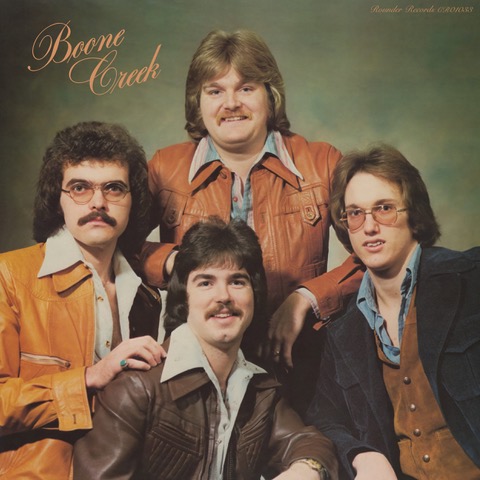
Boone Creek Boone Creek (Craft Recordings/HighTone Records)
Fans of quality bluegrass will be thrilled to hear about the re-release of Boone Creek’s debut from 1977, remastered and loaded, additionally, with previously unreleased tracks. First there was traditional bluegrass – established by Bill Monroe and his Blue Grass boys back as early as ’39. It kicked into popular fashion with the addition of Earl Scruggs and Lester Flatt to the band in and around ’45. A collision of styles, it blended Appalachian folk with its strong Irish and Scottish roots – which included everything from African American and Celtic music to many things in-between. Still, it remained loyal to the string band tradition of acoustic guitar, fiddle, upright bass, mandolin and 5-string banjo. A new development – newgrass – was birthed in ’71, helmed by Sam Bush and his New Grass Revival. Their goal was to buck tradition and take the key instruments of bluegrass tradition to new heights. As such, notable members came and went, including John Cowan, Béla Fleck and Pat Flynn, other acts entered the fray – notably J.D. Crowe and New South, Tony and Larry Rice, Jerry Douglas and Ricky Skaggs. This new blood covered an eclectic range of songs while power-loading elements of rock, jazz and blues into the mix. Previously ‘taboo’ instruments such as drums, pianos, electric bass/keyboards and pedal steel guitar were all key to this excitingly new, genre-bending fusion proffered by these young upstarts.
When Boone Creek came into being with their first release, it had something fresh to offer: the absolute virtuosity of its players. A veritable supergroup, the coming together of a 23-year-old Ricky Skaggs, a 19-year-old Jerry Douglas, a 22-year-old Terry Baucom and a 20-year-old Wes Golding treats the listener to a younger, more energized breed of musical explorers.
Beginning with Wes Golding’s original, “Dixieland,” the band explodes under the power of Douglas’ aggressive dobro-playing and the right-hand attack of Baucom’s fast-as-lightning banjo. Key songwriter, Golding, adds guitar and presents lead vocals buttressed by both Douglas and Skaggs on backup. There’s no missing the blazing speed of Skaggs’ contributions on mandolin while Fred Wooten sits in on bass and the well-appointed Karl Himmel guests on drums. Even as a listener, it’s hard to keep up.
Things slow down as the band tackles Bill Monroe’s “Dark as the Night, Blue as the Day” with the complete confidence afforded excellent players. Baucom (who was originally hired as their fiddle-player until their proposed banjoist bailed out), takes lead on fiddle as the shared vocals of Golding, Skaggs and Baucom blend beautifully. As always, Jerry Douglas’s dobro has a commanding presence, shining bright on his brief solo. Earl Grigsby (a veteran of multiple bands but most notably with Charlie Daniels) sits in on bass.
Ricky Skaggs once said, “We were trying to be somewhat progressive but we all loved tradition so much that we couldn’t stray too far from the fold – but just enough to make the purists mad at us.” That said, Skaggs’ take on the traditional “Walkin’ In Jerusalem” stays within the lines of the bluegrass foundation – one in which religion is a constant thematic pillar. Featuring Skaggs’ mandolin and sky-high tenor, the blend of voices on this number (Golding, Douglas, Baucom) on this call-and-answer classic demonstrates a vocal strength with few peers. Again, Earl Grigsby adds bass guitar.
You can almost hear Lester Flatt’s significant influence in the band’s cover of his “I’m Gonna Settle Down.” Baucom – also known as “The Duke of Drive” for his high-, 3-finger banjo style – sparkles here as Golding and Skaggs trade off on lead vocals, harmonizing beautifully. Golding’s guitar and Douglas’ dobro join Tommy Hough guesting on bass while Skaggs volunteers upbeat mandolin and fiddle. This is a highlight track if for no other reason than it makes you feel good just listening to it.
The traditional “Drifting Too Far from the Shore” continues the somewhat strict adherence to religion as a core symbol of community and Appalachian culture. Skaggs assumes lead vocals, doubling on baritone with Baucom (bass) and Douglas (tenor), has a honeyed effect as bassist, Hough, and Golding’s rhythm guitar accompany Skaggs’ mandolin and guitar. A beautiful combination, this cautionary tale is knee-deep in its elegant delivery.
The traditional “White House Blues” (written in the wake of the 1901 assassination of President William McKinley) gained popular significance with the high-energy cover by Bill Monroe and his Blue Grass Boys. Skaggs again takes lead vocal as banjo (Baucom), dobro (Douglas), guitar (Golding) and bass (Grigsby) collide with Skaggs’ mandolin and fiddle at speeds just beyond breakneck.
The band took its name from this Golding original, “Boone Creek,” named for the prominent waterway in Kentucky. Comparably laidback, Golding’s lead vocal demonstrates his strength as a masterful singer while Douglas’ dobro and Skaggs’ and Baucom’s fiddles dance, gracefully, behind him. Himmel returns on drums, Fred Wooten volunteers both bass and steel guitar and Douglas takes a deserved spotlight on dobro – with Wooten’s steel guitar playing a key role in this track’s sound. This title track also has a most pleasing, commercial ring to it and you find yourself wishing it exceeded its 2 ½ minute length.
The jaunty, almost playful “The Memory of your Smile” adds guest pianist Joel DeGregorio to the band’s musical arsenal together with the tasteful touch of adding Cheryl White (Buck’s daughter) on tenor vocals. Written by songwriter, Ruby Rakes (an alias used by Carter Stanley of the Stanley Brothers), the combined vocals of Skaggs and White and the dobro/lead guitar offerings of Douglas and Wooten, approximate so many country-rock leanings of this time period.
Cue “Intro” – which could easily be harnessed to provide hydro-electricity as aggressive playing takes a front seat on this user-friendly instrumental. This is a showdown on banjo (Baucom), guitar (Golding), mandolin (Skaggs) and dobro (Douglas) as guests Himmel, Grigsby and DeGregorio try to keep up.
Laying back a bit, Goldings’ “Satisfy My Mind” features exceptional vocals and harmonies from Golding, Baucom, White and Skaggs as Skaggs’ exceptional fiddle work is intertwined with Douglas’ dobro – making this a contender for the territory mined by early Byrds, Flying Burritos and Poco – but with a rich underbelly of exceptional musicianship by these ground-breaking bluegrass players.
Another original, Goldings’ “Sugar Daddy,” adds surprisingly levels of unconventional instrumentation to the mold they seem to want to create – inviting in guests on harmonica (Gordon Scott), Moog synthesizer and horns (Dana Thomas) and the great, late Buck White on spirited piano. The result of this combination on this surprising hybrid of a song is that it has a rollicking feel, bordering on New Orleans jazz. Golding shifts gears admirably while bassist, Wooten, and drummer, Himmel, keep things swinging. The players actually sound like they’re having a blast – right down to their accompanying whistling along the way.
Speed freaks will delight in the band’s cover of Harry McAuliffe’s “There Ain’t Nobody Gonna Miss Me” as Baucom’s banjo fires on all cylinders with blistering haste as Wooten’s perky basslines and dueling fiddles (Baucom and Skaggs) add fuel to this 5-alarm fire. Another notable Douglas dobro solo complements Baucom’s blazing banjo as the listener finds themselves trying to catch their breath.
A ‘found’ original, the previously unreleased “Hitchhiking to California,” sounds like a cross between early Eagles and the Grateful Dead, if you listen to it – were it not for the still-traditional bluegrass vocals of Golding, Douglas and Skaggs. Again, speed is at the forefront here and Goldings’ sturdy grasp on this hard left turn from Kentucky to California helps set the stage for their main point-of-difference in this musical evolution. Per usual, Wooten, Skaggs, Baucom and Douglas drive this blistering track with an uncommon agility which knows no bounds.
Another recently discovered original is Golding’s “Misty Wind” which, back in ’77, has the mellow, country-rock feel of a Poco or even Pure Prairie League. Chalk that up to the fact that Vince Gill guests on tenor vocals along with Cheryl White as the ever-elastic Golding takes a vocal turn resembling Craig Fuller or Doug Gray. Given his skills as a songwriter, he seems capable of anything.
Similarly. “Georgia Sunrise” conjures an element of the southern rock of the era (cue Marshall Tucker) as Golding stretches out on lead guitar to complement Skaggs’ lead vocal. An unknown pianist joins Cheryl White on vocals as Baucom and Douglas keep everything on-track. The addition of Fred Wooten on bass and electric guitar joins together with the distinctive 2-part vocal to deliver a song that seemed headed for the FM radio of the day – but just never got there.
Although it’s unclear who wrote “Georgia Sunrise”, the combined voices of Baucom and White help to deliver yet another twist on what Boone Creek intended to be. In fact, these hidden beauties seem to point to an entirely different direction – which, perhaps, is why they went missing for so many years. Skaggs’ vocals – especially – approximate the country-rock sounds of the Capricorn era of Cowboy, if not the Allman’s themselves. Wooten’s sturdy electric guitar sounds help strengthen the argument.
One last added track – another Golding find, “Dream Song” …..and…Holy Firefall, Batman – this is most certainly their pitch at commercial rock, if not folk-pop – combining lush harmonies and sweet, hook-laden melodies. Seemingly out of left field, electric piano, synth, tenor sax, flute and trumpet help to completely alter the band’s trajectory, while still incorporating enough dobro, guitar, mandolin and banjo to keep things from going too far from tradition. But such an odd track to close on as the band pours on the sugar: Skagg’s candied vocals, supported by both Cheryl and Sharon White on tenor, present an entirely different take on Boone Creek. You can’t help but wonder where this band could’ve gone, commercially, had they joined the fray with more of a pop angle – but with the added firepower of harnessing the talents of incredibly accomplished musicians.
Were these ‘lost tracks’ set aside for a reason? Or was the band’s original allegiance to – and love for – the more traditional elements of bluegrass what commandeered their final stand? As it turns out, it was their label – Rounder – who took them to the curb, voting to keep things more rooted in traditional bluegrass. It’s only because these lost tapes were tracked down and added to this re-release that we can realize two things: that there’s no denying the phenomenal ability of these musicians – individually or collectively – to take whatever musical path they deemed appropriate. Two, it’s a rare treat to experience such outstanding musicians in their relative youth, gaining a glimpse into their pioneering talents and hear them taking shape, before blossoming into the powerhouses each would become.*
• Terry Baucom passed in December of ’77.
More details are available here: https://bluegrassbios.com/boone-creek/
Side One, tracks 1, 7, 8, Side Two, tracks 1 – 4 were produced by Boone Creek and Sundance Lennard,
recorded and mixed by Dana Thomas and Sundance Lennard at Starday Studio, Nashville (1975 – 1976). Side One, tacks 2 – 6 were produced by Boone Creek and recorded by Cecil Jones and Tom Underhill at Lemco Sound Studio, Lexington, Kentucky (1976), and mixed by Ricky Skaggs.
Tracks on side one and 1 – 4 on side two originally released as Rounder Records 0081 Boone Creek (1977)
Side Two, tracks 5 – 8 were produced by Boone Creek, recorded by Dana Thomas and Sundance Lennard at Starday Studio, Nashville (1975 – 1976). Tape restoration was by Peter Brothers at Specs Bros in Los Angeles;Dolby A analog to digital transfers were by Penguin Audio in Los Angeles. They were mixed by Steve Reynolds and were previously unreleased.
The album was produced for release by Scott Billington with project supervision by Mason Williams and mastering by Paul Blakemore.
“Hitchhiking to California,” “Misty Wind,” “Georgia Sunrise,” and “Dream Song” are released under license from Jerry Douglas and Ricky Skaggs.