


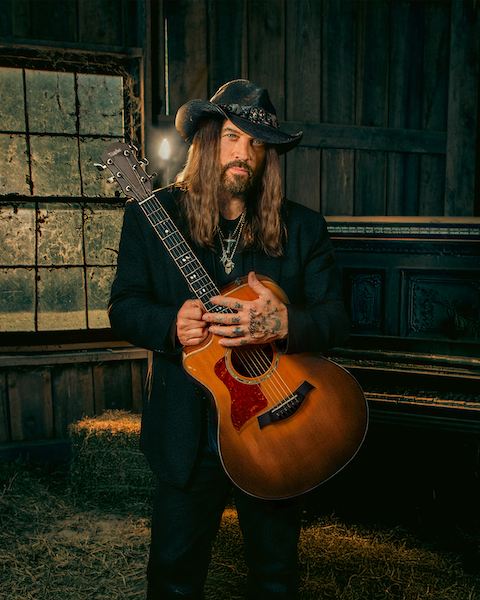
Billy Ray Cyrus photo by Derrek Kupish
Billy Ray Cyrus on Family, Collaboration, and ‘The Hill’
Billy Ray Cyrus is releasing his new solo album, The Hill, on June 16th, 2026, and has a number of live dates in the USA coming up. The album, which is his first solo collection in 14 years, marks a distinctive collaboration between Billy Ray and his son Braison, who co-produced the album with a very specific blend of sounds in mind, as well as co-writing many of the songs and assembling the featured players. Billy Ray’s Grammy-nominated daughter Noah Cyrus also duets with him on key album track “On Our Way Along,” from which the album’s title is taken, making this a very familial project.
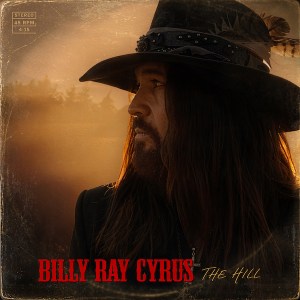
While each track on the album has its own emotional punch, the album itself seems to suggest an emotional arc where a common theme of perspective returns in varying forms, asking: Can we step back from the intensity of life enough to glimpse what’s most important? The album also plots a course through sonic textures that range from the barebone, minimal, and conversational, to the feeling of full-band energy and in-the-room performances. Throughout, there’s a sense of the personal, like something skillfully homemade and delivered by hand. While he was in the UK for a few days before his upcoming US appearances, I spoke with Billy Ray Cyrus about working with family on The Hill, his father’s cameo on the album, and the impact of his father’s support on his life.
Americana Highways: You’ve got some performance dates coming up just after your new album release. Are you taking it easy before then?
Billy Ray Cyrus: I’m in England, and I’ll be here another day or two, then I’m flying back into America to start doing tour dates, and I’m very excited. Right now, I’m out in the countryside. It’s absolutely beautiful. I went to Oxford yesterday. I did the CMA Fest last week. I have been working so hard, and honestly, I can’t even believe it. I have been loving it, I will say. I think that it was good for me, and to have something that I love so much to do, and to be so passionate about it. It’s a moment of music and new beginnings, almost a rebirth as such.
Today is my girlfriend’s birthday, and we just cut her cake. Her family’s here and is a real blessing. That’s why I had been down in Oxford, is that we also went to Jane Austen’s birthplace and the church. What an incredible human being! To me, the enormous impact she’s had on all of us, artists, and society, is maybe still untold.
AH: That’s wonderful that you went. I agree.
BRC: I took a deep dive on learning more about her. The little church there is one you have to go to, it’s really special. When you start digging into history, you start realizing that there are things in the UK that are so much older than America. America is new by comparison. Some of these structures were up during Roman times.
I went to Scotland last year, and learned so much there. I recommend to folks that they visit both places. There’s so much to learn. That’s something that Elizabeth [Hurley] and I have found so refreshing, that’s there’s the commonality of loving learning more about nature, music, the arts.
AH: I’m so glad that you’ve been able to do that traveling. I always recommend to friends and family to travel in the UK and in Europe. Sometimes you have to make a bit of an effort, to be determined to go to that church. You have to try for it a little, but the results are totally worth it.
BRC: I think you’re right. We can look at that pertaining to life and goals. What the human mind can do, when you challenge it to do something, is incredible. You have to define what it is you most cherish, to ask “What are your goals?” Write them down clearly, harness them, start a plan. And if that plan don’t work, start another plan. When you write something down, you immediately give it life because the problem clearly defines itself, and it’s half solved. Writing it down is the seed, and you have to start taking steps. Even if you fail, as Thomas Edison said, “Failure is the most important ingredient for success.” It’s part of it. That pertains to me. I’ve had a whole lot of learning the hard way, and learning what to do.
As Miley referenced when she got her Hollywood Star, “As my dad always says, ‘Every skyscraper begins with a jackhammer.’” Remember, it’s not the force of the jackhammer that busts up the concrete, it’s the repetition. That’s the thing. You keep on keepin’ on. Hopefully, first of all, you do what you do because you love it. And if you don’t, find something new to do, because life’s too short.
AH: I love the idea of writing things down and making them real.
BRC: I also use voice notes. There’s no excuses these days for not writing it down since we’re carrying our phones. We might as well use them for something as beneficial as clarifying the right chorus or charting the right path from one destination to another in life. It’s important.
AH: How have fans responded to the Hannah Montana 20th anniversary and special?
BRC: It’s something that happened in the psyche of the world-wide audience. I saw that happen with “Achy Breaky Heart,” I’ve seen in happen with Hannah Montana, certainly, and then I saw it happen with Old Town Road. Sometimes the world might need something where people can find that they have more in common than what divides them, whether that’s a TV show, or whatever. It’s something to unite folks, and music is a great vehicle for that. Most human beings love some form of music.
Now, when you can bend genres, that’s my favorite thing to do, invent new genres, or blend them together to make a new sound. Finding that combination of a new sound is always the trick for me to feel revitalized, refreshed, and reborn in music. Getting to the point of this new album, The Hill, for me to be able to hand the reigns to my son, and say, “I’m hungry to hear what you want your dad to sound like. What do you think?” I gave him the reigns, and he put together a great band, with a great band, in a great studio. We made a record where there’s a concept that’s something between Willie Nelson’s The Red-Headed Stranger and Pink Floyd’s The Wall, and all musical influences in between. The album as a whole was meant to be a concept, not just one song, then another, then another. Hopefully it’s a complete circle of emotion.
AH: I think the sound on the album as a whole is quite varied, but within each song, we can even see varying traditions combined. So that rule applied to each song, too.
BRC: What’s your favorite song on the album?
AH: It’s a close call between “Storm Windows” and “How’ve You Been?”
BRC: My goodness. Do you know that it’s my dad on that voice recording [on “How’ve You Been?”]?
AH: No, I was going to ask you who that was in the voice recording at the beginning of the song.
BRC: Unfortunately, he passed away while we were doing the episode of Hannah Montana where we sing, “I Want My Mullet Back.” During that episode, they called a break and told me that my dad had passed away, Miley’s grandfather, and we finished and came home. Then we took him to burial in Kentucky. When I got to my house in Tennessee, that was the last voice message that my dad had left on my old voice answering machine. I had kept that answering machine in my studio, in my office there, so I took my primitive equipment and recorded it, digitally, then, from the answering machine. I saved it all these years.
And “How’ve You Been?” was my dad’s favorite song from my older material. I actually wrote that song back in 1983 or 1984. I know that sounds ancient.
AH: No way! It’s such a great song.
BRC: That was before I was famous, if you do the math. It’s one of the first songs I ever wrote, but my dad loved it. I wrote it about a friend of mine who had committed suicide. I wondered what it would be like to see him in heaven. My dad always loved that song, so my son Braison had the idea of taking the voice recording and putting it in his favorite song, and he did just that. He figured it out.
AH: It’s an amazing thing to have included. I think people are getting more experimental with using spoken word that adds to the narrative of the song. I’m so glad that you shared that, even though it’s so personal.
BRC: You’re the only one I’ve told that to, so far. This album is so brand new. But it’s true. You’re also the first to comment on that song! That’s why I was able to tell you about my dad.
Back in the day, during Hannah Montana, Miley had a foundation called the Pappy Cyrus Foundation, because that was what she called my dad. She had written a song off of her very first Miley Cyrus album called “I Miss You.” That was the song that she had written for my dad. His name was Ron Ray Cyrus, his full name was Ronald Ray Cyrus.
AH: How did he feel about music?
BRC: Oh he loved music! I wasn’t sure how he was going to take it when I said that I felt like I had an inner voice tell me to turn down an offer I had. I was being scouted by the Cincinnati Reds and the Los Angeles Dodgers as a catcher. I was also paying my way through college at the same time as a catcher, because I had a scholarship. I was really doing good in baseball, but I was also hearing this voice telling me to buy a guitar, and start a band, and I would find my purpose in life. It kept happening so much, that one day I traded my catcher’s mitt for a left-handed guitar, and I didn’t look back.
AH: Amazing. That’s such a leap into the unknown.
BRC: I didn’t know how my dad would feel about it at first. He was the first and main guy to say, “I have no doubt that that’s what you’re supposed to do. You follow your dreams.” I’d written that song “How’ve You Been” and I’d played it for him. He said, “How’d you write that?” I said, “I don’t know, Dad, the songs just come from the sky, and I just write down and sing what I’m hearing.” I pointed at the sky. He said, “You keep doing that.”
Well, ten years later, through all my failures of trying to get a record deal, and all the ways I’d tried, he supported me. Finally, in the end, the song “Some Gave All” that I had written for a Vietnam veteran, that made it.
My dad had heard the song and said, “Beau, that’s your song, that’s gonna change your life.” It was “Some Gave All” that I played for a record executive after ten years of failure, and that one guy said yes, out of a thousand nos. That was the beginning of the album Some Gave All, which included “Achy Breaky Heart,” written by a Vietnam veteran. It was an interesting full-circle moment for that writer, Don Von Tress. I put him in the band and he joined the band. He became a Rock star! Me and him toured the world together two or three times and wrote a bunch of songs together.
AH: What an outstanding story. And it so hard to tell your father that you want to pursue an unconventional career. I think most people would be terrified of that. I’m amazed how that all went, that he supported you. That’s beautiful.
BRC: Thank you. He was a special man.
AH: I think you do call out your heroes on this album, in some of the songs, and that’s one of the songs where you do that, since he’s clearly your hero.
BRC: He sure is, absolutely.
AH: “Tip Your Hat” is another song that does that in a very big way. It’s quite a roll call of great artists and music.
BRC: It’s a really special song about the legends who opened the doors for all of who are doing anything in country music, probably all of us who are doing anything in any music. It’s the legends who made the evolution of today’s music what it is. Again, my favorite thing is to blend all genres. If you look at the song, you’ve got Dolly Parton, Waylon Jennings, Merle Haggard, Johnny Cash, Kris Kristofferson. It’s a long list, including Hank Jr., Earl Scruggs. They are the legends who opened up the doors for all of us to make a new sound, and still reference our roots. I’m excited about this song.
I just learned that it’s going to country radio. I feel like I’m going home. I’m being very real about that. I feel like I’m going home, home to country music. I’m from Kentucky. I was born on a road called US 23, which is known as the Country Music Highway, with Loretta Lynn, Patty Loveless. So many of us come from US 23. To go back to my roots of country music feels like coming home to me, and I’m very excited about “Tip Your Hat” going to country radio. I’m as excited as I was the first time my music got on country radio, but maybe even a little more excited because I wasn’t sure that I would ever make it back to this spot to have anything to be this joyful about. Now I can “tip my hat to the teachers,” which is what it’s all about. That’s what I’m talking about.
AH: I love how the song mentions the actual song titles, too, specific ones, as well as the artists. That’s a deep tribute.
BRC: Isn’t that brilliant? I did not write that song. That song was written by one of the greatest writers in the history of country music, Jeffery Steele. He’s written some of the biggest records of our time. I had fallen in love with this song as early as 1986 or 1987. He was signed to Sony at the same time that I was, and I had heard this song on a sampler. I loved it so much that I played it all the time, played it for the kids. When my son brought it up, he said, “I think there’s a cover we should do, “Tip Your Hat To The Teachers.” I was so excited. I said, “Braison, I’ve wanted to do that song since you were born. Let’s do it!”
AH: Before we go, I wanted to congratulate Braison on the production on this album, which sounds beautiful. I don’t think it was an easy job, because there are much quieter moments, and much more energetic moments on the album.
BRC: Thank you. Again, that’s where my spirit and my instincts told me to let Braison make the record that he wanted to make. I gave him the reigns and he really did a masterful job, with the right blends, the right harmonies. It’s not over-produced. Other than the saving of my Dad’s voice from a 1998 answering machine, that’s about how high tech this album goes. There is no AI. There is nothing else brought in. If anything, it’s the most imperfect album I’ve ever released. I’m a perfectionist. I’ll keep going forever, and still not be satisfied. But in this moment, when Braison said that he had what he wanted, it didn’t matter if it sounded imperfect to me, I had sense enough to let it be.
AH: The texture is definitely part of the personality of the album.
BRC: Thank you.
Thanks very much for chatting with us, Billy Ray Cyrus!
Find more details and information here on his website: https://www.billyraycyrus.com/