



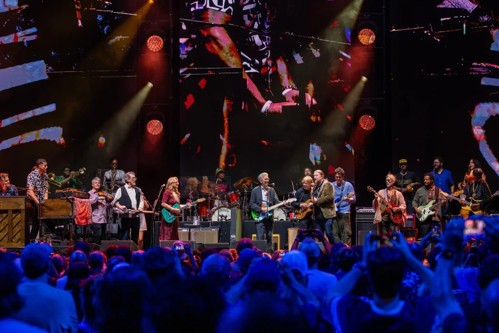
At Eric Clapton’s Austin guitar gathering, the most important moments were not displays of virtuosity. They were handoffs between musicians who reached the same music by different roads.
The first lesson from Eric Clapton’s Crossroads Guitar Festival in Austin was that a guitar festival need not be a contest. Over September 26 and 27 at Moody Center, some of the best-known players in rock, blues, soul and bluegrass kept making room for one another. Watching the official stream, I came away thinking less about who could play fastest and more about how many different people could find their place inside the same song.
It is tempting to draw a neat family tree: early blues musicians on one side, the British players they influenced in the middle, and the younger guitarists who grew up studying them on the other. The actual history is messier than that. But for two nights, Crossroads made the connections audible.
A Weekend of Handoffs
Night One belonged to Tedeschi Trucks Band. Opening with “Got My Mojo Working” went straight to the language at the center of the weekend, but the band sounded alive rather than reverent. Trey Anastasio joined for “Wah-Wah” and “Little Wing.” John Mayer came in for “Keep On Growing” and “Empty Pages.” Eric Clapton and Doyle Bramhall II joined for the Derek and the Dominos stretch, including “Anyday” and “Layla,” before the stage widened again for “Got to Get Better in a Little While.”
The point was not one famous guitarist protecting his spot. It was the music being passed around in public.
Night Two pushed the same idea outward. Performances by the Del McCoury Band, Sierra Hull and Jerry Douglas moved the festival comfortably into bluegrass territory. Marcus King welcomed guests including Hull and Joe Bonamassa, while Susan Tedeschi and Derek Trucks joined him for “Had to Cry Today,” drawing a line from Blind Faith into a wider Southern soul vocabulary.
King also brought out his father, Marvin King, for “Blue Ridge Mountain Moon” — lineage made literal.
Another memorable exchange came when Trey Anastasio and John Mayer found common ground on “What’s Going Through Your Mind” and “Ghost.” Neither needed to dominate the conversation. The music was better because both listened.
Clapton’s closing set and the all-star finale, “Going Down,” brought the weekend back to its central idea. A stage crowded with extraordinary musicians can easily turn into noise or self-congratulation. At Crossroads, the strongest exchanges treated the shared song as the center rather than any single name on the poster.
Whose Music Traveled?
Those connections are worth celebrating, but they also raise the question of who gets remembered once the music becomes a global language.
In a September interview, Bobby Rush took me back to his early work outside Chicago. In Blue Island, he told me, people wanted to listen to his music without looking at him. He played behind a curtain.
“The people wanted to hear my music, but they didn’t want to see my face,” Rush said.
When I asked when that barrier broke, he replied, “It didn’t break. They just took me out from behind the curtain.”
It is an unforgettable counterweight to the cheerful language of influence. Blues records and songs moved across borders, but the Black musicians who created them did not always receive the same freedom, money or visibility. Rush has credited British musicians who pointed listeners back toward their American influences, and that recognition matters. It does not tidy up the history.
Rev. Robert B. Jones Sr., the Detroit roots musician and Baptist pastor, made a related point when we spoke.
“We just kind of enjoy the product, but we don’t really appreciate the process,” he said.
The process includes the homes, churches, workplaces, family gatherings and small clubs that never acquire the prestige of a major festival.
The music had a life long before the musicians in Austin learned to play it, and it will need one after the festival is over. That means a young guitarist having a place to hear somebody better, a working band earning a cover charge, or an older player sharing something nobody can teach from sheet music alone.
The Music Between the Notes
There is nothing wrong with celebrating great guitarists. Watching Tedeschi Trucks Band move between blues, Hendrix, and Derek and the Dominos reminded me why the instrument can still command a room. Gary Clark Jr., Taj Mahal, Keb’ Mo’, Robert Randolph, Jimmie Vaughan and so many others also made it clear that blues influence has never been limited to one sound.
But Crossroads was at its most revealing when musicians listened to one another.
The question for the next generation is not whether they can reproduce the records they loved. It is whether they can take the music somewhere new while remembering the people and places that made it possible.
Crossroads is not where the blues began. For two nights in Austin, it offered a picture of how the language keeps moving: one player starts a phrase, another answers, and somebody younger is listening.
Find more information here: https://crossroadsguitarfestival.com
photo by David Brendan Hall