



“I did not have singing ‘In Spite of Ourselves’ and dancing with Emmylou Harris on my bingo card.”
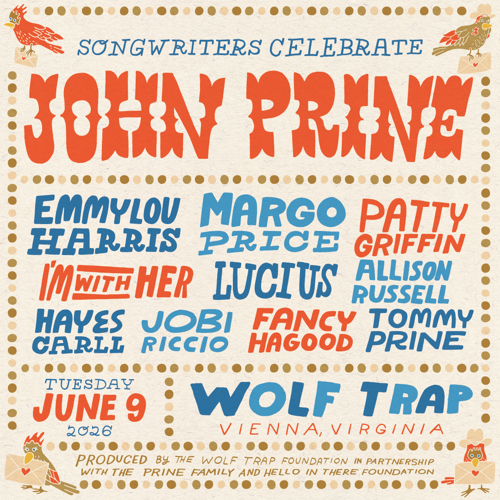
Texas singer-songwriter Hayes Carll’s remark drew a laugh from the crowd at Wolf Trap, but it also captured the spirit of A Songwriters Tribute to John Prine. The June 9 concert gathered an extraordinary collection of performers to celebrate one of America’s most beloved songwriters.
Yet what emerged over the course of nearly three hours was something more than a tribute concert. It was a portrait of the community that Prine’s songs continue to inspire and the family that has worked to nurture it.
Wolf Trap was the perfect setting. Prine first appeared there in 1972 and returned nineteen times over the decades that followed. Many of the evening’s performers shared their own history with the venue. Throughout the night, artists spoke of Wolf Trap with the affection usually reserved for old friends, reinforcing the sense that this was less a concert stop than a gathering place.
The evening’s structure was central to its success. Rather than asking performers simply to cover Prine songs, most paired one or more Prine compositions with songs of their own. The result was less a tribute concert than a conversation among songwriters. Again and again throughout the concert, artists demonstrated not only what they had learned from Prine, but how they had carried those lessons into their own work.
That was true right from the start when Jobi Riccio, whose songs would feel perfectly at home on a shelf alongside Prine’s records, took the stage. Her own “The Ridge,” built around the refrain “The more love you show me / The more I seem to need to be alone,” explored solitude and longing with the same kind of emotional complexity that characterized so much of Prine’s best work.
Nashville Singer-Songwriter Fancy Hagood followed with a playful rendition of “I Just Want to Dance With You” before turning to his own “To the Moon.” The straightforward love song could easily become saccharine in less capable hands, but Hagood found emotional honesty without excessive sentimentality—a balancing act that John Prine himself often managed with remarkable ease.
Allison Russell, greeted with one of the evening’s loudest ovations, observed that “John could make you feel five emotions all at the same time.” She proved her point with a stirring rendition of “Everything Is Cool.” Russell—accompanied by guitarist JT Nero and joined by the members of I’m With Her as a powerful chorus—floated gracefully through her own “Really Real,” built around the question, “Who’s gonna be your shelter from the storm?”
No performers better embodied the concert’s collaborative spirit than the members of I’m With Her—Sara Watkins, Sarah Jarosz, and Aoife O’Donovan. Appearing first without the house band, they relied only on fiddle, mandolin, guitar, and the distinctive vocal blend that has become their signature for a gorgeous version of “Bruised Orange.” There is a special alchemy when those voices come together, and their obvious enjoyment in making music together was contagious. Joined later by Prine’s band for “Wild and Clear and Blue,” which they described as being inspired by Prine and Nanci Griffith, they sang of hearing Prine perform “Paradise” as a child and of a voice that still runs “like the Brazos” through them. The song felt less like a tribute than a continuation of the musical conversation Prine helped inspire.
Lucius delivered one of the concert’s musical highlights with a haunting rendition of “Hello in There.” The song felt as though it had been waiting for the voices of Jess Wolfe and Holly Laessig all along. Their harmonies illuminated both the loneliness and tenderness at the song’s core, while Fats Kaplin’s pedal steel added another layer of emotional depth. Joined by the members of I’m With Her for “Dusty Trails,” they demonstrated how easily the show moved between tribute and collaboration.
The concert’s more established artists proved equally compelling.
Accompanied by Kaplin’s mandolin, Patty Griffin brought “I Remember Everything” to life with a performance that was melancholy but never sad. Rather than emphasizing the song’s grief, she revealed its personality, humor, and hard-earned wisdom. She followed with her own “Love Throw a Line,” transforming the amphitheater into something closer to a listening room.
Margo Price opened with a sharp, snarky rendition of “Your Flag Decal Won’t Get You Into Heaven Anymore.” Once heard primarily as satire, its references to a “dirty little war” landed differently in 2026. Price followed it with her as-yet-unreleased “Screw You and the Horse You Rode In On” before closing with a slow, almost stately reading of “Angel From Montgomery.” More than fifty years after Prine wrote it, a song that can sometimes feel overly familiar instead emerged as startlingly vital, earning the concert’s first standing ovation.
Prine’s longtime band, led by guitarist and music director Jason Wilber, connected performers, songs, and generations of artists. Multi-instrumentalist Fats Kaplin shone throughout the concert, moving between pedal steel and mandolin and contributing to many of the night’s strongest performances. These were not simply backing musicians. They were Prine’s musicians, his partners, the people who had spent years bringing his songs to life onstage. Their presence gave the concert an authenticity and continuity every bit as important as their musicianship.
Texas singer-songwriter Hayes Carll returned to the stage for a joyous rendition of “Illegal Smile,” recalling that it was the song he performed at his first open mic. Joined by Price and a crowd eager to sing along, Carll turned the performance into one of the show’s most exuberant moments. He later offered his own “Beaumont,” a powerful reminder that he belongs on this stage not only as an admirer of great songwriting, but as a practitioner of it. Carll also offered perhaps the concert’s most concise description of Prine’s work, praising the “humanity and grace” found in his songs.
Emmylou Harris spent much of the evening contributing to duets and ensemble performances rather than claiming the spotlight for herself. Nothing says loneliness like a pedal steel guitar, and Fats Kaplin’s playing provided the perfect accompaniment to a beautiful rendition of “Speed of the Sound of Loneliness.” Built around Harris’ voice and one of Prine’s most enduring melodies, the performance showcased Prine’s gift for expressing complicated emotions in language that sounds deceptively simple. Harris later closed her set with her own “Red Dirt Girl,” a reminder that icons are icons for a reason.
CBS News’ John Dickerson was a surprise addition to the bill. He spoke movingly about Prine’s songwriting before offering a dramatic recitation of “Mexican Home.” Stripped of melody and presented as spoken word, the song still held the audience’s attention from beginning to end. Lines such as “Mama dear, your boy is here / Far across the sea” demonstrated Prine’s remarkable ability to hold seemingly contradictory ideas in tension. The performance served as a reminder that his songs draw much of their power from what they leave unsaid.
The concert’s most personal moments belonged to Tommy Prine. Introducing “Far From Me” as his favorite of his father’s songs, he noted that John had written it as a teenager. Tommy followed with his own “Ships in the Harbor,” a graceful tribute that included the line, “I guess he was passing through, and I am too.”
That sense of community extends beyond the stage. Fiona Prine and son Jack spoke briefly about the work of the Hello In There Foundation, which supports community organizations across the country. Fiona described its mission as helping “the quiet people who need a hand,” while Jack spoke about reaching out to the fan community as an important way of keeping his father’s memory alive—a mission reflected in more than $1.4 million in grants to over 100 organizations.
For the finale, the entire cast returned to the stage. Introducing “Paradise,” Tommy Prine noted that only one song ever concluded a John Prine show. By the time dozens of voices joined together on the chorus, the choice felt as welcome as it was inevitable.
Some songwriters create works so closely tied to their own voices that other performers can only imitate them. Prine’s greatest songs seem to work differently. They remain unmistakably his, yet somehow make room for other artists to bring their own experiences, personalities, and perspectives to the material. That quality was evident throughout the concert, from Lucius and Emmylou Harris to Tommy Prine and the newest generation of songwriters on the bill. Six years after his death, the songs continue not only to endure, but to build the kind of community on display throughout the concert.
Find more information here: https://www.wolftrap.org/centerlines/2026/songwriters-celebrate-john-prine/
Mark Pelavin, a failed retiree, is a writer, consultant and music in St. Michaels, MD. His newsletter, A Feather in the Wind, is at https://markpelavin.substack.com/.