





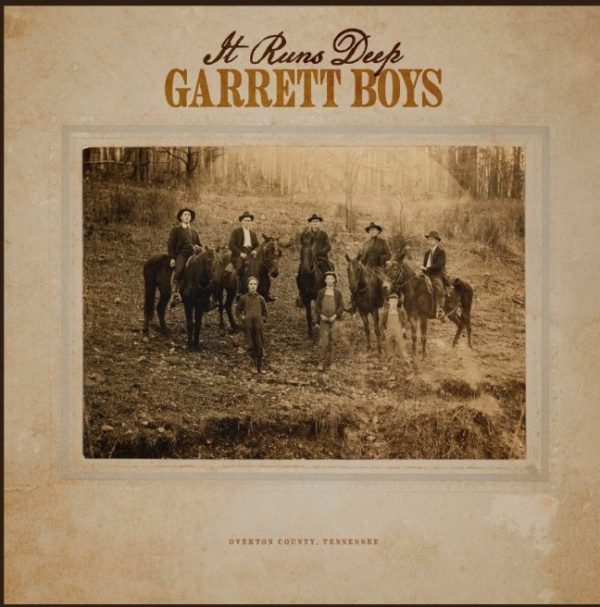
The Garrett Boys It Runs Deep
“It’s a funny thing about humility,” songwriter T-Bone Burnett once wrote. “As soon as you know you’re being humble, you’re no longer humble.”
The same is true for authenticity. Essential to great roots music, it works best when it’s felt rather than announced—like hot sauce in a pot of gumbo.
It Runs Deep, the debut album from East Tennessee’s Garrett Boys, never sounds like a pose. There isn’t an inauthentic note on the record.
That confidence comes from songs grounded in lived history. The Garrett Boys—brothers Stephen and Russell Garrett, joined by Stephen’s son Carter—are rooted in Overton County, Tennessee, on land their family has worked for generations. They call it simply “the Land,” and it serves as both the literal setting and emotional center for much of It Runs Deep: music shaped by family memory, hard labor, faith, loss, and the persistent pull of home.
I’ve been anticipating this release since seeing the Garrett Boys perform at the 2025 Annapolis Songwriters Festival. They struck a balance that isn’t easy to pull off: taking the music seriously without taking themselves too seriously. At one point they paused mid-set to check in for a Southwest Airlines flight the next morning—a moment most of the audience could relate to. That same combination of commitment and ease carries over to It Runs Deep, where the focus remains firmly on the songs and the stories they’re telling.
The heart of the album is the title track, which lays out the Garrett Boys’ worldview with uncommon clarity and restraint. Built around creeks, red mud, fishing holes, and a family tree stretching back generations, the song understands heritage not as nostalgia but as responsibility. It moves easily between tenderness and threat—between a grandfather’s gift of a first guitar and an older generation’s readiness to defend what mattered—without tipping into melodrama. Like the best communal storytelling, it isn’t really about one person at all, but about how land, memory, and family shape identity over time.
Those roots don’t come without weight, and It Runs Deep is clear-eyed about the costs of staying, leaving, or trying to do both at once. On “Back Home,” ambition gives way to reckoning: “Sometimes the nights turn into days and I can’t sleep / I stare at a ceiling wondering why,” before the truth settles in—“it’s a long, long, long way back home.” “God Forsaken Town” confronts economic precarity with similar restraint, capturing the grind of loyalty unrewarded—“Ten years at sixty hours a week / has turned these hands to stone”—and the exhaustion of “just trying to make a livin’ in this God forsaken town.” These songs don’t romanticize hardship or rush toward redemption; they sit with the tension and let it speak.
The album’s most harrowing moment arrives with “Pond Ridge,” a song that shows just how far the Garrett Boys are willing to go as storytellers. What begins as uneasy wandering—“I wasn’t lookin’ for trouble, I wasn’t lookin’ for nothin’”—darkens as the narrator admits he has “seen things I wish I hadn’t” and is “pretty sure I did, that night / up on Pond Ridge.” The song culminates in an act of brutal violence, rendered without commentary or melodrama, only the devastating finality of “they had to be together forever / the only way that they knew how.” It’s a reminder that the histories these songs draw from include cruelty as well as belonging—and that honesty about place requires facing both.
Elsewhere, It Runs Deep turns toward endurance, but never the kind that comes wrapped in easy answers. On “Who I Am,” identity is something arrived at slowly and with cost, shaped by “sacrifice and that ain’t cheap” and the knowledge that “there’s a price to be paid for anything.” “Me and This Land” sharpens that tension further, as memory and inheritance are tested by economic reality—“For six generations this deed has held our name,” before landing on the quiet devastation of “there’s an auction sign out by the road.” Even moments of defiance carry weight rather than swagger: in “Back to Akron,” the refusal to return feels less like rebellion than exhaustion, a wish to trade factory lines for something that still feels human. Resilience here isn’t celebrated or sentimentalized; it’s simply what remains when the choices narrow.
Taken together, these songs recall the spirit of The Band. Like their best work, the Garrett Boys’ songs feel communal rather than confessional, shaped by shared history, moral complexity, and the slow accumulation of place. The difference is that this music doesn’t imagine the rural South from a distance; it grows directly out of it. On It Runs Deep, heritage isn’t mythology or mood-setting. It’s the ground beneath the songs, uneven and enduring, holding everything in place.
It Runs Deep is a remarkable debut—confident, grounded, and fully realized. The Garrett Boys don’t ask listeners to admire their authenticity, or even to notice it at all. They simply tell these stories—plainly, patiently, and with respect for where they come from—and trust that the songs will carry what needs to be said. In roots music, that kind of confidence is rare. Here, it feels not just natural, but fully earned.
Find more details here on their website: https://garrettboys.com