



Stan Lynch Finds Rock ‘n Roll Collaboration In New Band The Speaker Wars
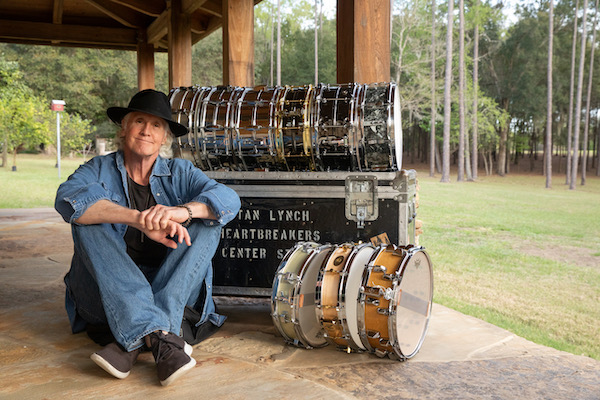
Stan Lynch is known for a large body of musical work as a drummer, producer, and songwriter, notably as the founding drummer of Tom Petty & The Heartbreakers, and for working with The Eagles, Don Henley, Ringo Starr, and many others. On May 30th, 2025, the self-titled debut album of his new band, The Speaker Wars, arrives, marking the first time he’s been a drummer in a band since 1994. It wasn’t necessarily a move that Lynch thought he’d ever make again, but through his close collaboration with singer/songwriter Jon Christopher Davis, a band was born.
Their debut album shows a wide range of influences and directions for rock ‘n roll, pulling in many traditional sounds, whether rockabilly, gospel, or blues. Vocal and lyrics are particularly emotive and important, but every instrument is also given its time to shine, and there’s a naturalness to The Speaker Wars’ collective sound that makes it seem like they’ve been playing together for a far longer time. I spoke with Stan Lynch from his home in Florida about how the collaboration with Jon came about, what keeps him going for so many decades in music, and what he’s looking for, and finds, in the chemistry of his new band.
Americana Highways: I see that I’m talking to you from your home in Florida. Is that somewhere you find conducive to creative work?
Stan Lynch: I’m kind of a nature boy. I farm, and I surf, and between here and St. Augustine is where I hang my hat. It’s pretty easy to get elbow room, and remember that the ultimate landlord is mother nature. That’s who I’m dealing with!
AH: That’s getting harder to come by.
SL: It really is. I agree.
AH: I think the story with you and Jon is really interesting, and how you came to form the band. You were working as his producer, initially, right?
SL: Yes, we originally met, and I was tapped and asked if I was interested in writing and co-producing with him. That situation went south quick because I had a visceral disagreement about the direction of his record with the record company. I just thought of Jon as a real artist, even though I didn’t know him that well. He had his own musical compass, and he knew where he was going. When I went into the record company with what I thought was Jon’s work, and was told, “No, no, we’re going to cut these other songs.” I said, “Why would I do that? This guy has perfectly good songs and they are better than this crap you’re suggesting.”
Basically, I was fired that minute, and Jon was let go by the label. I thought that would be the end of our relationship, but he literally tracked me down as I was walking through a parking lot in Nashville. I thought, “Oh, great, this is the part where I get clubbed in the head like a baby seal.” But he gave me a big hug and said, “Look, man, nobody has ever stood up for me.” So we built a relationship based on trust and a love of great music, which is a great place to start. I’ve said that my whole musical life has been based around friendships first, and we end up making music.
AH: I think more and more people are having to follow that compass that you’re talking about. People are coming to songwriting right now, at whatever stage in life, and the music industry being what it is right now, a lot of people are having to make their own way, on their own terms.
SL: Well, there’s no pathway to success. In the old days, like when we were kids, there were ways that you could conform and could find a way to be more contemporary, or more commercial. There were discussions with producers, labels, and radio. It wasn’t by rote, by any means, it was still seat-of-the pants. But now, if you’re not in it because you love it, you picked the wrong trade. If you have another way to make a living, you’re going to take it. People ask me about this a lot, and I didn’t have a B-plan. My B-plan was to live under a bridge and starve. If you’re in this because you want to make a living, or be famous, you’re out of your mind.
HMS: Survival comes first. What else is there?
SL: Yeah! Fortunately for me, this has been my way of life since I was 15. I have never looked back since I threw my life away after watching The Ed Sullivan Show. I said, “That’s it! I’m joining the circus! This is everything!” It chewed a hole in me at puberty, basically, and it still does. I’m still in it for the exact same reason. I love pushing play, or sitting down on stage, or sitting down with the guys, and hearing that noise. It’s still catnip to me.
AH: You all have released some live play videos of playing together, and it’s easy to see that you’re just comfortable and happy to be playing together.
SL: Yes, that’s fun! These guys are a little younger than me, but they are just as greasy, funny, and grizzled. I love it. I just love being in that. I didn’t know that I missed being in a band. I hadn’t been in one since 1994, and I’ve stayed busy, but I’ve had a whole second act and third act beyond the drums. It was really nice to be invited back, to take my old job back and see how it felt.
AH: Are you still working as a producer also?
SL: I’ve never sought that work out, but it just comes, so yes. I’ve done a lot of producing and co-writing. I’ve drifted from one gig to another, and it’s been really effortless and fun for me.
AH: Do you think that work has affected the music that you’re making now? Are you still putting on the producer’s hat when it comes to The Speaker Wars?
SL: I wear different hats, but not at the same time. When I’m writing with Jon, I wear the writer’s hat. When I’m making the demos that I think are going to grow up and make it on a record, I’m wearing a producer’s hat. When I’m playing the drums, I’m wearing a drummer’s hat. I wear a lot of hats since I’ve been doing it a long time, and the assembly of rock ‘n roll music, the nuts and bolts of it, are not foreign to me.
I can be a mechanic, I can be a stargazer, I can be a soothsayer, whatever is required. After years of collaboration with what I think are some of the best in the business, I’ve learned and watched. You bring all your experiences to the room, and you hope they are appropriate. You also have to learn, when you’re in a band, that you’re one voice of many. It’s a democracy.
AH: I can see how trying to wear too many hats at the same time could undercut your success at any one of those tasks.
SL: Right, you cannot create and edit at the same time. Creating is the most important part, if you can nurture that. If you can find time, and make time, to make that important, that’s great. You have to follow through to create. Writing is actually the hardest part. I’m not saying that editing is easy, but it’s a whole different skillset, and it’s already on the page, so you can move things around or embellish. To take an empty piece of paper and fill it up, that’s a balls move right there! You gotta get it on the page! You gotta do it. A lot of people I’ve met tell me how they would have done things differently once they’ve already seen what I’ve done. But I say, “Hey, man, let me see yours!”
I’ve got a little pride in the fact that I can do this job. Whether people like it or not, fine. But it’s not hard for me to get in a room with Jon and say, “Let’s write some material.” And he’s a great singer, so he’s a muse. If he’s going to be singing, that’s really helpful.
AH: When you’re writing, is it helpful to know exactly who you’re writing for?
SL: It certainly doesn’t hurt when the guy’s sitting right there. Songs get written at the microphone. You can write a song, and it can sit there, and I can even make the demo of it, but whoever is going to sing that song is where the rubber meets the road. That’s when you hear the sound of their voice, and they hear whether it’s believable for them. They might say, “Let’s talk about it.” The process is a reward in itself.
AH: These songs all shows a lot of different angles of rock and Americana tradition, and I’m impressed that this band can play equally well in any of these categories. It all feels very natural.
SL: Like I said, these guys all have the 10,000 hours. We’ve got the same touchstones. If I say, “The guitar sound on ‘Paperback Writer’,” we all know what we’re talking about. Or, if we don’t, I’ll just pick up a guitar and show them. It’s lovely to have guys where it’s not an image, it’s a lifestyle. Music is a lifestyle, so it’s fun to be around them, and they are soulful. I look for all the guys who make a certain noise together. What we lack, individually, is what we hopefully will make up for, collectively. If Jon is turned on and singing, we get out of his way, and support that. There’s a certain coolness to being in a rock ‘n roll band where the song is the star, and everyone else plays a supportive role. It’s either a role that you love, or you hate, and if you hate it, step aside.
AH: I feel like vocals are forward in this album, and you give a lot of attention to that. That does create a certain texture for the music.
SL: That’s old school, man! You listen to those old Capitol records, like Sinatra, and if it’s a good vocal, that’s your record. And that’s the way it was with The Heartbreakers. God bless Tom. If we cut 60 takes a song, he’d sing all 60. We’d pick the one with the best vocal. It’s not always planned, but if something cool comes out of Jon’s mouth, I’ll fight to keep it. That’s where the name “The Speaker Wars” really comes from. That’s where I really go to war. I’ll fight about what’s coming out of the speakers with anybody. Jon will say, “I can do it better.” I say, “I don’t want any better. That was the one! You’re done, man.” That’s where I am at.
AH: The themes behind these songs are wide-ranging, though a lot of them are to do with relationships, which is what we humans love to hear about. I was really surprised by the delicate nature of the song “Forgiveness Tree.” That’s not something people talk about much in songs. Then there’s “Sit With My Soul,” which is very gospel. When you’re writing, are you just wide open about what could come up?
SL: If I’m in the room with a singer, I have a standard line, that I often say to Jon, “When you step up to the microphone, I want to learn something about you. I don’t want you to be pedantic, and just tell me stuff, I want to learn about you.” That’s what I learned through working with some of the people in my past, you learn about them through their music. With “Forgiveness Tree,” I think Jon came in with that title, and I immediately went, “Wow! If you sing that, can I get a conversation going about the forgiveness tree?” I put myself in that position immediately, like with my old band. I immediately was trying to make that song about something relevant to me. As Jon and I were writing, it became obvious that it was about something for him, too. Without being specific, Jon was revealing himself at the microphone.
It was the same with “Sit With My Soul.” He came in with that and a story about his grandmother. I immediately identified with it because I had just lost my mom, and it was the idea of the empty chair. I talk to that chair a lot! Jon and I had that ability to be really tender-hearted with each other. It doesn’t bother me. As a matter of fact, I’m really happy when Jon hits me with one in the heart, and I go, “Ow! Ow!” [Laughs] We’re very soft-hearted guys, so we try not to be too much that way, but it’s an easy place for us to go. It’s not uncomfortable for me to reveal what hurts me, what scares me, what I want. I think that’s a beautiful thing in music, or even in poetry, where you read the words and think, “I like what he’s telling me.”
Thanks very much for chatting with us, Stan Lynch. Find more information here on the Speaker Wars’s website: https://www.thespeakerwars.com/
Enjoy our previous coverage here: Show Review: Mike Campbell & Dirty Knobs w/Stan Lynch in Boulder