



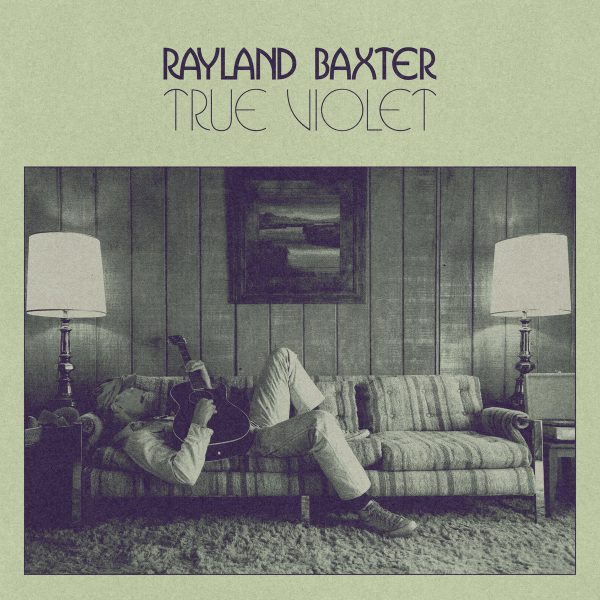
Rayland Baxter True Violet
True Violet is a good record. Easy, you could say. Or, vibe-y. How its pulse never wavers. Even as it is passed between a crew of phenomenal musicians. On top of it all, there is Rayland Baxter. His voice, sometimes crystalline. Sometimes, it is over-driven with longing.
One of those things about Rayland Baxter’s output—and True Violet is no different—is how it asks listeners to settle in and stare.
This metaphor, you might have noticed, is mixed. Listeners can’t stare insofar as they are listening. Except on True Violet, sound and color are entangled. Static, snow and SMPTE color bars are all of the same essence.
True violet is an independent color found between 670 and 790 terahertz, long past the point where human hearing fails. For Baxter, violet represents the intersection where “the reds of anger and the blues of anger” meet. But true violet is something rarer. Under the mixture of pigments and perceptions, there is something real.
What became True Violet emerged in the work of uncovering those colors and these hues. There was at first a record derailed by Baxter calls, “mediocre attempts,” and a call from his sister to write about feelings he’d been avoiding. In a season of solitary production, alone with a guitar and the TV playing in the background, Baxter tried to let the songs come when they would, and go when they wouldn’t.
It’s a fragile thing, how the spirit of a song hits you, and hard to return to.
But this is my experience with True Violet. In its steady pulsing, these things appear at the moment where you stop looking, or listening as it were. Like that breath in “Haymaker” after Baxter sings about getting knocked out and before the amplifiers squeal again.
There is no going back to Hwy-78 just north of Tarrant City, where I heard the guitars, slide or otherwise, after Baxter’s little bark in “What a Day My Friend” for the first time lifted up like the smoke from the stacks or steam from Fivemile Creek.
The assurance with which Baxter sings on the crest of this fragile wave about changing and its glories and sufferings is what it’s all about. All there is are waves of sound and of light. And what makes art special are these occasions where meaning can be made from it.
True Violet rewards the open listener, who can sit with Baxter’s patient and evolving songs that turn toward blue (as in “Never Do”) or turn toward mango and watermelon red (as in “The Fool”).
This review is late in coming. True Violet has been out for a couple weeks. And if you haven’t sat down with it yet, then stop what you’re doing and listen to it all. If nothing else for the track hidden at the end of “Oh My Love” which captures the room, maybe, where all these things occur. How the waves–those visible ones but mostly those that are out of sight–bouncie off the walls and gather in the corners and build and build and build.
–
You can find your copy of True Violet here.
Enjoy our previous coverage here: REVIEW: Rayland Baxter “If I Were a Butterfly”
True Violet was produced and mixed by Paul Butler and Nick Waterhouse @ P.A.N., and mastered by Reuben Cohen at Lurssen Mastering.
All songs were written by Rayland Baxter, except “Up and Down a Mountain,” which was written by Baxter with Barney Cortez, Todd Bolden, and Kyle Davis, “Better Man” and “Bad Love” and Betterwritten by Baxter with Tyler Ballgame, “Oh My Love” written by Baxter with Kevin Rhodes.
With performances by Rayland Baxter, Paul Butler, Nick Waterhouse (each with more instruments than can reasonably be accounted for), Barney Cortez (Guitars, Mandolin), Jay Bellerose (Drums), Jennifer Condos (Bass), and Zac Rae (Piano), Brian Lang (Bass[es]), Aaron Embry (Keys and Theremin), Harrison Whitford (Slide Electric Guitar), Ben LeCourt (Drums). Across this record and in the background are the voices of Tyler Ballgame, Carol Hatchett, Roberta Freeman, Lex Noblitt, Paul Butler, and Nick Watershouse.