



Like the similarly styled Cliff Richard, Liverpool, England native Billy Fury was mostly just a home-country phenomenon. The singer, who died in 1983, played no part in the British Invasion and never placed a song on Billboard’s Hot 100 chart.
In the UK, the story was different. Though not as big a star as Richard, Fury scored 27 Top 40 singles between 1959 and 1966, including 11 that made England’s Top 10. He also released several bestselling LPs and EPs.
As with Richard, the failure to break through in the States is harder to understand than the UK success. Fury, who succumbed to a heart attack at only 42, was a strong singer, capable of tender ballads, catchy, midtempo orchestrated pop, and raucous rockers. Moreover, he featured excellent material, some of which he wrote himself. Many of his other songs came from first-rate composers such as the teams of Doc Pomus and Mort Shuman, Phil Medley and Bert Berns, and Neil Sedaka and Howard Greenfield.
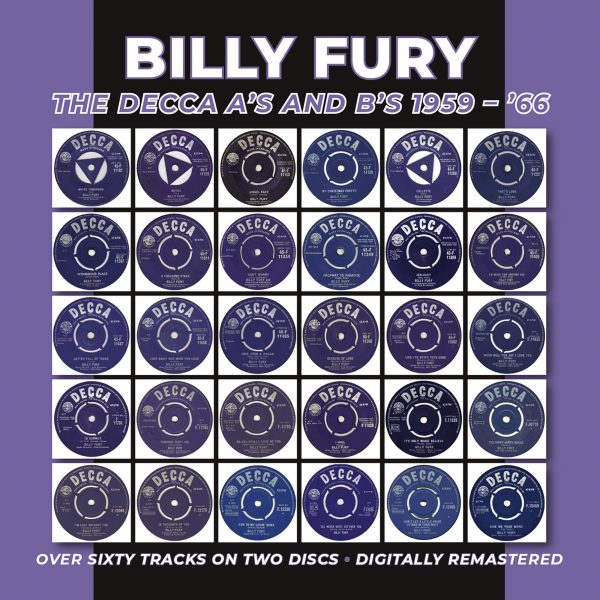
You can catch up with Fury’s catalog via a new two-CD set called The Decca A’s and B’s 1959–66, which, as the title suggests, collects both sides of every single he released for the label. This compendium of 62 remastered tracks, which comes with a booklet containing an essay about Fury, features all his big hits, including the self-penned “Colette”; “Halfway to Paradise” and “I’d Never Find Another You,” both by Gerry Goffin and Carole King; and “It’s Only Make Believe,” which topped charts for co-writer Conway Twitty in its original version.
Many of the B-sides are as likable as the As. Among them are covers of “Glad All Over,” “A Thousand Stars,” and “The Hippy Hippy Shake,” which produced hits for Dave Clark Five, Kathy Young, and the Swinging Blue Jeans, respectively; the self-penned “My Christmas Prayer” and “Last Kiss”; and the rocking “All I Wanna Do Is Cry.”
There is an occasional stumble, such as the inane “In Summer” (which reached No. 5 on UK charts despite its vapidity). However, the lion’s share of this collection suggests that Fury deserves to be ranked alongside better-known contemporaneous vocalists like Bobby Vee, Gene Pitney, and Bobby Darin.
Also Noteworthy

Domenic Cicala, Duet Again. Domenic Cicala collaborated with a variety of underappreciated female singers to cover country and folk favorites on 2021’s Come on Over: The Honky Tonk Duets. On this sequel, he harmonizes with two of those same vocalists as well as several other talented but relatively little-known singers. Drawing on consistently top-notch material from more disparate genres and eras than he did on Come on Over, he delivers a sparkling set that’s even more satisfying than its excellent predecessor.
Cicala, who hails from the Washington, D.C., area, duets with Austin, Texas’s Charlie Faye and her group on two numbers, including Bruce Springsteen’s “You Mean So Much to Me Baby.” Faye, who sounds a lot like Ronnie Spector, was a particularly inspired choice for this song, which Spector has also recorded.
Other highlights of Cicala’s set include Chris Issak’s exquisite “Breaking Apart,” with Canada’s Lynne Hanson, Brook Benton’s “A Rockin’ Good Way,” with R&B singer Nelly Luv, Willie DeVille’s “You’ll Never Know,” with vocalist and actress Patricia Vonne, and “The Dark End of the Street,” the Dan Penn/Chips Moman-penned classic, with West Virginia native Michelle Hannan.
The nine-track album’s only notable weakness is that it’s over too soon. A press release says Cicala has “a deep love for the three-minute song,” which is fine, but he also seems to be enamored of the 30-minute album. Let’s hope he delivers more of his fine music on his next CD.

Harry Tuft, Friends, Lovers & Other Strangers. Singer and guitarist Harry Tuft, who founded the Denver Folklore Center in 1962, filled this album with some of the songs that have meant the most to him over his long career. The acoustic set, which exudes his affection for the material, benefits from Tuft’s emotive vocals and backup from more than a dozen musicians.
The best track might be his strings-laden cover of Bob Dylan’s “Boots of Spanish Leather,” which Tuft opted to present as a duet with Colorado’s Carla Sciaky, since the lyric is a dialogue between the singer and his faraway partner. Also first-rate is a rendition of Jesse Fuller’s “San Francisco Bay Blues,” which the singer transforms into brass- and clarinet-spiced Dixieland jazz with the help of Denver’s Queen City Jazz Band. And don’t miss his moody take on Buffy Sainte-Marie’s “Piney Wood Hills” and his exquisite reading of Paul Simon’s profound “American Tune.”
Tuft turned 90 last December. As this album demonstrates, it’s never too late to create something great.
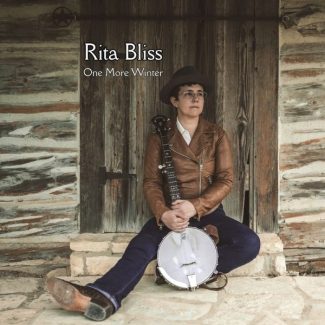
Rita Bliss, One More Winter. Though Rita Bliss plays harmonica and several accompanists sparingly add guitar, bass, fiddle, mandolin, and drums, her vocals and Appalachian-style banjo predominate on this likable second album. Bliss’s ballads and up-tempo numbers are melodic and catchy, and her unaffected singing exudes sincerity.
Her lyrics, many of which seem autobiographical, are charming and memorable. Standouts on this 10-song set include “Come Along,” an upbeat tribute to her home state of Texas, “All My Days,” a sweet, smile-inducing song about a lifelong love affair, and “The Highway,” which focuses on the compromises such relationships require.
Another highlight is the melancholy “Empty Houses,” where the singer remembers a former home. Sings Bliss: “I think of that old house as empty, I think about the walls we painted blue / I think about the days when time just got away, and all the things I said I’d do.”

Ventilator, Reseda Spleen. When Chicago’s Delmore Recording Society released this album 30 years ago, it attracted virtually no attention from critics or consumers. Now it’s getting a well-deserved second chance via the Bar/None label.
The record, available digitally (with bonus tracks) and on vinyl, contains elements of power pop and psychedelia. That’s not surprising given that Ventilator prime mover Matt Devine spent almost four years in Permanent Green Light alongside Michael Quercio, who also led Three O’clock, the Paisley Underground outfit. Reseda Spleen will likely remind you a bit of those acts, but Big Star might be an even better reference point.
Though consistently accessible, the material is adventurous and full of quirky twists and turns. It’s also much more richly textured and complex than you’d expect, given that Devine and his band mostly created it in a bedroom of his home with a Tascam tape recorder. Studios have their plusses, but inspiration comes from somewhere else.
Jeff Burger’s website, byjeffburger.com, contains more than four decades’ worth of music reviews and commentary. His books include Dylan on Dylan: Interviews and Encounters, Lennon on Lennon: Conversations with John Lennon, Leonard Cohen on Leonard Cohen: Interviews and Encounters, and Springsteen on Springsteen: Interviews, Speeches, and Encounters.