



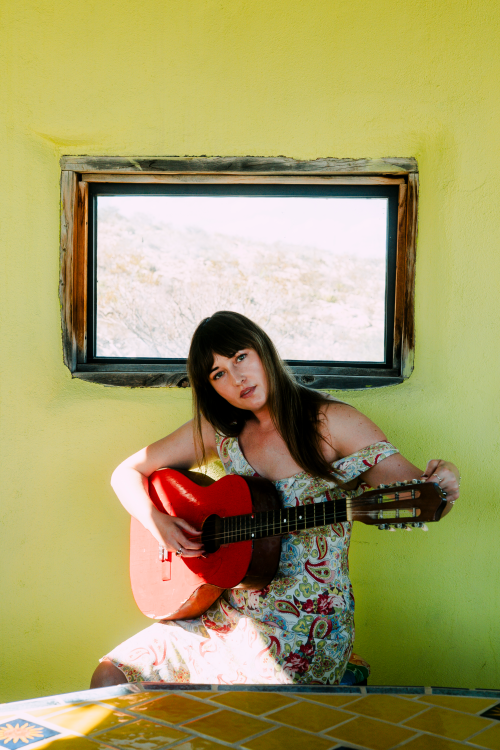
Jess Williamson: Raised on Dolly, Bound for Elsewhere
By Brian D’Ambrosio
Jess Williamson was four or five years old, riding in the backseat while her mother drove and her grandmother sat up front. A song came over the radio. The two women began talking about how much they loved the singer.
“Who is that?” Williamson asked.
“That’s Dolly Parton,” her mother told her.
Williamson liked what she heard. She liked it enough to announce her intentions right there in the car. “I remember saying to them in the backseat of the car, well, I’m going to be a singer like Dolly Parton.”
She has spent much of her life finding out what that means. Texas-born and now dividing her time between Los Angeles and Marfa, Williamson has fashioned a body of work that draws on country music without being confined by it. Her new album, A Mile South of Heaven, due October 9 on New West Records, brings her songwriting into closer contact with traditional country sounds, particularly pedal steel, while preserving the searching quality that has distinguished her earlier records.
Produced by Shooter Jennings at Sunset Sound Studio 3 in Los Angeles, the album also reflects the distance between the places Williamson calls home. She wrote many of its songs in Marfa, then recorded them in California. The two locations offer different kinds of inspiration, and neither has entirely won her over.
“Texas is like a hard place to ever fully leave,” she says. “It’s such an identity, even though obviously it has its problems. I’ve never been able to successfully leave Texas really.”
She has lived in Marfa for a little over five years, drawn to the landscape and the life she has built there. Los Angeles has its own hold on her.
“Marfa definitely feels more like home,” she says. “But LA still has the romance and the sparkly kind of you never know what could happen. And, like, there’s this magic to LA that I’ve always loved.”
Williamson grew up near Dallas in a house where music was always playing. Her mother loved Jimmy Buffett and Bonnie Raitt, as well as the Judds, Garth Brooks and KT Oslin. Her father was a Neil Young fan. The family went to concerts, and Williamson’s first was Buffett, when she was in first or second grade.
Her mother danced and sang along. Williamson and a school friend fell asleep in their seats.
“I was raised on Jimmy Buffett, for sure,” she says.
The appreciation took a circuitous route. As she grew older, Williamson began to regard some of the music she had grown up with as uncool. Around 2019 or 2020, she returned to Buffett’s earlier records and heard them differently.
“I had this attitude that, you know, was ridiculous,” she says. “I was just being a hater.”
She came to appreciate his songwriting and felt grateful for the concerts her mother had taken her to.
She was especially eager to see him again, this time with a better understanding of his music. Her mother had tickets for a 2020 concert, but the show was postponed and never rescheduled. Buffett died in 2023 while Williamson was on tour.
“I was so devastated because I felt like I didn’t get a chance to go see him again, like with my mom, now that I had taken off my pretentious cap and had come to appreciate his artistry again,” she says.
“Jimmy Buffett was honestly a huge influence, like whether I realized it or not.”
Williamson’s route into making music professionally began with a banjo. While attending the University of Texas at Austin, she saw musician Ralph White perform in a friend’s basement. Guitar had frustrated her, but White’s playing made her want to try something different. She found lessons with Eddie Collins at South Austin Music and began writing songs on the instrument.
After graduating, she moved to New York for graduate school in photography. Her first band followed, as did her first show, at the Brooklyn venue Death by Audio. Eventually, she recognized that photography was not what she wanted to pursue.
“I just realized how much more I liked playing music,” she says. “I was just like, you know what, this is all I really want to do. And I need to just go for it and see what happens.”
She withdrew from graduate school and returned to Texas.
That willingness to follow a song wherever it leads informs A Mile South of Heaven. Some compositions arrive almost whole; others remain unfinished for years. “Goodbye to All That,” which opens the album, came quickly. “Someone Else’s Horses” began during the making of her previous record, Time Ain’t Accidental, but did not feel ready to record until Williamson had spent more time with it.
“Sometimes with writing songs, it really feels like kind of channeling something from somewhere else,” she says, “and you’re just catching it before it goes away.”
The new record also allowed her to work in a way she particularly values. At Sunset Sound, she and Jennings favored actual instruments played by musicians together in a room. When an organ sound was needed, the studio staff arranged for a vintage instrument to be brought in.
“Everything you hear is like a real person playing a real instrument in a room together,” Williamson says. “When I listen to this album, I really hear that. It really feels like a tactile kind of human record.”
Williamson brought her songs to Nashville in September for AMERICANAFEST, held September 15–19, 2026, where she was among the festival’s showcasing artists. She also attended the Americana Honors & Awards at the Ryman Auditorium. The evening included a posthumous Lifetime Achievement Award for Parton, accepted through a prerecorded video message made before her death in August 2026.
“I loved it. I kept crying,” Williamson says. “The Dolly Parton moment was, like, that was so powerful.”
For a musician who had once declared her ambitions from the backseat of a car, the occasion carried a personal resonance. But Williamson is no longer simply following the example of a childhood hero. Her songs bear the marks of Texas, California, country music, indie rock and the years spent deciding which parts of herself belong in the work. She has developed a sound of her own, and A Mile South of Heaven gives it room to stretch.
Now she is ready to let the record go. After months or years spent writing, revising and recording, the songs become something beyond the songwriter’s control.
“I’m really proud of this collection of songs and the world that’s in there,” Williamson says. “It’s kind of like yours for a long time and no one else’s. And then once you release it, it’s kind of like surrendering and letting it find its way in the world.”
photo by Jackie Lee Younglow