



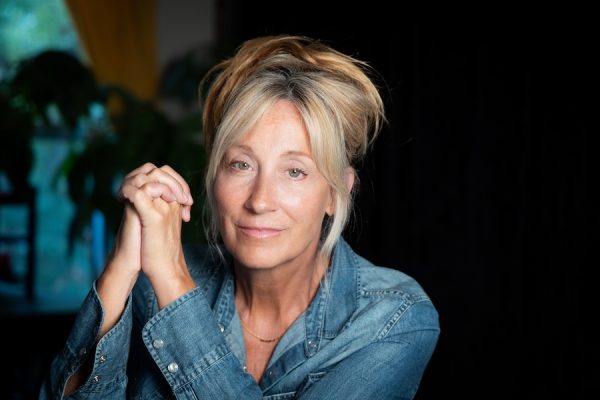
Amy Speace photo by Stacie Huckeba
Amy Speace on Weaving Together Poetry and Music For ‘The Cardinals’ And “Days Of Letting Go”
Singer/songwriter and poet Amy Speace is releasing a collection of poems called The Cardinals on September 1st, 2026, along with an accompanying single, “Days of Letting Go,” out September 4th, 2026. Both will be featured on her poetry + music tour which begins on August 27th in Columbus, OH and continues into 2027. The single that Speace has chosen to release along with the arrival of the poetry book and tour has close ties to her work as a poet, since it began as a written piece created during her MFA thesis.
Interestingly, the track “Days of Letting Go” also has a close relationship with Speace’s latest album, 2024’s The American Dream, since it, too, was recorded at Skinny Elephant Studio in East Nashville, and produced by Neilson Hubbard in the same sessions as the album. Its release acts as a kind of living bridge between her poetry, musical releases, and her live performances. I spoke with Amy Speace about the new song’s inspiration and release, how she experiences songs differently with the passage of time, and how music even creeps into her new poetry collection through meaningful shared experiences in her family.
Americana Highways: I’m interested to hear about the intersection of poetry and songwriting in your life, and also about your live shows coming up where you will combine the two. When I listen to your new track, “Days of Letting Go,” I hear that some of the lyrics are more spoken and some are more sung, which puts me in mind of your dual worlds.
Amy Speace: The funny thing about that song is that it was a poem. I wrote it in my MFA program at Spalding, Kentucky, working with Maggie Smith, who was my poetry mentor. The song was called “The Bluegrass Highway.” And it was called that because when I would drive up north, to Louisville from Nashville, to go to school, one day I took the back roads. I saw one of those big black signs, with big white writing, of the kind that says, “Find Jesus before you die!” But this one said, “Opioids kill, Jesus Saves.” I thought, “Whoa!” I wrote it as a poem, but I put it in song form, with a chorus. I thought of it in the tradition of ballad poetry. Maggie loved it, and it was going to go in the thesis. One night, I was strumming my guitar, and found music for it.
So I played it for my songwriter friend, Vance Gilbert. He’s an amazing songwriter, one of my besties. I was sitting at a festival with Vance, and I played it for him. He didn’t know anything about it, but said, “What if you just spoke the verses?” I said, “Dude, this was a poem, really!” I spoke the verses, and sang the chorus, and he was crying, so that was that.
AH: I’ve spoken with Vance before, he’s lovely. He teaches, as well, so he’s got that in common with you, too.
AS: Yes, we both teach performance at all these songwriter camps. He was my teacher, that’s how I met him! So that song came from a poem, and became a poem song. Then I recorded it in 2023, for my record The American Dream. I thought it would fit, stylistically, but the record was running long, so it got cut. But then when I was promoting this poetry, I thought, “There, I have to bring that song back! It’s the perfect single to weave in.”
AH: It would be very sad if that song was never released. I think it says a lot about you, and your sonic interests, too. It feels very right for this time in the world, too.
AS: I think it feels more relevant, now. Also, it wasn’t about me when I wrote it. I imagined this guy from Kentucky, and it was kind of a persona piece. But I just recorded the video for it, and they asked what things of my father’s I had that I could put in this video. I said, “This isn’t about me and my father.” And they said, “Yes, it is.” Then I realized. I had a box of my dad’s stuff that my mom had just given me, and I wore my dad’s hat in the video.
Sometimes you write something, and you find out that you’ve written it for your future self. Everyone has that, right?
AH: I have had that experience myself, for sure, but I have also had numerous songwriters tell me that. It’s a thing. It’s a bit spooky sometimes how that can happen, but we often don’t know where something creative comes from.
AS: Whenever I talk about this, I have to explain that I’m not a Bible-reading, church-thumping person. I was the angry atheist, feminist all through my 20s and 30s, which means I’m an ex-Catholic, and scarred. But I’ve always been a creator. Since I was six years old, I’ve been writing. So I’ve always been someone, at soul, at base, someone who wants to catalog what I’m seeing, and turn it into something mystical. Like seeing the billboard reading, “Opioids Kill, Jesus Saves,” and then my brain immediately adds, “…says the sign on the highway in black and white.”
I know when I’m in this, and I just pull over to the side of the road and continue. Maybe it’s part skill, since I just know this is what you do if you want to catch an idea. But I also do have a real faith now, so is there some kind of spiritual universe out there? This “She-God” of my universe and life is saying, “This is yours…Stop the car!” So then I say, “okay.” Then the person who has the skills, Amy sitting at the desk later, crafts it, and says, “Which is verse? And which is chorus?” I do believe that we all “drop in.”
AH: You probably have the experience that over time, the songs even change for you in terms of how they feel to you, and the things that you notice about them. Performing something ten years later is a big difference, I’m sure.
AS: I need to write about that. That’s exactly true. I have this song “Haven’t Learned a Thing” which came out on my 2009 record, The Killer In Me, which I wrote it when I was separated from my first husband, living in a shack outside of Woodstock, New York, trying to figure out if I was going to stay with him or not. Meanwhile, I was having a terrible affair with my drummer, hiding from everything. I remember when I wrote it thinking, “Wow, this is my writer’s voice.” I remember Mary Gauthier, much later, teaching about the “writer’s voice,” and saying, “You know when your in your writer’s voice.” She asked me which song was most in my writer’s voice, and I said, “Haven’t Learned a Thing.”
That song is about my first husband, and that whole feeling of “What comes around, goes around.” That was 2007. Since then, we got divorced, I moved to Nashville, gave up on my craziness, got sober, and wrestled with the past. I’m great friends with my first husband. I meet someone new, Jamie, I fall in love, I have a baby, I have a traumatic meltdown, my brain explodes from trauma, and I have to go away for two months to deal with old trauma and PTSD, while I’m sober, during Covid. When I come back after two months in Tucson at a treatment center, Jamie says, “Nah, I think your trauma is a little too much to handle.” And leaves. Then I’m single, divorced again, in my fifties, with a child. I thought, “But I just worked on all this, and I’m sober! I’m not going through this again!” But I did go through it. And it was two years of the biggest depression and heartbreak that I have ever experienced.
Now, on the other side, Jamie walks his own path, and I love him, he’s my child’s father, we have a great relationship. I had to walk through the acceptance of it. But I had to walk through the dark night of the soul, which has a lot of its own songs. Then, one day I was at a show, and someone requested, “Haven’t Learned a Thing.” I thought, “Man, I haven’t played that in a long time.” Then, I’m playing it, and the lyric goes, “I’ve failed and I have fallen, cried till I was bawlin’, been down so low my face was on the tiles.” The chorus is basically the Icarus story, “And though our wings are made of wax, we try to fly too close to the sun. I guess the only thing I’ve learned is that I haven’t learned a thing.” When I played that song, I thought, “I had to walk through two divorces, have a mental breakdown, have a child, to hear myself talk to myself. To go, ‘It’s okay.’” It’s almost like my former self was saying, “This is the sorrow-wheel of life.” I’ve done enough meditation therapy to know that there is something to the subconscious, to the unconscious brain.
AH: Yes, I personally really think there is. I love that you mention the “writer’s voice” because it seems like that’s when the unconscious speaks the most. I’m really impressed that you can play songs that are so emotional, and then they become more emotional!
AS: I learned some things from when I did acting. I was in my 20s, doing Shakespeare, and I had to do these big, highly emotional scenes. In King Richard III, I was playing a woman whose children have been taken by King Richard, and he has stabbed them. She has this scene where she’s coming at him. So I would sit backstage thinking of my dog, who I had to hold, and put down, since I didn’t have children. Then I could get that emotion up.
It’s a different experience doing music, but it’s kind of the same thing. I am not doing method acting in order to “act” a song, but I am in the middle of a song, and something happens to me. But I have realized that the audience doesn’t want to watch me cry, they want to cry. So when I teach performance, I say this, “You want to get yourself to the point where you can have an honest experience.” So I can sing that song and realize, “Holy shit, I haven’t learned a thing.” The emotion starts to well up. The image I give to my students is, “Have the tears well up in your eyes so that they spill into the audience.” I don’t want to have a break down onstage, so I allow the emotion to come up, and I kind of thank it, and breathe through it.
AH: To change over to the poetry a little more, do these poems in your new book tend to come from your recent life experiences, or from other inspirations?
AS: I write all the time, so I have a trove of poems. But sometimes I am determined that a newer one just has to go in, like “Moon River,” which is about my son. I literally am in the process right now of putting my live show together, and I went through the poetry book, wondering, “What poems have a story I can tell if I read them?” Then I saw “Moon River” and knew I would have to include that and sing the song “Moon River” in the show.
The poem “Moon River” was written after I got out of grad school, and after I got the [poetry] book deal. My editor had the manuscript. Then I said, “I’m going to send you a couple extras, and pull a couple.” It refers to my son being born, by c-section, having him put on my chest, and us being wheeled into a room for an hour by ourselves. I was still on drugs, and I just started, spontaneously, singing “Moon River.” My son’s name is Huckleberry. I got to the part of the song that says, “Huckleberry friend,” and I looked at him, and was crying. Jamie was videotaping the whole thing. I was having one of those “spirit moments.” So I started singing that song to him every night. I still do it. He’s eight. So, this poem is very reportage.
It mentions my son being too young to notice the absence of his father. He’s eight and he’s never asked, “Are you divorced?” He knows we live in this house, and he goes back and forth to that house, but I don’t know what he understands. But when I wrote the poem, I was deep in the absence, in the loneliness, since Jamie and I were married in this house. I think I had started this poem with the absence idea at the end of the poem, so it was a lovely picture that ended that way. But I think my editor suggested I flip some lines, so that the poem is not so pastoral, and there are clearly things missing at the beginning. And “Moon River,” if you really listen to the song, has got this longing for the “other,” this absence.
AH: Yes, it’s a melancholy song in some ways. But I think the song becomes a through-line for the poem. These other things have changed in life, but the song is the continuity in life.
AS: I hadn’t thought of that! That’s the only continuity for him, and for me. That’s beautiful.
AH: It’s great that music is the continuity, and the connection, and an expression of connection. I’m glad that poem made it into the collection.
AS: Me too! Once I wrote it, I knew it was even better than some of the others, and had to go in.
Thanks very much for chatting with us, Amy Speace. Find more information here on her website: https://www.amyspeace.com/
Enjoy some of our previous coverage here: REVIEW: Amy Speace “The Blue Rock Session”