


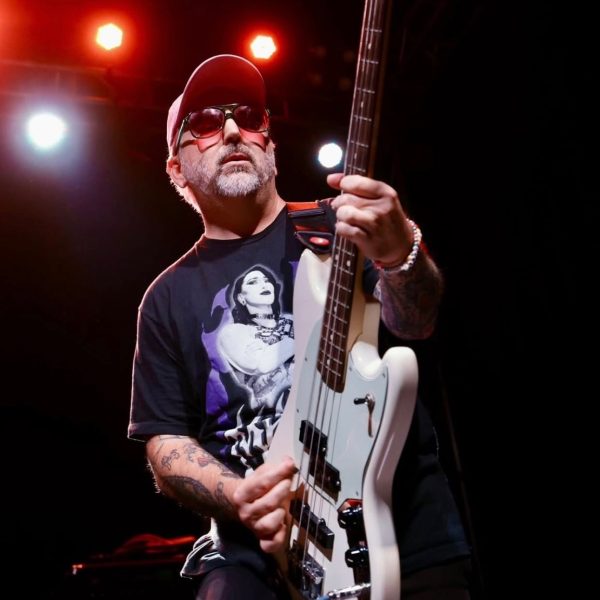
Cory Graves Alive and Thriving (photo by Jason Janik)
Cory Graves has been part of the Dallas music scene for decades. He is most famously known for being a founding member of Vandoliers, oft-times seen swapping belly sweat on stage with bandmate and bow slinger Travis Curry. I recently received a telegram telling me that Cory had left the band and retired an exotic, seaside location in the Dallas/Fort Worth area. American Highways sent me on a mission to track down the trumpeting troubadour on a quest for truth, justice, and the Americana way.
AMERICANA HIGHWAYS: It’s been a wild ride, me and you. We first met in a chat room over at the now defunct Gimme Country. You and Travis had a weekly show. I didn’t know either of you, or what a Vandolier was, but ya’ll were fun on that show, and not just fun and funny but honest. Warts and all (which I always heard was caused by frog pee). This started in the COVID era where you couldn’t really tour and things. Did doing that kinda (see what I did there) direct to audience engagement expand the Vandoliers fan base? Ya’ll were a known entity already, but when the self-titled album came out in 22, that record really popped.
Cory Graves: My whole life I always thought I was an introvert and just generally kind of shy person. When I describe myself this way to friends they always laugh because they say, “Dude, you’re the exact opposite of that.” I guess I am not always the most self-aware. But it was during the 2020 lockdown era where I didn’t really have any real human interaction for months that I admitted to myself I am actually an extrovert, and interacting with people kind of charges my battery.
Starting our radio show, Ameri-Kinda, on the Gimme Country app gave me and my best friend/bandmate Travis Curry a weekly excuse to break lockdown and hangout, and then a second excuse to hop in the chat room and interact with fans.
After the app shut down, we kept the show going as a podcast for five years, and I would say pretty much every gig we played in that time at least one person would come up and say they were a listener. We shared a lot of our really personal lives on there – the good, bad, and ugly. So people really got to know us on a personal level through that and connected with us – many of which later became friends in real life to this day. But, yeah, I’d say the radio show was a major way for us to really connect with fans on a different level, it turned us on to some people that wouldn’t have ever heard of the band otherwise, and it turned some casual fans into some diehards.
AH: Could you talk about the tour that came after, specifically the European tour. I can’t remember if ya’ll were in the US leg when we did the van interview or overseas. But I recall you having some pretty rough experiences – not with fans, but with…accommodations. From an interested outsider’s view with a bit of insider’s insight, it felt to me, and please correct me if I am wrong, a band who had already paid their dues paying them all over again instead of getting their flowers. Would that be fair of me to say?
GC: Unless you’ve got rich or famous parents, or some kind of big breakout radio hit, you’re kind of always paying dues at the level we were at. I toured with Vandoliers for 11 years and it never got super easy. Most of us were fortunate enough to have wives back home that made more money than us that could kind of hold down the fort financially and otherwise. Vans break down, gas and hotel prices go up, there’s managers and agents and other crew to pay, and at the end of the day the business owners (band members) divide up a portion of what’s left. So there’s times when the people working for you are making more of the money than you are. I think being so honest about all these types of things in our podcast episodes really helped endear people to us and rally behind us. Everybody loves an underdog.
AH: So, you left the band I guess last year, this year. I have no interest in turning this into some fucking dramatic expose’. I didn’t even know that you had “retired” until I reached out about this interview. My initial thought was, “who retires in Dallas.” But I read on this AI – you know about AI – and it said that Dallas is a very popular retirement destination. For real though, why did you decide to step away from travelling the world with very limited resources and bad accommodations in a van filled with sweaty and often naked men? Isn’t that the Ameri-Kinda Dream?
CG: Ever since I was about 11 years old the only thing I ever wanted to do was be a quote-unquote rock star. I consider myself among the lucky few that got to grow up and actually live out some version of the childhood dream. I toured year-round with Vandoliers for 11 years, and several years prior to that in bands like Mount Righteous and Whiskey Folk Ramblers.
I saw so many places and met so many people I never could have possible done if not for playing music. Vandoliers played in shows in 44 states and 20-something countries. I got to play The Ryman shirtless. I got to play for a crowd of 7,500 pop punk fans in Wales. I got to meet and play with so many of my heroes. The drummer from my all-time favorite band DMs me memes pretty much every day.
In a nutshell, I am extremely lucky to have far exceeded every expectation and goal I had growing up.
AH: Another thing I discovered about you that I never knew before is that you were a music journalist for a while for a site called Central Track. What led you down that…track? Also, with your editor hat on, am I doing ok in this interview so far or will I quickly be fired?
CG: In my past life, and again now that I’m trying to go straight again, I earned something of a living as a writer. While working for places like the Dallas Observer and Central Track in Dallas I got to review tons of concerts and albums and interview so many musicians – including my all-time favorite, Chris Cornell.
I think being on both sides of the interviewing coin, as both a journalist that was interviewing people and as a musician that was sometimes getting interviewed, proved really helpful to both roles. As a an interviewer it helped me avoid cliché questions and find ways to really put the subjects at ease and open up in ways they didn’t do in a lot of other interviews. As the subject myself, such as now, it helped me find ways to make interviews interesting even when the person wasn’t always asking great questions. Oh, you want to know how we all met for the millionth time? Let me segue that into a story about the time Travis pooped his pants in the van or my take on a story arc from my favorite Real Housewives franchise.
AH: I’ll ignore your subtle dig at my talents and move on to the next topic. I have always wanted to write a song but I can’t play an instrument so I just have a Word document filled with half-formed thoughts and one-liners. Radney Foster once told me that sometimes songs just come to him, fully formed. Two questions here: does Randey Foster have a direct connection with the almighty and what is your songwriting process? I don’t think a lot of people realize that you have that arrow in your quiver (sorry I have been watching Robin Hood: Men in Tights).
GC: The thing about songwriting is kind of magical, and I’m not sure any two people really do it the same. Some songs come to you in a dream fully-formed and some you plug away at for weeks before getting it right. I’m jealous of those folks that seem to write one every day or every week, because I’m more in that camp that feels fortunate if I get one or two good ones in a whole year.
For the two cuts I had on the last Vandoliers record, one was the title track, “Life Behind Bars,” a throwaway idea I tossed out to Joshua Ray Walker many years ago and forgot about. We were in a songwriting session with Jenni Rose and our longtime friend and producer John Pedigo when Josh remembered it and we hammered it out in under an hour. And the cool thing about writing with others is that it took on some new, much better, meanings with each of our different perspectives poured into it.
The other tune, “Thoughts and Prayers,” was initially inspired by the mass shooting at that festival in Vegas, but it also caused me to dig up an almost forgotten memory of a public shooting I experienced at a mall in Texas as a kid. Another verse harkened back to the church I used to go to in college, Wedgwood Baptist in Fort Worth, where one of the first big national church shootings occurred. I was not a member there at the time, but memories of it echoed through their congregation for decades. Getting to see that one through from the idea stage all the way to stepping into the lead vocal role for the very first time — on my 40th birthday, no less – was both cathartic and surreal.
AH: Okay, lightning round:
Name the top three country songs about Dallas.
CG: First, to not answer your question at all, whenever anyone asks me my all-time favorite country song, I always say “Thunderbird Will Do Just Fine,” which isn’t at all about Dallas, but was written by Dallas legends, and our friends, Eleven Hundred Springs. It’s literally THE perfect country and western song.
After that, I will add the caveat that every single country-adjacent band in Dallas, as they’re coming up, cuts their teeth on “Dallas” by the Flatlanders and the traditional tune “Deep Ellum Blues,” so while those two are probably the quote-unquote right answers, I might be just a little worn out on them, as truly incredible as they are.
After that, I figured I’d just keep breaking the rules and give you six, in no particular order. My all-time favorite band Old 97’s with “St. Ignatius” from their perfect debut record.
One of the very first songs I heard my now good buddy Joshua Ray Walker do was about storied Dallas honky-tonk “Bronco Billy’s,” an early version of which appeared on an out-of-print EP that pre-dated his first record.
Then there’s Caitlin Rose’s cover of The Felice Brothers’ “Dallas,” Charlie Daniels’ much copied “Trudy,” Jeannie C. Riley’s “The Backside of Dallas.”
And finally, Willie Nelson’s “Dallas,” which drops so many really specific references to my hometown, like a line about the brand new I-635, which I took to work this morning, and has, apparently been under continuous construction since that song came out in 1968.
AH: Name the top three bands you opened for/opened for you in your time as a Vandolier.
CG: This is another impossible task, I fear. We did get to play many, many times with Old 97’s, though, which as I’ve said three times in this interview is my all-time favorite band, so nothing will ever top that.
A couple that came close were opening the very first Turnpike Troubadours shows after they got back together at the sold-out Cain’s, and again with them at The Ryman, a place we probably would have never gotten to play on our own otherwise.
Getting to sit in on trumpet with Mariachi El Bronx on Cinco De Mayo was another one I’ll never forget.
Lucero and Flogging Molly each took us aside and gave us lessons on how to do bigtime tours like a pro.
And Bowling For Soup, in Europe, put us in front of the biggest crowds we ever played for.
AH: Finally, what are you doing now musically? I know you are doing something. Writing songs? In a local band? Calling my editor so that you can take my job?
CG: Now that I’m back in Dallas full-time, I’m catching up on a decade of lost time with my wife, dogs, friends and family. It’s been wonderful. I’ve been doing some writing as well. Some of the corporate copywriting variety, but I’ve also done a little freelance culture stuff and written a handful of bios for some musicians, which is something I hope to do a little more of in the future.
On the music side, I’ve been playing bass in a local Strokes cover band, which has been hella-fun. Taking my entire livelihood and well-being out of the equation and not making the band my entirely personality has made playing on stage fun again in a way that it hasn’t been in a decade. That is to say, I’m thriving.
Thanks very much for chatting with us, Cory Graves. Find Cory here: https://www.instagram.com/mr_wonton/
Enjoy some of our previous coverage here: REVIEW: Vandoliers “Life Behind Bars”