



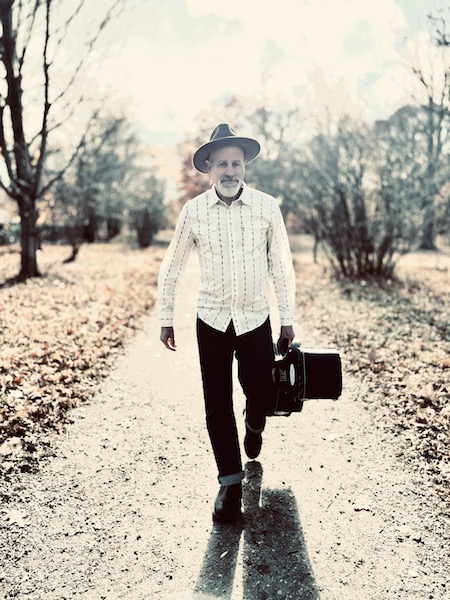
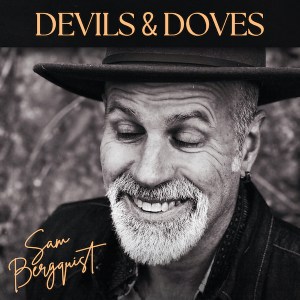
Sam Bergquist Grounded Himself in Nature and The Senses For Devils & Doves
Boston-based singer/songwriter, Sam Bergquist, released his new full-length album, Devils & Doves, this Spring, bringing in a wider sweep of musical interests than we’ve seen from him in the past, and also a broad range of topics drawn from life in his songs. His previous album, Racing Down The Valley, was only released in 2025, but he’s making up for lost time since his career-shift following many years as a teacher while playing in the multi-teacher country blues band Loose Change.
Focusing on his songwriting has led Bergquist to get to know many people in music in the Boston area, but also more widely through Folk Alliance, and this has encouraged his exploration of the variety of sonic directions one can take surrounding a core of solid songwriting. Time spent in nature, and off the grid, has also informed Bergquist’s creativity, helping him craft initial ideas in a focused atmosphere before working on songs in his home studio in the city. I spoke with Sam Berquist about his background in music, the steps he’s taken along the way of a life in music, and the ways in which he uses imagery and sensory details to ground his songwriting on Devils & Doves.
Americana Highways: I understand that you’ve retired from a career in teaching, but you were also in a band called Loose Change. Was there overlap between your time in teaching and your time in the band?
Sam Bergquist: Yes, for about 15 years. That whole time period. It was great. It’s amazing that we held it together as a band, because we all had families, and several of us were teachers, but we stuck to it. We rehearsed once a week and were very good about that.
AH: That’s really impressive, to keep that corner of your life open and operating.
SB: It was a great outlet, honestly, in a busy life with a couple of kids, and all of the responsibilities that you have as an adult. For all of us, it was a great thing.
AH: It seems like being able to interact with other band members on that level was important, too, not just the music, though I’m sure that was therapeutic.
SB: Yes, and that was a big part of it, since we were also playing in the community where a lot of us taught. We played a lot of parties, and bar mitzvas, and things, within that community. We were all teachers, but we were all musicians, too, and we had some great musicians in that group. We weren’t just dabbling. It was three fourth grade teachers, in the same school, who were all men, and all of us were musicians.
One of the guys, Chris O’Rourke, played in the band Sleepyhead, a New York City band. But every Friday, religiously, for many years, we’d ditch all the required instructional time, and get all 65 kids in a room, and we’d just sing Woodie Guthrie songs. It was a big hootenanny, basically. That’s something a lot of kids would remember when they came back to see me. At the end of the year, we’d make a recording of all the kids, and give it to them. All those rituals in music was a key part of teaching for me.
AH: That’s very encouraging to hear, the ways that music can be integrated into daily life. Was the Boston music scene part of your life growing up?
SB: I didn’t grow up in Boston, but I’ve lived here since the late 80s, over 30 years. But initially, when I started playing music, my parents started a very alternative high school up in central New Hampshire, up in the mountains, a mile up a dirt road. There was a ton of music, just people in sitting in a room, playing guitars.
I was exposed to a lot of folk music during that time period, and we had that Sing Out! songbook, with all the classic folk songs in it. So I just naturally picked up the guitar and started strumming some chords. That’s really how I got into music. Back in the day, I’d hitchhike down to Boston and play in the subways, and make a little money. I’d have my little cap and harmonica-holder, like Bob Dylan. And then I worked at a summer camp where there was a lot of music. That’s where I got the bug to play for people. At college, there was also a lot of music. When I moved to Boston in the late 80s, I went down to Fort Apache Studios and made a cassette, and then I went out to summer camp, and sold all these cassettes. Then, Loose Change, was later on after that.
AH: You’re mentioning folk music, but I’m wondering how you got into the country blues aspect, with Loose Change. Did it all seem like similar music, the music of people when they gather together?
SB: It’s the whole idea of bringing people together, and the power of people singing together, is what brought me together initially. But I got into listening to Hank Williams, and older Country music, and a lot of acoustic music. I was drawn to that. But really I was also just interested in writing, and songwriting in particular. I studied literature in college, and I wanted to be a short story writer, which I did for a while. I was also writing songs at that point. I lived in Greece for three months after college, and I got a job in a pub on Crete where I’d play music three times a week.
The country blues thing is partly because the makeup of the band meant that we played a lot of blues in that band. I don’t necessarily think of myself as a blues player, but I can play blues. We played a lot of blues and country music, and some original, but we did a lot of cover songs, too. I think it’s tough to define what I do now. Moreso I see myself nowadays as a songwriter. My emphasis is to write good songs, however they come out. My retirement from teaching was really more of a career-shift, and since then my focus really has been on songwriting. I’ve been involved in the Boston community, and different songwriting groups. I’ve gotten involved in the folk community in New England through Folk Alliance. I’ve gotten to know a lot of people that way also.
There are so many musicians in Boston, and I’ve been focusing on developing that sense of community. It’s a lot of fun, and I’ve also gotten to know a lot of younger people in the songwriting community also. Jackson Emmer has been a mentor to me, and Ray Bonneville, who I’ve gotten to know. I love to pick peoples’ ears about music, songwriting, performance, and how things work. As an educator, I know it’s good to have people who can teach you things.
AH: I notice with this album that your songwriting strategy is often to use multiple images per song, and keep things moving, which I find refreshing. Rather than just focusing in on one image, you have a more mobile feeling, and may use several images that help move the idea along. It feels more relaxed.
SB: Well, I love nature, and being outside, so a lot of what I’m writing about, even if it’s not the central subject of the song, I’m writing a lot about that. I find myself, when I look back at my writing, thinking, “Oh, I’m writing about snow again!” Or, “I’m writing about rain again.” I have a song called “Redwood Tree” that came from an experience where my wife and I were out in Redwood National Park. There was no-one else around, and it almost felt like we were having a conversation with the trees. That’s where that song came from, but a lot of my songs do have an attraction to being outside having sensory experiences.
I also taught poetry and writing to fourth graders for many years, and that was one of my favorite things. We talked about using sensory imagery and trying to bring the listener or reader’s mind in by using sensory imagery.
AH: That’s a good point. You don’t just have images in these songs, you have sensory details. I think that’s great. I love the sound in the forest, and in a really deep forest, the way that sound operates. I think it changes your mental state, too.
SB: Yes, that’s true. And even the lack of sound. I live in a city, so a lot of times when I’m hiking at this cabin that we have, off the grid, in New Hampshire, I love sitting there and just not hearing anything. That experience is something. That song “Redwood Trees” was inspired when I heard a woodpecker way up the tree. I had that image and the sound of the words, “peck peck pecking,” sensory imagery, and went with that. Nature’s a big part of my life. I love to cross-country ski and hike.
AH: Is being in nature directly responsible for the inspiration in your songwriting often, or do you think it’s just beneficial to you in a way that makes creativity more possible in your life?
SB: It definitely is an influence on me. I have written a lot sitting up in our cabin, away from technology. There’s no electricity up there, so I’ve spent a lot of time just sitting in front of the wood stove.
AH: Whoa! That’s awesome.
SB: That’s a big part of it. Staying physically active, and being out in nature is something that I think has been proven scientifically to help with creativity. I think it would be hard for me to write songs if I was just sitting around the house all day. Then, there’s also getting out there, and being around other people. A lot of great experiences come from that.
AH: I was particularly struck by the song “In a Box” and how that could seem different to different people who hear it. How did it come about for you?
SB: I think it was a reaction to what’s going on in the world right now, and people being able to express themselves. I don’t think it’s explicitly about that, so people can interpret it the way that they want to. But that’s sort of where it was coming from: People having the freedom to say what they want to say without feeling like someone is going to come down on them for that. That could be on a very micro level, in one person’s relationship to another person, or it could be our relationship to the government.
AH: Yes, this could even be a situation faced by a kid whose parents don’t let them have their own voice to speak out, or it could be someone whose job makes them feel like they have to put on a persona, or who continues to work in a job that doesn’t really suit their personality. It’s any time you’re feeling like you can’t be yourself.
SB: Right! There’s a lot of imagery in that song. I felt that was the best way to get at that particular topic. It’s not a story song, so it’s more open-ended. I think it’s good to use a lot of imagery for the feeling of someone having a grip on them that they can’t really get out of. The teacher in me refers to the “who, what, when, where, why.”
AH: Yes, exactly. A more short story-like song on this album is “Louisiana Lightning.” It has characters, and a place, and sensory detail like we were talking about. But you don’t reveal all. I think you invite the audience to reconstruct the story.
SB: I was really trying to get at place in that song, too, and how place shapes the way that we think about things. I’ve spent some time in New Orleans, and there’s such a strong sense of place and culture there. In the last verse, I talk about a musician, and the Dixie band isn’t playing anymore. I try to use that as a metaphor for someone who’s “not hearing the music.” Things are not going their way.
AH: Yes, it’s an internal state as well as external state. You got your harmonic on that song! Is that from your old days playing in the subway?
SB: Yes, I got my harmonica on a couple of songs, though it’s understated. I have a little recording studio in my house, where I record all my vocals, and my parts on guitar. Then I have other musicians working remotely. That was a song where I spent a lot of time trying to work the “drip drop drip drop” aspect into the song. That’s part of why I put the harmonica in there. I think in an interview Paul Simon said, “You never want to do the same thing more than twice in a song.” So I’m always trying to add different elements to mix things up.
I feel like the ear likes repetition, and getting familiar with things, but for my own taste, I need to mix things up a little bit. That’s true of that song. I just added the harmonic in there to do something a little different. I’m not a phenomenal harmonica player, but I feel like it’s something that can add some texture, so I’m attracted to that. And then, when I do play solo, I do play harmonica, since it brings something a little different. It adds a mood or emotion.
Thanks very much for chatting with us, Sam Bergquist. More information is available here on his website: https://bergquistmusic.com/
Enjoy our review of the album here: REVIEW: Sam Bergquist “Devils & Doves”