



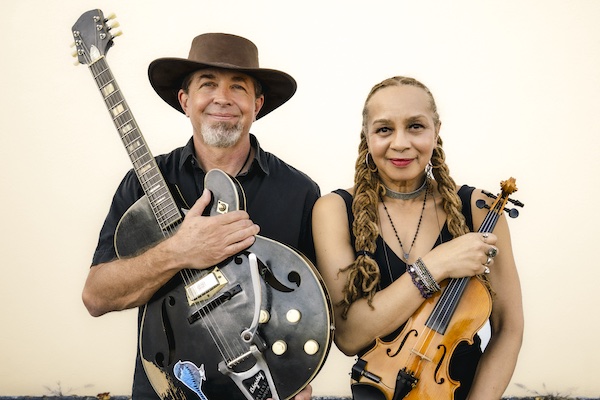
JP Soars and Anne Harris photo by Daniel Boone
JP Soars has a new album set to release on May 29 on 40 Below Records featuring singer/violinist Anne Harris. JP, an International Blues Challenge winner and recipient of the Albert King Guitar Award, has built a style over twenty plus years of playing onstage to hone it. JP grew up in the Ozark mountains in a musical household. His sound emanates from a hill country blues foundation and weaves it with rock & roll, country, Latin rhythms, and gypsy jazz. Anne Harris was classically trained on violin and has been steeped in playing American folk and blues, including notably with Otis Taylor, which combined and evolved into her own approach. Together their style is rich and alluring. The album, Gypsy Blue Revue was recorded live in the studio, a rare thing these days with the ease of online sharing. We had a chance to speak with JP Soars about the album.

Americana Highways: Your new album is named Gypsy Blue Revue. How did you come to name it that, and how did you decide to use the rich traditional imagery of a gypsy revue?
JP Soars: I’ve been tossing that name around for a while. Back in 2004 I had a Gypsy Jazz band dedicated to playing traditional Gypsy Jazz in the style of the Django Reinhardt and the Hot Club of France. We call the band The Gypsy Blue Acoustic Revue. When we started this project the name Gypsy Blue Revue just seemed the perfect fit.
AH: What was the experience like working on your new album? Can you share a funny or interesting anecdote or two about the process?
JP Soars: The experience working on this new album was a lot of fun. We recorded all together basically playing in the same room. No click tracks and very minimal overdubs. We tracked most of the album in rural Cadiz Ohio. It was mixed and mastered in Ft Lauderdale FL. The last track is a long jam on the cigar box guitar called Cigar Box jam. We’ve been playing it live for quite some time and it’s always a fan favorite that we close our shows with.
We decided to record it at the repeated request of fans asking for a recording of it. It’s 18 mins long and has a considerable amount of drum and percussion break downs which really elevates it and makes it that much more special. Our drummer Chris Peet nailed it in the very first take. Thank God. If we would’ve had to start all over again after ten mins or so into the track , it probably would’ve turned into a nightmare trying to capture it. As I mentioned it’s 18mins long and there are no places to punch in the drums and start over. We were ecstatic when Chris got it in the first take.
AH: How much would you say Gypsy Blue Revue connects back with blues history?
JPS: Well the first song in a tribute to the late, great hill country blues guitar player, singer Jessie Mae Hemphill (1923-2006) whom I had the honor of meeting back in 2003. She had a huge impact on my playing and my approach to playing the cigar box guitar. I’m playing slide guitar on that song, utilizing an open tuning and picking method that I learned from Jessie Mae. I don’t necessarily consider this a blues album but that particular song has that element of blues, hill country blues, slide guitar and that feel of the blues directly connected to my encounter and experience with Mrs Jessie Mae Hemphill. Her father was Sid Hemphill (1876 – 1963) An American blues multi-instrumentalist and bandleader who played in his own string band mainly in Mississippi. He recorded for Alan Lomax in 1942 and again in 1959.
AH: How did growing up in Arkansas shape your sense of what’s of primary importance in music?
JPS: I grew up in the Ozark Mountains of rural northwest Arkansas. We had an outhouse, we hearted our home with a wood burning stove, at times we had no running water, no electricity. I’m the oldest of 7. My happiest memories are get togethers my parents would have with their friends. Everyone sitting around playing music and telling stories. Laughing, cutting up and having a great time. Those were happy, peaceful times in the household. So I learned that music was almost an escape, a therapy, a happy, peaceful thing that brought people together. I associate music with that.
AH: Did you grow up in a music loving family, and how much did your family support your musical growth and exploration as a kid?
JPS: I did grow up in a music loving family. My Dad played guitar and he had friends that played. My parents have always been very supportive of my music, my interest in music and my desire to pursue music and become a professional musician. My Dad showed me my first chords on the guitar. My Mom did the artwork on this new record and my Dad helps me build the cigar box guitars that I play and sell.
AH: As a teenager, which musicians helped broaden your interest in music? Were there any significant shows or concerts that blew your mind?
JPS: My Dad first and foremost. My Dad didn’t play professionally but he had friends that did. I would get to jam with them, they would show me things on the guitar. I even got to get sit in with them occasionally when they were playing some clubs in Ft smith Arkansas. I remember going to a party with my Mom. Some of my parents friends were playing. I remember just being mesmerized and in awww. I knew I wanted to do that. I went to my first concert when I was 16. It was Molly Hatchet and Pat Travers at the Harper Stadium in Ft Smith Arkansas. That blew my mind. That was in 1985. What’s really cool is back around 2019 I got to open up for Pat Travers at a small club here in Boca Raton, five mins from my house. It was definitely one of those full circle moments. I got to meet Pat Travers and tell him the story of seeing him at my first concert when I was 16! He was cool.
AH: How did you get Anne Harris to play on the album?
JPS: I’ve known Anne since 2010 after meeting her on the legendary rhythm and blues cruise. We’ve been friends ever since. After that whenever we would cross paths at a festival or something we would always ask Anne to sit with us. Then in 2019 after playing a full set with us at the Big Blues Bender in Las Vegas we decided to start the Gypsy Blue Revue project. We’ve been playing festivals, doing small tours ect since then. Folks always ask for the music on record. Last June we decided to get into the studio, record an album and give the fans what they wanted and to also document what we have been doing musically by capturing it via a recording.
AH: How is her sound a vital part of the album’s vibe?
JPS: Anne is huge part of the sound and dynamic of the band. As you may be aware, Violinist Stephane Grapelli was an integral part of the sound of Django Reinhardt and The Hot Club of France. Anne really gives it that feeling and vibe.
AH: If someone hadn’t heard of your music, which 3 songs would you direct them to listen to, and why?
JPS: First would say the song “Jessie Mae.” It’s got the blues in there and hopefully will connect with strait ahead blues lovers. Second would have to be “Viper.” It’s minor and is very directly influenced by the sound and vibe of Django Reinhardt and the Hot Club of France.
My third choice would have to be the instrumental “Paradise.” Written on the Cavaquinho. A stringed Portuguese instrument about the size of a ukulele. Used for playing traditional Brazilian Samba and Choro music. I think this tune showcases the diversity of the band and the ability to create these different musical vibes and sounds that transport the listener.
AH: What’s on the agenda for you this spring and summer?
JPS: Festivals, tours and spreading our music to as many people as possible.
Thanks very much for chatting with us, JP Soars. More details and tour dates are available here on his website: https://jpsoars.com
Enjoy some of our previous coverage here: REVIEW: J.P. Soars “Brick By Brick”