



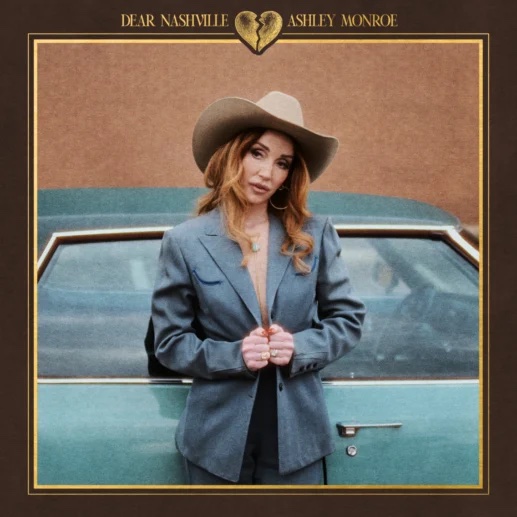
Ashley Monroe Rewrites Nashville as a Fickle Lover on Dear Nashville
On March 25, Ashley Monroe shared a heartfelt letter on Instagram reflecting on the highs and lows of her career and her complicated relationship with Music City. She released a music video for a new song alongside the letter, teasing a surprise: just two days later, she dropped her eight-track concept album Dear Nashville on Mountainrose Sparrow LLC.
Co-produced with Luke Laird and co-written entirely by the pair, the album sharpens a unified emotional perspective. At its core is a single, unvarnished truth: “I wish you loved me like I love you,” Monroe admits. Rather than leave that longing abstract, she builds a sustained metaphor, recasting Nashville as a romantic partner, intimate yet elusive, promising devotion while withholding it.
That relationship began in 2001, when Monroe left Knoxville with her mother after her daddy’s death, pursuing music not just as escape but as reinvention. Her devotion yields tangible rewards, including three Grammy nominations and three country chart-topping co-writes.
At the same time, Monroe deepened her creative identity through four albums with Pistol Annies, alongside Miranda Lambert and Angaleena Presley. Now, on her sixth solo record, Monroe returns to the same dynamic, still pursuing, still negotiating, still questioning what the relationship gives back.
Making it in Nashville has always been a test of endurance. Some artists leave disillusioned, while others accept its reputation as a “ten-year town.” As folk musician Tim Easton has observed, “Maybe it’s a fifteen-year town now,” reflecting how Nashville has changed in relation to its creative community.
Notably, the forces shaping that reality were already in motion before Monroe arrived. After the April 1998 tornadoes in the Mid-South, a surge of insurance claims kicked off rebuilding efforts in underinvested neighborhoods like Five Points. East Nashville transformed into an affordable, creative hub. Mid-level studios and intimate venues supported emerging artists, while media attention recast the city as a destination, fueling migration and rapid redevelopment.
Monroe stepped into this expanding creative community and draws nostalgia from its energy. Yet the city’s popularity has brought constant change. Bungalows have been replaced by three-story, narrow “tall skinnys.” Mid-level studios like Sixteen Ton on Music Row became condos, and other spaces on the Row made way for offices or hotels.
Some landmarks, such as Exit/In and RCA Studio A, narrowly escaped demolition, while others, including Douglas Corner and Bobby’s Idle Hour Tavern, relocated. Spaces where artists could test their devotion in real time, like The Stone Fox, have disappeared, and low-brow venues such as Radio Café and Charlie Bob’s exist only in memory.
The city’s reinvention mirrors the emotional pattern Monroe explores in her album. Nashville offers intimacy, fosters dependence, and then moves on. Artists, like Monroe, are left to question whether the love they pour into the city was ever returned.
In balancing nostalgia with critique, Monroe places her story within Nashville’s broader transformation. The city inspires and elevates, even as it erases the spaces that once sustained it. What emerges is a portrait of devotion shaped by instability, where success and loss are intertwined.
That instability reflects a wider trend in country music. Female artists now face steeper barriers to chart success, as radio consolidation, streaming algorithms, and playlist curation increasingly favor male performers. The contrast with the 1990s is stark, when women commanded 30 to 40 percent of airplay compared with just 15 to 20 percent today. In this context, Monroe’s story is not just personal. It reveals the structural challenges that continue to define who gets heard and who does not.
What else has changed is not just where music happens, but how artists become artists. Dear Nashville traces that change in real time, as a culture grounded in place gives way to something more diffuse. Nashville no longer gathers people so much as routes them. It is less a home than a current, a place artists pass through and plug into along the way.
Monroe’s lyrics bring the city’s emotional contradictions into focus. “I Hate Nashville” captures frustration at the city’s unyielding nature and sets the emotional tone for the album. Pedal steel play provides a deliberate textual echo mirroring the push and pull sentiment of the lyrics where there is wistfulness, nostalgic melancholy, and reflective longing.
Dear Nashville is draped with ambient layers and minimal percussion, where pedal steel sighs beneath a voice that feels both wounded and weary, all wrapped in a hazy Americana glow.
In songs like “I Hate Nashville” and “Quitting,” Nashville is cast as someone artists cannot leave, despite frustration and hardship. “Haunted,” “Steal,” and “In a Web” use imagery of seduction and obsession. “Having It Bad,” “Gettin’ Out of Hand,” and “What Are We” portray desire, intensity, and uncertainty, where romantic intensity mirrors professional ambition.
By turning Nashville into a romantic figure, Monroe clarifies the emotional cost of pursuing a music career in a changing city. The album frames success and loss as intertwined, showing that the city can give inspiration and recognition while simultaneously erasing the places that nurtured it. Artists must constantly navigate uncertainty and loss, much like navigating an uneven romantic relationship.
In the end, Monroe’s metaphor holds. Nashville is not a stable partner but a fleeting one, capable of inspiring devotion while quietly moving on. The question her album leaves behind remains unresolved but unavoidable. Was the love ever meant to be returned?
Dear Nashville is co-produced by Monroe and Luke Laird, recorded by Luke Laird at The Cabin (Nashville, TN) and Mike Stankiewicz at Sound Emporium (Nashville, TN), with assistant engineering by Joanna Finley at Sound Emporium (Nashville, TN). Production coordination by Kelsey Granda. Mixed by Mike Stankiewicz and mastered by Nathan Dantzler at The Hit Lab (Nashville, TN).
Musicians and vocalists on the album are Luke Laird on drums, bass, keys, electric guitar, background vocals and and acoustic guitar; Paul Franklin on steel guitar; Luke Laird and Ashley Monroe on programming; Ashley Monroe on lead vocals and background vocals. Luke Laird and Ashley Monroe co-wrote all songs on the album.
Tour Dates Supporting Stephen Wilson Jr.:
4/17 Fri – Kansas City, MO – The Midland Theatre
4/18 Sat – Denver, CO – Mission Ballroom
4/22 Wed – Omaha, NE – Steelhouse
4/24 Fri – Madison, WI – The Sylvee
4/25 Sat – Chicago, IL – The Salt Shed (indoors)