





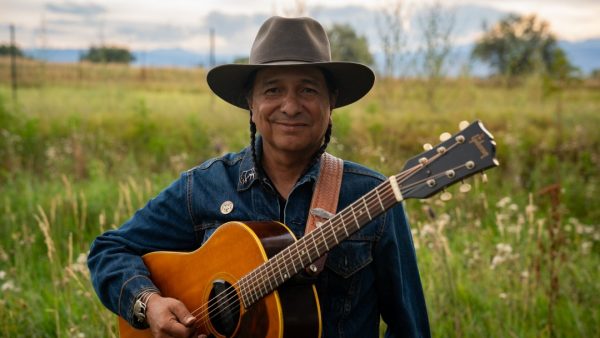
Cary Morin Pocket Of Time Doubles Down on The 70s and Brings Production Home

Indigenous, Colorado-based artist Cary Morin previously released a Western-inspired album, Innocent Allies (2023) and now has followed it with the album Pocket of Time, which draws inspiration both from a sense of the past and from a locale. For the new album, he’s also joined on many of the tracks by his live band, Ghost Dog.
Morin is always inspired by storytelling, and these songs bring out the perspective of Indigenous characters in everyday life, some of those specifically drawn from the Crow Reservation. Sonically, both Innocent Allies and Pocket of Time have been steeped in the sounds and production methods of the 1970s, though the former leaned towards country songs, and the latter towards rock ‘n roll and other genres. A major development in Morin’s life that affected the creation of Pocket of Time was Cary Morin’s decision to take a recording class that would make it more possible for him to begin recording at home with his band. The hard work paid off and not only does the album have a 70s feel, it moves between full-band songs and more introspective pieces that showcase Morin’s well-known, intricate guitar work. I spoke with Cary Morin about the development of these songs, his move to home-recording, and the timeless appeal of 70s music.
Americana Highways: Were these new songs all written in the same period of time, with a plan for an album?
Cary Morin: It was a goal to do an album, it wasn’t so much a plan. There was a TV show that I had been interested in, and I had heard that they were kind of interested in some songs, so I thought that I’d make the songs a little more attractive. I was trying to write in the production style of the time of the setting of the show, which happened to be the 1970s. I just kept writing songs with that show in mind.
We ended up with this body of work, and though they didn’t take any of the songs, they all kind of fit together because of the way that I was thinking at the time. It doesn’t really matter what the show was, or the timeframe was, everything just kind of matches. Innocent Allies was a real concept, and that was pretty deliberate, but this one’s kind of a concept album, almost on accident. I didn’t know that I was going to have a whole pile of songs, enough for an album, but it just kind of worked out that way. It was a nice development.
AH: I feel like a certain amount of intention goes a long way, even if you aren’t thinking about it during every second of working on an album. If there’s a kind of prevailing direction, I feel like it helps things fit together.
CM: Yes! This all happened way back in 2024, when I started writing these songs. We were on the road a lot, and I did a lot of writing when we were out driving, and came home with, if not the songs, the ideas for many of them. So then I had to start thinking about lyrics and melodies. The album came together in pretty good time. We did all the pre-production here. About that time, I decided to take a recording class that was about six months long. The classes were twice a week, and two to three hours long, so it was a lot of time spent. I thought of it as “production school,” and I was one of seven or eight folks. We all had similar goals, and we all had a similar experience-level.
My goals for that were just getting over problems I’d had recording at home for years, my fear of recording drums was the big one! That always freaked me out. I was never really confident in getting my mixes of songs out. I would give them to friends to say, “What do you think of this thing?” But never with the intention of, dear Lord, it being played on the radio or something like that. That class really helped me get over all that. It was really helpful. Then, we thought, “Let’s record this album here. Let’s just do the whole thing, and mix it, and master it.” So we went out and bought a little bit of gear, some microphones, and some snakes, and wires. Then we emptied out half of our living room. It’s still set up like that right now. There are two snakes, which are essentially a big bundle of mic cables, set up on either side of the living room. One has a drum kit hooked up to it, and the other has other stuff. We had bass and some microphones set up.
AH: I’m amazed to hear this, because about half these songs are recorded with your live band, so I’m just picturing that everyone is in your living room, right?
CM: Yes! It was a lot of fun. We rehearse here anyway, so I started recording our rehearsals as practice, so I could do mixes of that. Then, these guys would come over, and I’d present them with songs. I don’t know that they listened to them too intently beforehand. A lot of that happened here, at my house. I’d ask, “Where do you think this needs to go?” And we’d record the rhythm section three or four times, and narrow down the direction of the tune. Then I’d go and decide what to do, whether I was going to play pedal steel, or whether there was going to be electric guitar, or keyboards, or what. I spent a fair amount of time coming up with mixes of those songs.
Another thing that freaked me out was learning to master the songs. So it was a process of making sure that all the songs were essentially the same volume. That was another thing to figure out, but I felt confident, through this whole process, that we could make an album. And we could make another one, now, and it wouldn’t take as much time. I got a lot of the learning process out of the way. So those were a couple of things that happened, making this album, that were memorable, to say the least.
AH: That’s a big milestone, doing everything yourself. It sounds like you built on the experience of recording your rehearsals, since that’s one step away from making a live album.
CM: Right, and then you’re dealing with twenty songs. Then you go back and think, “Look at all this stuff!” Then I’d practice, making songs and mixes. The whole process, really, was something that probably would’ve happened anyway, but taking that class really explained that process to me, sometimes over and over. We’d all sit in on each other’s process during that class, so we could all help each other, and watch each other make mistakes. I’m so glad that I took the time that I took to do that.
When you go to a studio, aside from the expense, depending what it is, you have to go and stay there. We did Dockside Saints in Lousiana, at Muscle Shoals, and we essentially had to drive our RV out there and stay there. And we had to work late into the night every night to crank this album out. Now, we don’t have to do that, it’s a little more relaxed.
AH: I’m sure it changes the atmosphere a lot not to be on the clock as much. You also can’t realize that you’ve left behind the guitar that you actually wanted, or something like that.
CM: There’s a lot of that, right. There’s just the ease of doing it here. I have to be careful that I don’t think there is no clock at all, because things still need to get done. That record that we did in Louisiana also had really experienced, fabulous pros who could come in. When you’re working with a crew like that, who spend a lot of time in the studio, it’s quick, doing a song in a couple of hours. Doing it with my guys here, we could take three or four days with a song. So the time that we could spend polishing, at the end, was really valuable to the whole process.
AH: Plenty of people are choosing to record this way to give more texture and a personal touch to the recordings. Also to record with their live bands sometimes, as you have here.
CM: Recording this way has also enabled me to work on multiple projects at the same time, and to keep them kind of in motion. When Pocket of Time was about to be released, we had actually gone to the West Indies to start another project, so there were about three things going on at the same time, and most of it here at home. Today, I’m working on tracks that we did in the West Indies and on that project. Because we had the home situation, we could work on multiple things, and I couldn’t have predicted that would be the result of a home studio. It’s fun, and interesting, and there’s always something creative going on.
AH: You mentioned the 70s as a focus for ideas for these tracks, and I do think the album sounds reminiscent of the 70s. I noticed some Reggae sounds on the cover of “Best of My Love” for this album.
CM: That was an idea that started decades ago, when I used to play for a band in Fort Collins, and around the Midwest. It was a dance band, and I liked doing Reggae tunes, and I liked doing remakes of classic tunes. That was an idea that I had for that song, specifically, way back when, and we ended up putting it on the album.
AH: I love that it was played a lot and it finally came to a recorded form.
CM: One thing I’ve always enjoyed doing is coming up for an intro to a song that doesn’t sound anything like the original. That song is 35 or 40 years old, so I don’t want to try to recreate what The Eagles did with the original version of that song. You’d always miss the mark. So I always try to go in the opposite direction, and make it as different as possible. But as far as the melody goes, we always try to stick to that.
AH: I think it’s interesting how the songs fit together on this album, and that song really fits because it has the idea of time in it, and talks about time. A lot of the songs fit with that idea.
CM: It also came from the time period that I was dealing with, the 70s, and I was trying to keep the sound and Production 70s-feeling. I spent a lot of time listening to old albums and thinking in those terms. The one thing that you can’t do as much, that was part of the process back then, is tape. Everything went onto tape. I think that creates a feel and sound that was impossible to duplicate. But otherwise I studied it quite a bit during the time of making this album. I take the dogs out every day to the same area, so they can run around, and I would always have my phone with me, and I’d be listening to a play-list from the 70s, just trying to keep in mind through the whole process.
AH: I do feel that way when listening to this album, that it has that up-close 70s texture. The 70s were a big time for singer/songwriter music, as well as rock. You get confessional lyrics and relationship songs. And often one album will cover a lot of ground when it comes to the 70s, with a lot of different sound approaches overall.
CM: We had that intention with this album, and also, with Innocent Allies. When the idea for that album came up, we were listening to old Country Production from the 70s. It’s interesting for us to immerse ourselves into the entire process, both listening and creating. It turns out that we’ve been on that quest for the same goal for the last few years now. Now we’ll see what happens now that we’ve gotten these two albums out of the way, and we’re on to the next thing.
Thanks very much for chatting with us, Cary Morin. More details and information can be found here on his website: https://carymorin.com/home
Key to the Highway: Cary Morin