




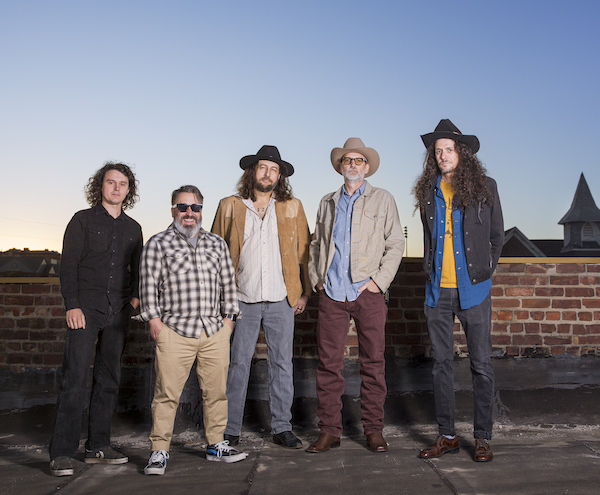
Lightning Stills photo by G. Knee Photography
Craig Fort of Lightning Stills on Bringing The Everyman To Their Debut Album
Lightning Stills recently released their self-titled debut album, having previously released an EP and some singles, building on their roots in the Omaha music scene to incorporate multi-faceted players like Craig Fort (vocals, guitar), Mike Friedman (steel guitar, guitars, keys, vocals), Tom May (guitars), Dan Maxwell (bass), and Matt Baum (drums). On the new album, Oliver Bates Craven also played fiddle, and Javid Thunders played drums. Many of the musicians have been and continue to be in other projects focusing on genres as diverse as Hardcore, Metal, Post-Rock, and more.
Craig Fort was the originator of Lightning Stills, starting back in 2020, and using the new outlet to help him express and reflect on his new sobriety. Fort, who is also the lead of post-rock band Leafblower, gravitated toward this more confessional form, and his first collaborator was multi-instrumentalist Mike Friedman who had been playing country for decades. Together, they’ve built up a debut album that’s at once humorous, direct, and reflective of daily life in a way that many will recognize. Its deadpan directness is supported by inventive and compelling musical chops, making for a winning combination. I spoke with Craig Fort about the origin and development of Lightning Stills, and about how invaluable playing music with friends is for him.
Americana Highways: I see that you’ll be playing an album release show on the 27th, when the album comes out.
Craig Fort: Yes, and that’s also the date that will be six years without drinking, for me.
AH: Wow, congratulations!
CF: Thanks. It’s a special occasion, and I started this project after I quit drinking to help me get through it, so it’s kind of a big deal to have it all on one day.
AH: Is it also the sixth anniversary of the band?
CF: Six years ago, I went to treatment, and while I was in treatment, I started writing the first song. And when I got out, Covid started right away, so my friends and I did stuff, computer to computer, and we sent stuff back and forth. I started to put releases out, and once we were out of Covid, we got together as a band.
AH: I’ve heard about a lot of bands who were challenged by Covid conditions to start working remotely, but it sounds pretty special to form a group during that time and keep it going until you could get together in person.
CF: It worked out great, because I was just getting out of treatment, and I was figuring out how to start over. I was figuring out how to re-live my life in a different way than I’d lived it for the past 20 years, so it was kind of nice that everyone was on lockdown and I couldn’t go out to the bars or anything like that. It forced me to stay in the basement, and work on songs. Then I’d sent it to my buddy Mike, and he’d decorate the cake, and send it back to me. We put out a five song EP and two singles during Covid, all that way.
AH: Had you ever worked remotely on music before?
CF: No, it was a kind of trial by fire thing, learning as I went. I’m a utilization type of guy. If there’s something that comes up that needs a work around, I’m pretty good at figuring it out. Writing during that time was a big release and coping mechanism for me, getting sober. It’s been a journey, and it started out with me as Lightning Stills and the Midtown Ramblers. I was a kind of moonshiner character.
Lightning Stills was a character I’d made up, kind of like the Rhinestone Cowboy. The name “Lightning Stills” comes from moonshine, white lightning, stills. The character I had was a moonshiner trying to get sober, and so I was just basically projecting myself through it. Then, as we went on, and we started projecting more as a band, I couldn’t keep doing it as just a character, because the guys I’m playing with are so good, and so talented, that it’s really a whole band. Lightning Stills a collective.
AH: It’s a pretty big group of people. These days it’s more common to get smaller and smaller groups, but this is a big collection of talent. How does this sound relate to the other types of music that you’ve done? I know that you have a long history as a musician, as do a lot of the band members.
CF: It’s completely different. We’re kind of a rag-tag bunch who have been through the ringer of different styles of music. I have another band that Danny [Maxwell], the bass player, and the main man for Max Trax Records, is in with me, called Leafblower. And we’re more of a heavy, post-rock, psychedelic type band. We just released an album last year. It’s really fun to have a band practice where we shake the house down, and then two days later, have a nice Country session. It keeps it interesting.
Danny has been in indie bands, I’ve been in hardcore and punk bands, all over the board. Most of us now are retired drunks. We were all barstool neighbors at the same place, and we’d play shows there, too. It was kind of a community there, and we’d all show each other our music, and play shows there. It was a fun bar to be at, but I am glad that we’ve decided to step away from the bar and pick up our guitars.
AH: It sounds like you’ve held onto the parts of that experience that were really meaningful to you—your friendships that you made.
CF: Yes, absolutely. You make connections along the way. If you knew the Omaha music scene really well, and looked at the fellows who I have with me, it’s a Bad News Bears type situation. We all come from different places, and it’s a fun mixture that I hand-picked as we were going through Covid. I had these people in mind of who I wanted to play with afterwards.
AH: Do you feel different, as a person, when you stand up and perform this music, then when you stand up and perform heavy music? It is a different persona? Sorry if that’s a strange question.
CF: It’s not a weird question at all! With Leafblower, even, I kind of made a persona of an old guy who hates his job. His name’s Tim. We ran with that for a long time and made tons of videos around that. Looking back, I’ve made masks or personas for each band that I’ve been in, to try to use it as an outlet to get what I’m dealing with off my chest.
It is different with Leafblower. I play very loud, and there’s lots of hootin’ and hollerin’. I have all this noise covering up my mistakes. It’s nice to have that little filter there. Me and Danny go back and forth on vocals in Leaflblower, kind of a call-and-response type of thing.
AH: Is it more vulnerable to perform as Lightning Stills because of the use of humor and personal details?
CF: Oh, yes. With Leafblower, I have the band covering me up, but with Lightning Stills, it’s me up front, playing guitar, which is not my first instrument, really. I don’t really have one! But it’s me playing guitar, so I’m vulnerable on that, then it’s me singing instead of yelling, which is vulnerable. It was a challenge, for me, to put myself out there. Sometimes I still have a little more anxiety with Lightning Stills before a show than with Leafblower, but once I get up there, with that first note, everything’s gone, and it’s the best time. It’s that high you get from playing.
AH: I think it’s really brave to be able to make that transition. It seems like the subjects of the songs in Lightning Stills feel very human. There are these small, real-life issues and ideas. It feels like everyman.
CF: I am an everyman kind of figure, I guess. I’m just living paycheck-to-paycheck, trying to get by. I’ve been working at the same place for 11 years. I’ve got two boys of my own, and two step-children, so we’ve got four kids, four goats, four cats, a big old dog, and a little bit of land. So we’ve got a little funny farm going on here. It’s real nice.
AH: I’ve seen your dog in your music video for “Gas Me Up,” he’s great.
CF: [Laughs] We just got done releasing that Leafblower album, and I needed ideas for music videos. I had to make a bunch for Leafblower, and then a bunch for Lightning Stills. I decided to just get a GoPro adapter, and strap it on my dog, and let him loose. I let him run through the goats. I make all my videos with my phone.
AH: He’s a very good sport. He doesn’t seem to mind the phone on him.
CF: I got a harness for him, and I used a GoPro adapter for my phone. Then I just let him loose, and edited it. He’s a good boy. I like to put him in my videos. He’s in a lot of Leafblower videos as well.
AH: He’s used to life in the music biz.
CF: Oh yeah! He’s got no problem with it.
AH: It sounds like writing these songs is cathartic for you, in the sense that you’re able to talk about things that are on your mind. Do you write a lot and then throw some out, or is this album a good representation of everything you’ve been working on for Lightning Stills?
CF: This has been the best project that I’ve been in as far as me having lyrics come out of me. Before, I didn’t really force them, but I’d have to sit down and want to write. Now, with this band, ever since I started it, the ideas just pour out of my head, and I’m constantly on my phone making notes. I’ve got over one hundred notes on there. With the first couple releases, we just sent things around digitally, but with this new album, the writing style was a little different. I gave the lyrics to Mike [Friedman], and he just went through, and said, “Okay, I’m going to use these ones. He put chords on it, and the song blossomed from that point.
It wasn’t picking a certain collection of songs to go on there, it was saying, “How about these?” And we’ve got plenty more. We already have more recorded, actually, and no shortage of ideas. For me, I just want to keep pumping them out. As you said, I am the everyman type of guy, and with my lyrics, I don’t necessarily try to make it like this, but they come out kind of funny, when really, they are a lot darker than what they let on. The more you sit with them, the more you realize it. And with all those songs, nothing is fictional. It’s all me. It’s all things that I went through.
AH: I felt that way, listening to them. There’s a humor there, which I appreciate, but if you think about things more deeply, it’s a hard picture, it’s heavy in terms of subject. Country music is really good at that, I think, combining those elements.
CF: It’s not something that I expected, but it seems like that. I have the weirdest writing style. I think of a goofy pun for a line, or for a title, and I’ll base the lyrics off of that. I’ll use whatever situation I’m dealing with at the time, and blend it in. That’s kind of how I cope, and use that as a mechanism to get through. I’ve always been someone who hides things with humor. The real stuff is trying to get out, but there’s humor. We’re having a good time as a band, but there are darker undertones. You just have to put your head down, and keep going, and do what you can to have fun.
AH: Music is very good at helping people with that, as I’m sure you agree.
CF: It’s therapy for us, for sure. We talk about it as our poker night. We get together, and we jam, and we all have shit going on in our lives, that we’re dealing with. But for those nights, and the couple of hours we get together, everything just kind of goes away, and you walk out with a big smile on your face. You go to bed feeling real nice, and wake up the next morning and deal with the rest of the stuff. Each time I play with the fellas, doesn’t matter which band it is, just getting together with some longtime friends and playing together, it’s very therapeutic.
Thanks very much for chatting with us, Craig. You can find more details here on the Lightning Stills website: https://lightningstills.bandcamp.com/