



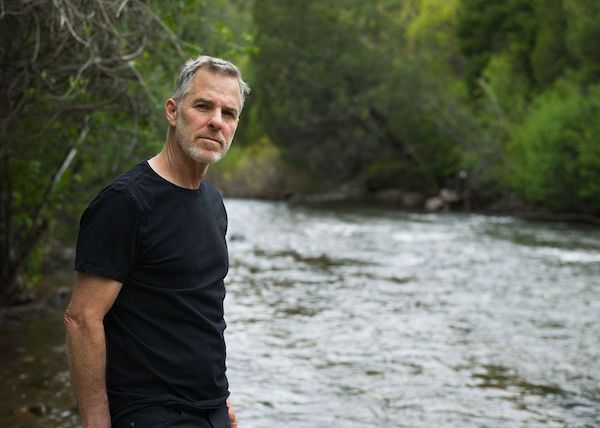
Michael Rudd photo by David Rosenfield
Michael Rudd has a new album releasing this week on Invisible Road Records, Ways of the World. The songs are haunting, in a modern way, while they rest on a timeless foundation at the same time. The style of the album might be considered conscious. Michael had a cancer diagnosis just before starting to write these songs, which, understandably, prompted his reflective mood and songwriting on most of the songs on this album. We had a chance to chat with Michael about the songwriting process, the production choices, and more.

Americana Highways: We’re so happy to have you join us at Americana Highways to talk about your music. You have a new album out called Ways of the World. Did you go into this planning to do an album and writing with that in mind, or did the whole thing come together more organically?
Michael Rudd: Thank you. I think the answer is both. I’m not intentional in what I write. I just follow what I hear, and then, if I’m lucky, there’s a decent song at the end of it. But I’m old-fashioned. I make albums that are meant to be heard like albums, not just a compilation of songs. So, when I’ve decided I’ve written enough songs for the studio, inevitably I’m replacing a few of them in the last few days before starting the first sessions because I’ve written a new song or listened to an older, unrecorded song that would be a better fit for the album. This process also happened with Ways of the World.
AH: What background information can you give us about the album?
MR: The first track, “The Water,” was the only one written before Going to the Mountain, my previous album, but I wasn’t ready to share it with the band or put it on that album. I’m glad I waited. Leaving aside the question of quality, the song is essential for the overall project and belongs exactly where it is now, dead-center of the five albums. As for the other songs, I started writing them in the first few days after sessions for Going to the Mountain when I learned that I had cancer. Some of the songs deal directly with that new reality, while others are somewhere in that orbit. But really, I’ve been writing about mortality off and on well before my diagnosis.
AH: We understand this is part of a series of albums that work together as a larger whole. Can you talk a bit about that?
MR: This also wasn’t intentional, at least not at first. When I looked back at the songs I chose for the three albums and then the two albums to come, I realized that what I was writing was a kind of novel that ends in a natural way with the songs for the fifth album, which will be recorded in March and released early in 2027. The last song of the last album in the project is a direct response to the questions in the first song of the first album – a response rather than an answer, because none of the people I write about, including me, have any answers. The albums change lyrically and musically as the characters – all real of sorts, or close to real, and some composites of people I know or have known – move through life searching for something else: acceptance, love, redemption, transcendence. From another angle, the fifth album closes a period of songwriting that began in the summer of 2023 when songs started coming back to me after not playing or writing for more than 30 years. Songs are still coming, but now they’re meant for another project.
AH: You mention people searching for something, but what other kinds of themes run through the songs?
MR: The same themes that run through all of these albums: how to live and how to love in a chaotic, random world with one eye on the past and another on a turbulent present. I wish I could write carefree, simple love songs, but even when I try, they don’t come out that way. Maybe for the next project.
AH: How did you choose the album title?
MR: It comes from the first words of “The Water”: “The ways of the world are too hard to know / If suffering is the root from which we all grow.” This sums up the mindset of a lot of people I write about through these five albums. This is not to say that the songs – or “The Water” itself – are morbid or depressing. It’s just that everybody is going through something that they’re trying to work through or overcome. People deal with these challenges in all sorts of ways, as do the songs.
AH: Which songs are standout tracks to you and why?
MR: Not sure about standout – that’s up to a listener to decide – but “The Water” ties in the songs of all five albums. I’m a failed prose writer. I wrote many novels and stories that never quite got to where I wanted them to go. “The Water” is an entire life told in six minutes and allowed me to feel things and understand things that I never did when writing 500 pages of nonsense.
AH: Who did you work with in the studio, and what were the sessions like? How was the vibe, and how did the songs come together?
MR: Pat Malone on electric guitar, Mark Clark on drums and percussion, Asher Barreras on bass and cello, Brant Leeper on Hammond organ and piano, and Kelly Khun on backing vocals joined me in the studio. I love working with them. Sessions are always collaborative. I bring in the songs, and they bring out aspects of them that I couldn’t hear myself. I look at recording as part of the creative process. A song isn’t done until it’s sent to the mastering engineer.
AH: How has the creative process in general and your songwriting specifically – both music and lyrics – changed and morphed through the years as you’ve grown as an artist?
MR: When songs started coming to me, I was writing a song every day or two just to get them down on paper and in voicemail, where I record every idea I have. Even though I’d played in a working band decades ago, I had to relearn how to play guitar to account for the years of not playing and try to match or figure out what I was hearing. As I’ve learned, and continue to learn, more music theory, and become more comfortable on the guitar, the music underlying the songs evolves into approaches that are more diverse. It helps to play with gifted musicians who have a deep understanding of what I’m trying to do musically. As for the lyrics, the fifth album, which we’ll record in a couple of weeks, is the wordiest. Not sure why that is. But the same people and the challenges of being alive run through all of these albums, so in that way, nothing has changed at all.
Thanks very much for chatting with us, Michael Rudd. Find the music right here: https://ffm.to/yvadyxe
Enjoy some of our previous coverage here: Song Premiere: Michael Rudd “This Life is Made for Me”