



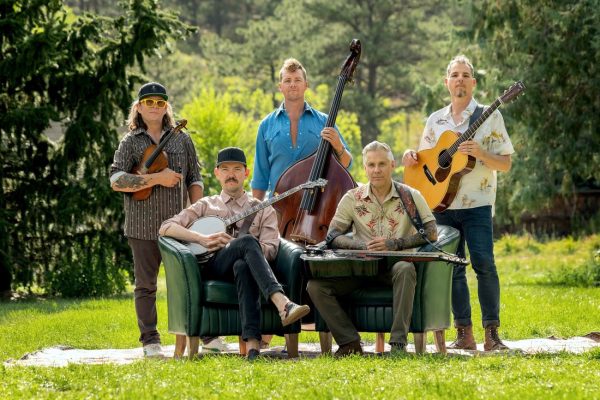
Andy Falco / Infamous Stringdusters photo by Daniel Milchev
Andy Falco of The Infamous Stringdusters on Their Prolific 20/20 Album and 20 Years of Staying Genuine
The Infamous Stringdusters are celebrating 20 years since they banded together, as experienced side-men, to create their own innovative music. Along with that comes a very special album, titled 20/20, which was recently released via their label, Americana Vibes, and a dedicated tour, which is underway now. Bluegrass brought them together and is their binding agent, but banjoist Chris Pandolfi (banjo). Travis Book (bass), Jeremy Garrett (fiddle), Andy Hall (dobro), and Andy Falco (guitar) draw in widespread influences from Americana, country, indie folk, and beyond. As a statement piece, 20/20 shows their dedication to songcraft and diverse approaches, creating a fresh declaration of their identity.
Part of that identity is also a genuineness in their thematic approach to songs and albums, and you’ll find that the tracks on 20/20 connect deeply with the ideas of struggle and resilience, economic challenges, and mortality. Each song feels carefully chosen to bring a different idea and a different musical attitude to light, a combination that reflects another facet of The Infamous Stringdusters. I spoke with guitarist Andy Falco about what makes 20/20 a different kind of album for the band and why they feel so confident about the statement it makes.
Americana Highways: You have a tour coming up, and you travel so much for gigs, do you have any strategies for how to survive that time or even use it productively?
Andy Falco: I take advantage of that time to do certain things which I don’t often have time to do at home. I do side-project shows, and if they are coming up, I have to come up with setlists to send it to the musicians, so I use that time where I can just kind of sit and go through things, and figure things out. I write some e-mails, or catch up with some friends I’ve been meaning to catch up with. When I’m home, it’s really hectic, because we have two kids, and I’m away a lot. When I’m home, I really do try to maximize the time and put my energy towards the family. If I can use that time, which is almost like free time, when you’re sitting in an airport, it opens up more space for when I’m home to be doing stuff with my family.
AH: That makes a lot of sense. It’s time you kind of take back when otherwise it would be dead air.
AF: Yes, and we have this tour coming up, for this new album, and it’s twenty songs that are entering the repertoire, some of which we haven’t played since we were in the studio. Sometimes I can use that time traveling to get a refresher, and listen to the stuff. I do a lot of practicing that way, too. I know it sounds weird, but you can practice without your instrument in your hand, sometimes. Sometimes it’s by visualizing playing certain things, as you’re listening to music. To me, that’s a very valuable part of practicing, listening to the music and visualizing what I’d be playing. It’s almost like a meditation, but when you do get the instrument in your hand, you’ve thought about what it’s going to be. It’s help for me to use that meditative practice to learn songs and refresh songs. That’s all stuff that I can do in an airport or on a plane.
AH: That’s amazing. Thank you so much for sharing that. It reminds me of how musicians, in the old days, would have to learn records simply by listening to them over and over, without tablature or anything to go by. You can sort of mentally teach yourself and figure out how to play things in your mind.
AF: Absolutely. And when I grew up playing, that’s how you learned stuff, off the records. You didn’t have Youtube, and a million tutorials to pull up. I think that’s great that those exist now, and makes things easier for folks, but when I was young, you did a lot of rewinding on a tape. Sometimes you could slow things down on a tape, or on a record player, you could move the needle back over and over again. It’s that meditative practice. Sometimes on really complex stuff, I still need an instrument in my hand. But if it’s Dusters stuff, I know what I’ve played, so it’s more of a reminder to listen to the parts, and visualize actually playing.
AH: This album, obviously, has a lot of songs, and they are quite diverse. Some are more laid back, but some are super-fast and complicated, and I can imagine there’s a lot to master. I don’t think that you go for complexity for its own sake, but I do see that you all push yourself on this album.
AF: When I think about making this record, for a lot of the record, we kind of went back to our roots. On our earlier records, we would have a lot of complex instrumentals. But at some point, we said, “There’s something also to be said for simplicity in songs.” So on some of our records, the music doesn’t need to be that complicated. We gradually got a little bit away from complexity, but I think on this record, we came back and wanted to go a little deeper on some of the heavier arrangements.
But we still had some songs on here that maintained the idea of simplicity. At the end of the day, it was about trying to give the song what it needed. Sometimes serving the song is just keeping it simpler. After doing this for twenty years with each other, I think we’ve gotten good at just getting to the essence of what’s good for the song, in our opinion.
AH: You’ve had many releases in recent years, but it’s been a little while since you’ve had a collection of original songs out. Were there lots of songs waiting for you to use them, or did you write specifically towards this album?
AF: The writing process for this album was something that we’d never done. We’ve done many record cycles where we made a plan, and said, “We’re going to make a record. This is when we’re going to go into the studio.” Then we looked ahead, and talked with our manager, and booking agent, based on that. They knew we’d have it in hand by a certain time, so the release would be on a certain date, and the tour would be on a certain date. And this was all planned out, before we’d even gotten into the studio.
We’ve done that many, many times. But this time, we thought, “We’ve made a lot of records, and it would be nice to not really make a plan for when this album is going to be released. Let’s make a record and see how it goes. Then, when the record’s done, we can make the plans.” This took away that sense of deadline. We didn’t have to think, “I wish we had another tune on this, but there’s a deadline.” This time, we were able to go into the studio, have some sessions, look at the body of work that we had, and then say, “You know? I think we need another fast Bluegrass tune to balance things out.” And then, we’d go home and write it! And then we’d bring it back into the session to see how the band likes it. We could also try this and try that.
Usually, I would only bring songs to the Dusters that I think would work well for them. Sometimes you’re surprised, and the band’s playing it, but it’s not really vibing. Or sometimes you’ve got a song that you don’t think is very good, but the band plays it, and suddenly they love it, and it’s clicking. We had this opportunity. We all brought songs in, as we usually go, and we were compiling. We had somewhere around 50 songs to choose from. They were 50 songs that we played through, and were all contenders for an album.
Then we were able to do sessions, see where things were going, see where the chips started to fall, and which songs were rising to the top. We were able to really fine-tune and focus on the songwriting, and make an album that was not just twenty songs for volume. We had the goal of having twenty songs for twenty years, but they had to be good songs. We weren’t sure that we would have twenty songs unless they were the right ones. Once we saw that there was a light at the end of the tunnel on making the record, we were able to tell our team, and they were able to plan the releases. It was a nice way to make a record, to be able to focus 100% on the creative side of things. We didn’t have an impending release tour, and that was really refreshing.
AH: I’m really glad that you were able to deconstruct that album release format, especially because this is a celebration album, and it was great to do something nice for yourselves, in that way. To make an album in a way that seemed right for you.
AF: We think this is the best album that we’ve ever written. We spent the most time on the writing process this time. We were all really focused on that. At the end of the day, we have to make music that’s important, and genuine to ourselves, first, that we think is good, and the best that we can do. Then we put it out there in the world, and hopefully people think it’s good, but you can’t really chase that. I think if you do that, the music can become very sterile.
AH: First of all, the energy on this album really pops for me, as well as the sincerity, and a lot of the lyric ideas that come up. I was expecting a great album, but I was struck by how energetic and strong it feels. I think you all have gotten to twenty years because you follow your own goals, rather than chasing someone else’s perceptions of who you are.
AF: Right. That’s not being an artist if you do. You have to do your thing. It’s a fool’s errand to do otherwise. If you’re not true to your art, then what the hell are you doing this for? The love of what we’re doing, and the love of doing it together, is what it’s all about.
AH: I think a lot of the ideas that you take on with these songs could also be very helpful for people. You’ve got several songs that are very much about struggle, and finding something positive in that, that are more anthemic. But you also have really honest songs about human experience, like “Working Man Blues,” and you talk about death, like in “Dead Man Walking.” You hit on very serious stuff, which people need to continue to think about and hear about.
AF: We’re all going through this world together. We’re all experiencing a lot of the same things. When you’re thinking about things to write about, as they say, “Write about things you know.” We’re all experiencing a lot of the same things, so when you dive in and try to write about what you’re going through, there are bound to be similarities that people can connect to, and say, “Yeah! Me, too!”
Sometimes I write a song that’s about one thing, to me, but what it means to someone else is completely different. But it’s something that’s speaking to them. I love that, too. Sometimes you write about something that could be applied to various things, and it really speaks to people. I think that’s great. I have songs like that, too, where there’s a Beatles song, and it means one thing to me, but then when I read about it, it means something completely different to Lennon and McCartney. I think people can find their own meaning in songs, too.
AH: Where it comes from in you may not necessarily be where it lands in another person.
AF: Sometimes if lyrics are more psychedelic and abstract, that happens, and sometimes I like to write like that. bluegrass music, country music, and folk music can be very clear, and matter-of-fact, and sometimes you can bring in influences from more psychedelic music, or from rock, that are more abstract. I enjoy going into that space as well.
AH: Do you ever write, personally, in a purely instrumental way, or is there always an idea attached to it?
AF: I think I almost always write the music, the general music, first. It has the idea of a melody. Every now and again, I write a lyric first. A lot of times, if I think of a lyrical idea, like a synopsis of a story or a line, I’ll just kind of jot it down. I do the same with music, if I come across a little lick, I’ll throw it into a voice memo. Then, when I’m sitting down to write, a lot of the time, I’ll go back to those voice memos that I had, and think, “This is kind of cool.” Then, I might go back and start working on it, developing an idea. Then, I might dig into lyrics and see if there’s something that can connect the two things. If something isn’t working, I might scrap it, and go back and look at other lyrics.
AH: It must be really hard, that moment of thinking, “This isn’t working,” and throwing something out.
AF: Yes, it is. Sometimes when I do a co-write, I’m not really starting a song from scratch, but I have an idea. But it’s an idea where I’ve only gotten so far, and I say, “I’m not finding it, but here’s what I’ve got so far. See what you think.” And sometimes, they can see some other avenues, and some other ways into it. They might change this or that, and suddenly, it’s “That’s exactly right! That’s awesome.” I think that’s one way to go about it.
Thanks very much for chatting with us, Andy Falco. Discover more information here on the Infamous Stringdusters website: https://www.thestringdusters.com/
Check out some of our previous coverage here: REVIEW: The Infamous Stringdusters “20/20”