



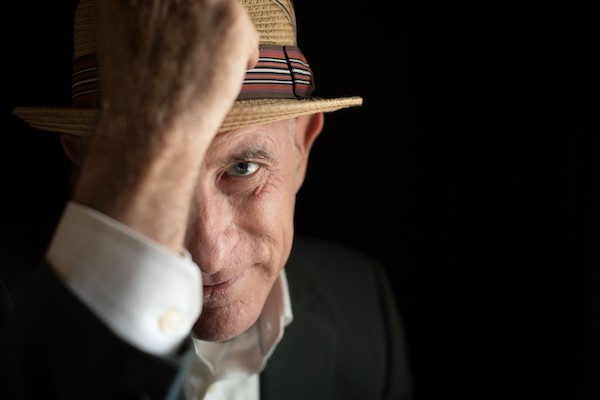
Robert Deeble photo by Michael Wilson
Robert Deeble Crosses Distances For The Space Between Us
On February 6th, 2026, Seattle-based singer/songwriter Robert Deeble will be releasing his seventh record, The Space Between Us, via his own label, Mind Bomb Publishing, in digital format. It’s gone through an intricate release schedule that allowed fans access at every turn, from crowd-funding, to Bandcamp exclusivity, and now, lastly, to digital release, while physical copies also remain available.
The album has its own special story of development, since not only did it span several years, but it represents a step forward in a collaboration between Deeble and longtime colleague Ric Hordinski which began as a focus on string arrangements and ended with Hordinski and Deeble Producing the album at Hordinski’s The Monastery Studio in Cincinnati, Ohio. The geographical distance between them had kept them from working closely together in the past, but experimentations and developments during covid encouraged them to make the leap into a hybrid distance and in-person construction of the record, also working with bassist Viktor Krauss (Allison Krauss, Robert Plant) and drummer Lacey Brown (Damien Jurado.)
I spoke with Robert Deeble about his choice of release schedule for The Space Between Us, the gradual development of the record through collaboration, and about the ways in which experimentation opened up new ground in Deeble’s own writing and recording methods.
Americana Highways: You’ve had a really interesting pattern of release for your album where it’s gone through several stages of availability, and now it is also comes out digitally in February. Since that plan might be interesting to other artists considering their options, can you tell us about it?
Robert Deeble: Well, naturally I wanted to include my most supportive, core fans through a crowdfund. I never really do those things until the record is essentially done because it’s too anxiety provoking. I’m always about 90% done with the record, and we’re waiting to put it into production, so it’s a nice way to be able to engage with people who have stuck by you over the years in such a personal way. At that point, it’s not yet about the product, it’s still about you as an artist, and supporting you, and trusting you that what you put out is something they’ll appreciate. Crowdfunding is very personal. From a small label standpoint, it also gives you a pretty clear indication of what you need to manufacture.
Then, gosh, there are not a lot of platforms out there right now that are honoring of musicians, but Bandcamp is one of them, and I just wanted to make a point to honor them in a very particular way. Because they’ve just been so great from day one, and I hope they stay that way. As far as being able to be sustainable financially, Bandcamp are amazing. When it came to the actual physical product being manufactured, and it came time to distribute the product or the download, we did that all through Bandcamp. We let that be the medium. I think that was honoring to them, but it also keeps fans personally engaged with a platform that isn’t going to go away after the crowdfund is over. We gave that to Bandcamp for two and a half months, and they were thrilled, and gave us an editorial review. We engaged with a lot of new fans from that.
Now, the last stage is digital distribution. I think all this would be different if I was at a different level as an artist. There are some artists who make a sustainable living through digital means, but it’s hard until you reach a particular level. I don’t really see the digital medium as distribution, at least right now. I see it as marketing. It’s almost a form of social media. They’ve reduced the value of the music so badly, that it’s almost like getting a “like.”
AH: That really fits with my observations, though you’re the first artist who’s put it quite like that to me. I think you’re looking down the road and seeing what’s essentially already true, that it’s an “up vote” for likes and exposure. But what I’m hearing from your plan is how it keeps ownership as long as possible, and how it compartmentalizes things, like letting fish through chambers in a fish run until it’s not out until it’s out.
RD: [Laughs] It’s less compressed, too. Some of this comes from the fact that I go back almost 30 years, maybe more. My first record came out in 1994, and in those days it was all physical. I still have memories of paying a full band on tour just from physical sales, and I wasn’t a large artist. You can’t compare that now. There is a snowball effect. I talk to my label friends all the time and they do make a living through streams, it just has to reach a particular level.
To get philosophical, I think that’s, sadly, what has happened pretty much with our entire society, where we have this paradigm where you don’t make it until you’re a billionaire. There are the have-nots and then, the ridiculous. At some point, the system works in your favor, but if you’re just one restaurant owner, you’re so screwed, since you’ve got to have five for it to make sense with your costs. I think that’s true for everything from people renting apartments, to the very lucky people who can afford a home, to bands. It’s just that playing field. You’re no longer valued for what you do.
AH: Of course not, you’re right. It’s this fragmentation where only landslides win. Is the plan for your different stages of release part of why the recording for this album stretched over several years, or is that unrelated?
RD: No, not really, it’s because I’m a pathetically slow songwriter! [Laughs] The only time I’ve ever felt better about it was when I was listening to an interview with Leonard Cohen and he said there are poems that he’d taken ten years to write them.
AH: Oh yes! There’s a whole documentary, I think, about the song “Hallelujah” and it’s just brutal. It’s years, and fifty notebooks, or something. It’s crazy!
RD: It is crazy. He was on KCRW many years ago, playing it, and he was still in the middle of writing it, and he said, “This is about 70%. I was still working on it in the hallway.” And they said, “How long have you been working on it?” He said, “Oh, I don’t know. Ten years.”
But my origin story was always DIY. From the moment I put some little clunky cassettes out after college, then put my best foot forward to put out our first full-length in 1994, the idea of funding the recording, and all of that, was always something that I was determined to do, because I wanted to keep the rights to the recordings. And it did take a long time, because it wasn’t that I was wealthy, or something. We were just constantly working, and every dime that I made went towards studio time. It was a very long time from when we started working on our first album, Days Like These, until the first version of it came out, and then a label stepped in and did a lease to do a second rendition of the same record for distribution.
But there was a band called Over The Rhine, at the time, out of Ohio, and their guitarist was my producer on this current record, Ric Hordinski. They kind of led that kind of ethos of doing everything DIY but very, very well. And I remember being very inspired by their first record in the way they presented it. As you know, many labels will be pretty cheap about things, like the artwork, so it’s great to see people who put their best foot forward and make something unique. That caught my attention early on. I’ve always Produced by own records, for the most part. I’ve been lucky to be able to have my full discography over the years, and still have it available.
AH: Do you usually record one song at a time, or do you wait until you have a few?
RD: Back in the early days, it was one song at a time. But on this record, that four or five year process really came down to was that during my previous record, Beloved, we were recording the title track, and we wanted something really unique for a string score. We had cobbled the string scores together for that album between me and the players. But on the title track, I wanted something a bit more intentional, so I reached out to Ric, and I asked if he would score it for me, and he agreed.
So he did the score for “Beloved,” and I was floored. All of my records have had strings on them, but I’d never been so intentional as I was on that record. From the point that record was done, I started handing Ric songs, one at a time, as I wrote them, or pulled them out of the archives, to create string scores. He’d then score it on paper, send it back, I’d play it out with my string players, we’d make a few notes, and send it back. He’d make some adjustments, and then we’d play it out live a little, until my production brain fully wrapped around the score. Then we’d agree to make some more alterations. Finally we’d have a final score, then I’d start all over with the next song.
So, the album started with string arrangements, and we hadn’t even agreed to record an album at that point. Ric had actually reached out about ten years, when I didn’t know him practically at all. I’d opened up for Over The Rhine a couple of times. He called me and said, “I really want to make a record for you.” I said, “I’m honored, but I can’t figure it out. You’re in Cincinnati, I’m in Seattle. I don’t know how this is going to work. My players are out here.” Then we ended up talking about Brian Wilson for an hour, and it was a great conversation. But it stayed in our heads, and every once in a while we’d reach out. He played on a guitar track. He scored that title track.
Next thing you know, he’s scoring about four or five songs on this new album, and then I called him up and said, “Remember that record you wanted to do? Let’s do it!” But that time, with Covid, we had a little more confidence in doing some things remotely. And then, basically, I’d fly out multiple times for my parts. Plus, I’d gotten a little bit better with my own recording of demos in my own studio, so we had more to work with.
AH: I was interviewing a lot of people during that time period, and I think a lot of people learned pathways of remote collaboration which opened doors for them, and which has stayed with them. The innovation necessary to do anything then opened up remote collaboration for them. I guess there’s that silver lining.
RD: For sure. It was a little silver lining. Plus a lot of us ended up learning how to record songs, or writing tunes during that time. I have a wide range of people who I’ve used on various albums, and Ric kind of has his team who he uses a lot, so it just opened up the palette. We just used a bunch of people from all over the place. There are three different drummers on this record, but they are not session drummers.
These are people who I’ve worked with intimately, or who have worked with Ric intimately. Most of the strings were recorded here. Half of the drums and vocals were done by my dear friend Lacey Brown, who is Damien Jirado’s drummer. She has a huge role on this record. The other half were done by Ric’s main player. There were all kinds of people coming in and out on this record, and it’s another side to the title, The Space Between Us.
AH: I’m amazed to hear that because these songs don’t sound like they come from different sonic universes. Having all this time involved, distances, and so many people, did not create any clashes for the album. That must be because of how carefully you chose people, and how much attention you gave to production.
RD: Yes. I think a lot of that goes back to Ric and my own production sensibilities. We didn’t want it to sound kind of like a hodge-podge, a catch-all record. There were even some places where we had to carefully negotiate that a bit. I think Ric, intuitively and naturally, was able to keep the album sounding as one. I think all the string parts help with that, too, creating a theme. All of these songs were started with drum machine as time-keeping, to hold the skeleton of the song down. I’d goof around with loops, which aren’t my forte.
Towards the end, I asked Ric to keep some of the drum loops in place. Then, drum loops were coming in and out of real drums, and some songs just had drum loops. I remember that he said, “I don’t know about this.” He said, “We don’t want this to sound like a disjointed record.” I said, “No, we don’t, but I think if we stay with this intentionality, it won’t. Why don’t we just use it like a palette, let’s use it like a brush.” And I love how it ended up. Even though you have some tracks that are full drum loops, and some tracks that are full live drums, you don’t have this feeling like, “Did the drummer not show up that day?” [Laughs]
AH: Because of the ways in which organic and electronic elements work together on the album, as a whole, I feel like you can move and in and out on individual songs, and within individual songs. That’s a very difficult terrain to explore for a lot of people, it’s subtle.
RD: Yes, it is. For every record that you might appreciate on the planet, there’s also someone who is the glue. We were struggling with glue for a while, because it was not a record which was recorded with a band in the studio. It started with tracks. They say that was one of the trickiest things on one of Tom Petty’s records. The glue finally ended up being his voice, and that was the rhythm that everyone ended up following. I remember, in the beginning, we were struggling because I had my little drum machine tracks, and I’d have my initial guitar scratch tracks, and a vocal. I’m not the best time-keeper, and we were straying time-wise.
I think what really locked it in was Viktor Krauss. When he stepped into the record, suddenly that was the glue. Viktor is on bass on all of the new tracks on the album, except for one. Once Viktor’s parts were in there, it was the “aha moment.” We thought, “Thank God! This is going to work!” You don’t know if you’re just scaffolding, and things are going to fall down in the end, when you’re building all these tracks.
Thanks very much for chatting with us, Robert Deeble. More information is available here on his website: https://robertdeeble.com/