






Haunted By Human photo by Laura Schneider
Haunted Like Human Take A Look At The Big Picture for American Mythology
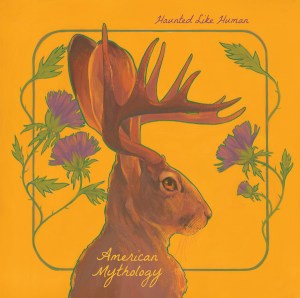
Folk duo Haunted Like Human are releasing their new full-length album on November 21st, 2025, titled American Mythology. The album’s title builds on their storytelling focus and trajectory, and casts a wide thematic net all the way back to Greek mythology, and all the way forward to experiences that are very present in our lives today. Dale Chapman (they/them) and Cody Clark (he/him) build their characters and settings so clearly that the mood-inducing magic of the music makes you feel that you’re witnessing storytelling as focused on American soil as upon our long, shared human history.
What’s also exciting about American Mythology is that with it we begin to see the shared songwriting world that Haunted Like Human’s albums and songs inhabit. There are both musical and lyrical networks of ideas between songs that you can pick up on as their work rolls out to the public. I spoke with both Dale Chapman and Cody Clark about the world their imagination inhabited while crafting American Mythology and why it felt like the right time to take on a more “zoomed out” view of American life in their music.
Americana Highways: This album feels so focused and carefully planned out. Has it been brewing for a long time?
Cody Clark: I think it was a combination of a lot of planning. And while most of the album came together in eight or nine months, there was a lot of thinking about how it all went down. We had the name American Mythology since the time that we recorded Tall Tales.
Dale Chapman: Yes, I think it was from like the end of 2020. I originally came up with the idea American Mythology. I think the thinking behind that goes back to “Ghost Stories,” the first song that Cody and I ever co-wrote together, and that went well enough that it spiraled into us saying, “We should be a band.” We chose the name Haunted Like Human, and obviously “Ghost Stories” had to be the title.
As we found our footing in storytelling being the core of what we do, it was something that we decided to lean into in all of the record names being storytelling traditions. We’ve got Ghost Stories, we’ve got Folklore, Tall Tales & Fables. Coming out of the studio for Tall Tales, we said, “What comes next?” Obviously, we had some time to figure it out.
AH: There’s an escalation, I think, in that use of language. The word “mythology” is more grand, and more massive, in a way. It’s a mountain to scale, for sure.
Dale: I think that got imbued, in a way. It’s not a concept record, but there’s a lot of concept in the record, on purpose. There are little things that we tried to capture. Like “Growing Pains” is like a thesis statement for American Mythology. It’s this idea of the myth of American excellence. The American history that we’re taught is so white-washed, and so sanitized. That’s one direct way of crafting the mythos of America. But then there’s the micro-scale of “Appaloosa” or “Milliner’s Daughter,” where we zoom in and think about, “What is like to fall in love, barefoot in the pines?” Or, “What’s that feeling that’s beautiful and terrifying of the plain stretched out in front of you?”
I joked that through the first three records, we got a bit more “barefoot in the woods,” wandering out and finding a more Americana, folky, rootsy sound. And that we’d been sort of honing in, in a way. But with this, this was more of a zooming out in terms of what we were trying to capture, though Americana is still the vibe. This is about all the things that could be threads weaving American mythology.
AH: It’s amazing to address that question and those ideas in music. I think most Americans will agree that America has this tendency to be looking for itself, for its own identity. I think this kind of album really grapples with that. These are a lot of questions we’re still working on in society, and you’re providing your own answers.
Dale: Thank you. Hearing that what we’ve put into this album has translated the way that we wanted means a lot and is really exciting.
Cody: The fear is always that it’s not going to translate.
AH: Well, don’t worry about that! The songs are all very clear. I think that’s an intentional clarity that you’ve created. A really classic example would be “Eurydice,” where you just use your own voices. You take that mythology, you make it your own, you tell your version of it. You bring it home. How did you decide to do that song just vocally?
Dale: We’ve got some friends who are folk duos and trios, who we’ve seen do little snippets, or start a song a cappella. I said, “I think that’s so cool! We should do that sometime!”
Cody: I think we had talked about the idea of maybe opening a record a capella for a while now. We just hadn’t had the right song.
Dale: I think we started talking about it during lockdown. We wanted to do a whole track that was very intentional, including where it starts and where it ends, that way that it eases you into a record. There’s an artist, Vincent Lima, who leans in a lot to mythology, and has this whole record that’s almost a retelling of the myth of Orpheus and Eurydice, with some beautiful songs.
I thought this story would be a great tie-in to mythology. As such a bleeding-heart romantic, myself, and I am such a lover-boy, I would always turn around! I would always be doomed! It was a beautiful, delicate idea to bring into the album. I was sending Cody snippets of it and trying to piece it together.
Cody: We wanted to set the stage with that, and it’s one of the two songs that come from all the way back in Greek mythology, and those are the ones that stars the record, and the ones that end the record. Between all of that, I love how we start with mythology, take you on a journey, and then end with a very old mythological story again.
Dale: They are these ancient things that are still so true. “Eurydice” came first, and then “Cassandra” was one of the last ones that came together for the record. I feel like “Cassandra” was only written, maybe ten days before we went into the studio, maybe a week before. Once it did come together, we thought this would be a really cool way to book-end the record, and to leave things on a much more somber note than we have before, actually.
AH: That’s a cool, almost literary construction there in the track order, because “Eurydice” is about going down, into the underworld, at the beginning of something, and “Cassandra” is foreboding about the future. Not that there’s anything foreboding about the times we’re living in!
Dale: Oh, no…Of course not. [Laughs] That was one of those songs that felt like it had to be written, more than we wanted to write it. It came up all at once. I was working at the record plant, where we’re doing all of our vinyl pressing, and I was texting Cody about it. I’m a big fan of Florence and the Machine, and Taylor Swift, and both of their recent records at the time had a song called “Cassandra,” and I wondered if it was too much for me to do it, too. But I couldn’t help myself.
AH: I feel like that is not at all overkill because that idea keeps coming up in our society as we do not listen to whistle-blowers and people who can see bad things coming. It’s just a big part of culture now. Also, I think there are many Americans who do not feel listened to, whether due to gender, orientation, race, or other factors. It’s the idea that there are people and things that are deeply important, but we are being deeply dismissive of them.
Dale: I feel like that goes back to how tight this record became, because in writing “Eurydice,” we sat down and read through a couple different translations of the myth. The research and thinking that went into every song, and every word, is really intentional here. All of the thought was there before we went into the studio, and that made it easier.
All of the research into Cassandra, all the different pieces of her myth, and how they exist in different places, came into play. Also something like “Cassandra syndrome,” which came about under the patriarchy, the consistency of women speaking up about things, and being ignored. It’s a sociological-psychological thing.
All of that is imbued into that song on purpose. It wasn’t meant to be a follow-up to our song “Soothsayer,” but when we were putting the finishing touches on the song, and going into the studio, we realized, “This grew out of the same thing as ‘Soothsayer.’” “Soothsayer” was this cry against everything that was happening, and it was written in summer of 2020. It was this warning that was given, a shout, and expanding on the idea of, “You didn’t hear, you didn’t listen, and now here we are.”
Once we realized how thematically linked the two songs were, it was something that we leaned into in the studio. In the bridge, for instance, on “Cassandra,” Cody goes into the same “ooohs” that he went into on “Soothsayer.” There are some percussion hits that have a similar feel, that we did intentionally. I think that really added something to the song.
AH: There’s just so much here on the album. There’s also a category that includes “Lazarus” and “Plastic Jesus,” that derive from the Bible and Christianity, and then we have some songs that are very grounded in geographical places and American families. How did you feel about bringing old mythology and our more current mythology together in one place?
Dale: Some of my background is in words, and Cody’s is in music. But something that we talked about as we wrote this, a couple of times, is that there are really only four stories that are ever told: Man vs. Self, Man vs. Man, Man vs. God, Man vs. Nature. As storytelling is what we do, I think that place is intrinsic to story. In a lot of ways, a true story of humanity, and the nature of people, is pretty timeless and can be moved from its place in many ways.
Who humans are is who humans are. I think that’s what we played with on this record. I tend to think of some of these songs as almost sepia-toned. Songs like “Appaloosa” and “Milliner’s Daughter” feel early 20th century, if I have to put it somewhere. But they feel like a faded old picture. I think there’s something special about weaving together truths from different times that still remain true and grounded in us.
Thanks very much for chatting with us, Dale and Cory. Find more information on Haunted Like Human here on their website: https://www.hauntedlikehuman.com/
Enjoy our previous coverage here: Song Premiere: Haunted Like Human “Family Name”