


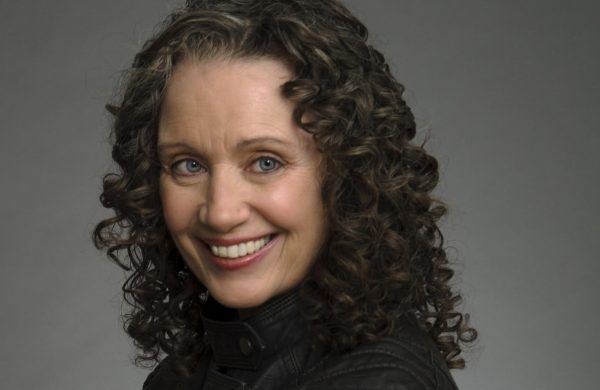
Tamara Saviano has seen just about everything in the evolution of Americana music. The journalist/author/producer has worked with Kris Kristofferson and Guy Clark, served as the first female president of the Americana Music Association, produced several of that organization’s early award shows, and somehow found time to write a few books along the way. Her latest, Poets and Dreamers: My Life in Americana Music, traces her own life story through moments with some of her (and our) favorite artists and music. During AmericanaFest earlier this month, I had a chance to sit down with Saviano at Fido Cafe in Nashville. Over cold coffee on a hot day, we chatted about those artists, as well as AI and other modern influences on music, the state of the AMA, her role in keeping Guy Clark’s legacy alive, and how maybe we can all learn a little from Taylor Swift.

Americana Highways: We’ll start off in the book. I worked in radio a little bit back in the 90s, so reading your career a little bit before then, was really interesting back when radio was independent.
Tamara Saviano: Yeah, local. Focused on local communities.
AH: And the magazines that existed through the radio stations – tell me a little about that, because I think a lot of people don’t know stuff like that ever happened.
TS: You know, there were several stations that did that, but it wasn’t common. And it wasn’t like
every station did that, but I worked for a company called Sundance Broadcasting. You know at the time, you could only own a certain amount of radio stations in a market So, they had two stations in Phoenix, Arizona, two stations in Boise and two stations in Milwaukee. And they catered really much to each market, and Milwaukee has a really serious music fan base. The festival season is all summer long, and then during the winter, there’s just show after show after show. It’s a big music city. So our stations were really focused on the music, and they decided that they could start a magazine, go more in depth on music stories, sell advertising in the magazine, and it doesn’t take up time on the air, so there’s all this non-spot revenue. So my magazine was bringing in more than a million dollars a year. Didn’t take any air time at all. Sometimes we would do a little promos on the air, but not usually. It was great! It was really great, and then they added an interactive phone system where people could call into a certain number and leave messages, and then I would call them back or I would leave messages back. It was the early 90s, I moved here [Nashville] in ‘95, so it was really innovative. Pre-internet. pre-social media, of course!
AH: Yeah, before everything changed. It’s much less personal now. Well, there’s no “personal” now.
TS: Everything on the internet, social media is so…especially now with AI, there’s so many bots, so much misinformation, so much political stuff. And I think all the authentic voices and stuff just really gets suppressed. I use social media and I’m not a fan, but I use it.
AH: It’s necessary. It can be good. It can be entertaining or days like yesterday… [This interview took place the day after right-wing podcaster Charlie Kirk was killed]
TS: Oh yeah.
AH: It’s a toxic mess.
TS: A toxic mess. Yeah, yeah. Absolutely.
AH: You talked a lot about working for Kris Kristofferson. It was a job, but it was a friendship too, wasn’t it?
TS: Yeah, it started out, and I say this in my book that I’ve really prided myself on being a professional, and my intention was never to be a hanger-on or buddy-buddy with the artists. I liked being a journalist, with distance. But when you’re on the road with someone, and you just
spend so much time, every single day, either together or on the phone, you just can’t help but become friends. And Kris was easy to be friends with. If he was sitting here with you for an hour, you’d be friends. He would be calling you. He loved people. He was one of those people that asked people more above themselves, and he didn’t like to talk about himself, so he really pulled people in. He pulled me in. He was a lovely, lovely, lovely man.
AH: I got to know him a lot more through your book. Interesting life, interesting career, and he stood up for people. I knew about the Sinead O’Connor story before the book. I remember that happening, but it seems like he did that type of thing a lot – he was always there to stand up for people.
TS: For the underdog – always, always. I learned a lot from him just by being in his presence and watching him. And I wasn’t joking when I said the other night that it kind of spoiled me for working with other artists. Because, and I guess this is kind of human nature, but there are some artists, when they make a record, and they have a record deal, it becomes so about them, and the narcissism – it’s hard to be around. And Kris had none of that. And Guy really didn’t have that either. He thought he was good. Kris never believed he was good, Guy knew he was good, but he just wanted to do things his way, and he wasn’t looking for an entourage to pump him up or anything. So working with those guys was great, but it spoiled me doing other things, I think!
AH: Guy Clark kind of seemed stubborn in a good way.
TS: Yeah, yeah, that’s a good way to put it. He was stubborn, but in all the best ways. He was not going to let the industry or people tell him how to do it. He did, early in his career, but he learned from that. He was like, “They’re trying to put this square peg in a round hole, and it’s not working.”
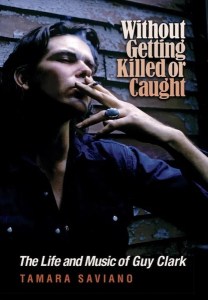
AH: I remember reading in your book [Without Getting Killed or Caught] they convinced him to do it with a band.
TS: He did his first few albums with a band. First, he was with RCA and he did two records and then Warner Brothers, he did three, I think. But at the end of that, he was like, what am I doing? I’ve done these five albums, and I don’t like any of them. They were pushing him to be a radio-friendly, country artist. He was never that.
AH: Radio-friendly country artists…generally aren’t very good!
TS: Yeah, I mean that that can be debated, depending on who you’re talking to, but it’s definitely not Guy Clark. He wanted to write songs that could be three minutes long, or they could be 10 minutes long, you know what I mean? He was gonna tell his story and do this thing.
AH: That’s one thing I was reminded of yesterday at the Shawn Camp event, is the storytelling and how good it is. And the interesting part that Shawn was telling us is, “Well, now we need to write a ghost story.”
TS: We’ve got to continue this, right?
AH: You think, “We’re done,” but not quite done, because it’s that kind of music, that kind of storytelling where you need to finish it, and you need the ghost story.
TS: When Guy was still alive, and he and Shawn were writing those songs, it was just how Shawn described it where Guy was like, “All right now, we gotta do this. Now, this has to happen” in the story, and it was fun to sort of be a fly on the wall and watch their conversations and watch them talk about where Sis Draper was gonna go next. It’s very exciting that Shawn finally pulled this album together.
AH: I’m fascinated by Guy, too, because he was a writer, which I can do a little bit of, a musician, which I can do none of. And then build guitars, which is completely separate. My grandfather was a woodworker. He didn’t build guitars, but we still have some of his furniture. That is an incredibly different set of talents. I can’t think of anybody else like that.
TS: Did you interview Guy when he was alive?
AH: No, I didn’t.
TS: If you would have, you would have been invited to go to his workshop. He had a bench about this tall that was his songwriting bench, and then he had a taller one against the wall in front of him that was his workbench for guitars, and there were antique tools and guitar scraps laying on that . And he would just write a little bit, then he’d go over there and do whatever and come back and write. He said it worked both parts of his brain, and that each part helped the other.
AH: I don’t think they’re completely separate talents in that way, because they push you a little bit. I’m sure he was working on a guitar, the brain’s going a little bit, and then “Oh, oh wait!”
TS: Yeah, yeah.

AH: The Americana Music Association – you had a big part in establishing that. Compare it then to now, to today, this week.
TS: To be clear, I wasn’t in that initial meeting when they formed the organization. I was at the one at South by Southwest that was sort of a, “Let’s talk about this,” and then it was an official meeting in November of ‘99, where they formed it. I was not a part of that. However, I became involved very quickly after that. I was the managing editor at Country Music Magazine, and we covered a lot of what we now call Americana. And then I produced the first four or five award shows at the Ryman, and I was on the board. And then I was the first woman president of the board, so I was very involved in the early years. You know, I guess you can make arguments either way. I think that the organization has become too much about how to monetize things and not about the pureness of the music. But that’s just one woman’s opinion, you know, when they started having a red carpet at the awards show…first of all, most artists hate red carpets. So now we’re gonna make artists do something they don’t even like to do, where before, they just came, and they played, and they hung out, and it was much more laid back. So, you know, I can see someone else sitting here that’s going, “Yeah, but it’s bigger, and there’s more money!” And okay, maybe – I liked it better before. I think it could have grown organically without trying to push things. Yeah. But also, I don’t know how they’re doing in this – I do think that the times have changed and things need to be diversified, and you need to embrace younger people and hand the baton on to new people. If a bunch of old, gray-haired people are running the place, it’s never going to become the next thing it should become. So that’s a beef I have, too – I think that Jed Hilly [Executive Director of the Americana Music Association] should have retired years ago and handed it over to somebody younger. I don’t know if that ever is going to happen, but I think there’s a lot of – and that’s not just in this industry. I think that that happens everywhere – where old people hold on with a death grip, and they don’t want to turn it over, and that’s in my mind a huge mistake. You have to let the next generation take over.
AH: Yeah, I feel like musically, purely musically, it’s “there.” There are bands that I hadn’t heard of two years ago that I love now. It’s partly because I write about them, partly because I’m here and doing this.
TS: That’s good news. I’m glad to hear that.
AH: But some of the promotions, some of the stuff that the awards show is more focused on – older, existing bands – it’s a little bit hard for the younger bands to get a leg up here this week.
TS: And I think you know, like, I love Rodney Crowell. Rodney Crowell is historically an Americana artist, and he’s still creating new music, so I don’t think they should put him out to pasture by any means, but they can have both. They do it better with both, and I think if there were younger people in charge, that would keep an eye on the history while also looking forward – I just think it’s time for younger people to be in charge.
AH: Are there bands now that you listen to, that you like, or younger artists?
TS: So, I’m not as hip to younger artists as I should be, or that maybe I want to be. There are artists that I see or hear about that really intrigue me. I think Tyler Childers doesn’t want to be called Americana…
AH: Yeah, I remember!
TS: But, whatever he wants to be called, I think he’s fabulous. Jason Isbell isn’t young anymore, but he came up after me, and I think he’s great. I love what Sierra Ferrell is doing. I love the I’m With Her women, Nathaniel Rateliff. And there’s bands that you haven’t heard of, because they haven’t broke through yet that I know about. There’s this band in Canada called HORSEBATH. I hate the name, they know I hate the name. They’re never changing their name. But they have a deal on Strolling Bones Records, which is underneath New West Records. They put out their first album [Another Farewell] earlier this year. I think they are fabulous, and they’re doing well in Canada and Europe, but they haven’t really broken through in the US yet. They write all their songs, play their instruments. On stage, they’re just really electric, really old beyond their years as far as their stage presence. I love those guys. I think they’re fabulous. But I’m 64 years old, I’ll be 65 in February, and I spent the last 50 years of my life going out to see live music constantly, and I just don’t do it that much anymore. There’s a lot of been there and done that, for me, so I’m not out, like I was 30 years ago, seeing all the newest stuff coming up. I don’t do that, so I’m out of the loop. This is why that’s a history book!
AH: You mentioned AI, and I just went to the AI discussion panel [Staying Ahead in the Age of AI]. I know it’s…not good. But what are your thoughts on the future?
TS: Well. you know, it’s interesting, I don’t know a lot about AI. I know what I see in social media and all that, but I had an experience. I had to do an audiobook for this and I am not a voice-over person. I don’t like my voice. I’m not comfortable doing that. It’s difficult, but my publisher really wanted me to do the voice. So, my husband [Paul Whitfield] is an audio-video engineer…
AH: Worked with Springsteen. I’m a little jealous…
TS: Yeah, he still does. He has for the last 20-some years. He’s with the Jonas Brothers at this moment in time, but he’ll go back with Springsteen when Bruce comes out. So I was trying to cut corners because I didn’t want a voice for 10 hours, talk for 10 hours, so we did a little AI trial with ElevenLabs where I read for three hours, and they took my voice sample, and then we put in the whole book, and they did it. And that was a fun experiment to really see, but there was no way it was going to work because they couldn’t get tone and inflection, they can’t tell if you’re happy or sad or any kind of emotion right. And they couldn’t pronounce anything. And, as you know, there’s so many names in my book. So we had to scrap that and I had to do the whole thing from top to bottom. Now will it ever get there? Maybe it will. What did startle me was my voice, the sound of my voice, was completely replicated. And I asked Paul, “Can we go ahead and delete that? Can we make sure my voice is gone?” Which we did. That’s scary. It’s scary, because if somehow you’re giving a voice sample and you don’t know what it’s going to be used for…it can be used for anything. Like, what if they’re taking Obama’s voice sample, and he’s saying something he would never say – you know what I mean? It can be used against you, so that worries me and then musically. Verlon [Thompson] was telling us this yesterday – that he just was learning about AI, where there’s companies, and I don’t know who they are, but where they can take music samples like they could take from Shawn’s album and recreate new sounds, taking Shawn’s stuff, and then put out their own thing, and Shawn’s never going to see any of that copyright money. Already, Spotify has ruined songwriters’ lives. Songwriters can’t make a living anymore unless you’re Taylor [Swift}, somebody like that. So I don’t know, it’s kind of one of those things, like if it’s used for good, like medical interventions and stuff like that, yay. But when it’s used for puttin’ down the little guy, even more than they’re down? I don’t like that.
AH: I mean, it sounds like the tech companies are going by the old saying, “Do it, and then ask forgiveness later.” Ask forgiveness instead of permission.
TS: But you look at Spotify, or Google, or any of those companies where and now we’re just getting into social issues. but where Daniel Ek [co-founder and CEO of Spotify] is making a gazillion dollars a year, and all these songwriters are making pennies. And without the songwriters, he doesn’t have anything. So, if I’m Daniel Ek, and I start this streaming company. I’ll pay myself well, but I’ll also make sure everybody else gets paid. But they don’t think that way. They’re, like, “How can I get the most and flip all the rest of you?” I don’t know much about AI, but this is what I see happening.
AH: Yeah, it kind of goes from Napster to Spotify to AI. It’s continuous. I like the songwriters and the performers. Have you listened to any of the AI “stuff?”
TS: No, I can’t bring myself to do it, although I’ve heard stories about it, but I can’t bring myself to do it. I have a Spotify account, a non-paid Spotify account…
AG: Same, yeah.
TS: …that I have to use sometimes for work, but I don’t listen to it as a music lover. I still listen to CDs, and Sirius satellite radio in my car.
AG: Why are cassettes coming back? Totally off topic, but…
TS: Oh, I don’t know, but here’s the thing, like Doyle [Davis] at Grimey’s told me the other night when we were there, that CDs are coming back, too, with young people. And you could take the cynical version – if there’s a rise in CD sales, well, they were at nothing. So if they’ve “risen” two percent, you know. But to me, any rise in physical media, it’s good, because if the younger generation is starting to feel like they want to own their music and their books and their stuff, to me, that’s them making a statement that they care about the art. It’s not having Spotify on in the background or whatever happens, happens and whatever plays, plays. They are supporting creators. They are supporting writers and artists, and I hope that that pendulum does swing back. It probably will never be what it was, but any amount of the pendulum coming back to actual consumers and listeners supporting artists, I think is a good thing.
AG: I feel like, when I go to shows, and I do still go to a lot of shows, I feel like “young people” really are conscious of that. Merch sales are great – t-shirts, physical music.
TS: And that’s what supports artists right now.
AG: Yeah, they’re not making money selling music.
TS: Ticket sales and merch – that’s the only way that they’re making money.
AG: I’m 54. I feel like people in their 40s and 50s don’t quite get that, but I think younger folks, they’ve grown up in this now enough. They’re like, “All right, well, if we want real music, we have to pay something, somehow.”
TS: And I also think, when I was young, I had a great record collection. I had a great book collection. I very carefully spent my allowance or any money I made on, “Okay, I’m gonna go to the record store. I have this much money. What am I gonna buy? And then I cherish those things to this day. And my friends were all the same – having our collection was kind of part of who we are. You know, here’s my record collection, this is my book collection. And I know young people that are really into the arts, they’re the same way. They want their collection. And I think that’s great.
AG: I was always the kid – and I still am – I have to have something first. If it’s something I like – first day it comes out, I have to go get it.
TS: Yeah, I used to do that, too. I’d stand in line if I had to.
AH: And I think the listening parties are coming back a little, and the midnight sales are coming back a little, so that’s good to see.
TS: I also think that, especially after the pandemic, having a sense of community, doing these community things – the reason we had the album release party for Shawn yesterday wasn’t because we expected everybody to sit there quietly and listen to the music. We’ll put the music on over here. We’ll have food over here. People can mingle, but it’s about bringing people together, having the community together and just having people in the same room. I really think that’s important, because especially young people – and my daughter’s 45, so she came of age after, earlier than what we’re talking about – she was still going out and seeing friends and being in the same room with friends and didn’t have a phone in front of her face. After her? Forget it, that’s all you see. How do we get young people to understand how great things like yesterday are and do that in their own communities. And I’m just always trying to think of ways to do that.
AH: I am not a Taylor Swift fan at all. I’ve listened to four or five of her songs in my life. But she is, whether she intends to or not, helping that to happen again.
TS: She is! I know maybe a handful of Taylor songs myself, but I am a huge Taylor Swift fan – just about who she is and how she handles herself and the way she brings people together, young people together. I’ve had a chance to be around her a few times. Let me tell you this story, because this is not a known story. When she made her record 1989 – I’m in the GRAMMY Producers and Engineers Wing. We got an email one day, saying, hey, Taylor offered to bring the producers and engineers into the studio to show them how she made her records. Anybody interested in that? We’re all like, “YES.” So, we went in the studio with Taylor. They had food and drink and everything, but she just walked us through how she created that album from playing her little iPhone voice memo things right through. And there were a bunch of old, middle-aged men engineers in there that started out the night like, “OK, show me.” And by the end, everybody had their mouths hanging open. Another time I was around her was at the Country Music Hall of Fame, All for the Hall benefit. And this is in my book. It was 2010 in LA, and it was a guitar pull and Lionel Richie on piano. So, it was Lionel Richie, Emmylou Harris, Vince Gill, Kris Kristofferson, and Taylor Swift. And this was 2010. She already had a lot of success, but not like she is now. And there were a lot of naysayers who were like, “She can’t sing! It’s all AutoTune!” blah, blah, blah. And that girl put down her guitar, she’s sitting there with these legends on stage, and she sings acapella. The artists on stage with her were like…she blew the roof off the place! And then, while we were there that day, she asked if she could have her picture taken with Kris, and she was so reverent to her elders. And Vince Gill was saying then – this is 2010 – he was like, “She’s gonna be bigger than all of us. She’s going to be a phenomenon. This is going to happen.” I think she’s magnificent.
AH: Yeah, and of course, Vince Gill is pretty much right about everything, so…
TS: Yeah, I always listen to Vince.
AH: You’re somewhat outside of the AMA at this point…
TS: I’m not part of it anymore, yeah.
AH: Where do you see either this festival going or American music in general going? What do you see or what would you like to see?
TS: Well, as I said earlier, I’d like to see young people come in and take over and make it their own. Really take a look under the hood at everything and fix what needs to be fixed and bring people under the tent and move forward is what I would like to see. I love that there are more artists now under the tent than there were when we started, but I just think there’s so much more room and, and I don’t know, I really don’t have any numbers on this, but has this festival really grown, or has it stayed the same size? How many people come, how many people were coming five years ago, what is their growth? And what is that growth? And is it measurable because I don’t know the answer to any of those?
AH: And is growth a good thing?
TS: And is growth a good thing? What kind of growth is it?
AH: So, what’s next for you? What do you have that you’re working on?
TS: So, what’s next for me is, I’ve been here 30 years last month, and I never meant to stay this long, so I’m hoping to move back to Wisconsin next year, and I’m working on a book right now. It’s historical fiction, which is a stretch for me – a big stretch for me. But it’s based on three artists that met at the Chicago Institute of Art in 1940. I’m in the research stage. I’ve written a little bit, but more just like scene-setting. But that’s my next big project, is that book.
AH: Fictional artists?
TS: The artists that met in 1940 at the Chicago Institute of Art are real, so I’m going to do historical fiction. I’m gonna use a lot of their lives, and then I have a couple other fictional characters to give it a setting. It’s really fun. I started with this group called The Gateless Academy, Mary Gauthier turned me on to this Gateless Academy. It’s a writing program – the woman that runs it, her name is Suzanne Kingsbury. Mary wrote her book [Saved by a Song] while she was going through this program, and she told me that Suzanne was like the “book whisperer,” and that this Academy, this 10-month program, was great, and I didn’t know what I was going to do after Poets and Dreamers. So I called last fall after I talked to Mary. I applied and got into this 10-month program. It is the best, most inspirational writing thing I’ve ever done, and I do lots of writing workshops. I love those kinds of things – this one is blowin’ my mind. So, I did that for 10 months, and I just re-upped to do it another 10 months, and that’s really supportive in me trying to write outside of my norm. So I’m having a great time with that. And I’m running the whole Guy Clark legacy. We have Truly Handmade Records, which is releasing Shaun’s record and we release Guy’s archival stuff. We have a few other artists that we release. We have the Guy Clark Family Foundation, which is a non-profit, and all the money we raise in that we want to give it back to songwriters. And then Guy Clark, LLC, which kind of takes care of Guy’s copyrights and all that kind of stuff. So I’m running that – Verlon. Rodney Crowell. Guy’s grandson and Scott Robinson who used to be with Dualtone [Music Group] there on the board. So we’re doing all that, and so that’s how I kind of am keeping one foot in the music business, being in the Guy Clark world. We’re doing a bunch of “Old No. 1 at 50” concerts this fall. Guy’s first album is 50 years old. There’s six shows on the East Coast – Chicago, Washington DC, Nashville, Texas. What I love about that is, it’s local songwriters in every market, and they’re doing Old No. 1 from top to bottom, and then a second set of all their own materials. So they can remember Guy, and turn people on to their stuff. And that was really fun to pull together – 13 shows. That runs through December 9th in Nashville. But, yeah, that’s about all I’ve got going on. That’s all!
To order Poets and Dreamers: My Life in Americana Music, go here: https://www.tamarasaviano.com/
To order Shawn Camp’s The Ghost of Sis Draper, go here: https://shawncamp.store/products/the-ghost-of-sis-draper-cd