





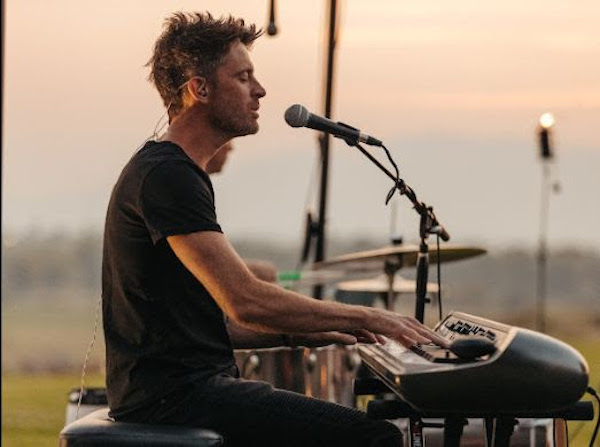
Brendan James Follows His Golden Thread To Chase Light

Pianist and singer/songwriter Brendan James has released his sixth solo album, Chasing Light, in mid-January, and brought with it several more years of experience, observation, and expertise as a songwriter. Some of the themes on the album include relationships, mental health, and the perspective of older generations. But in comparison with his previous work, Chasing Light is also more overtly challenging about the assumptions we seem to inherit about life and the real-world experiences we gather that may undercut tidy truisms. Those little elements of contrast bring a depth to Brendan James’ songwriting and enhance the appeal of his carefully crafted layers and arrangements.
What continues to ring out in these songs is a clear-eyed look at the nuances of the human experience and a deep appreciation for beauty, whether it’s found in the natural world or a piano tune. Songs like “Happy Just To Be Alive” and “Great Unknown” take on the shadows we encounter in life with questions and hard-won affirmations. I spoke with Brendan James about his life in recent years, and the ways in which he was able to find his personal “golden thread” and follow it into new creative territory for Chasing Light.
Americana Highways: I understand that a lot of life challenges have been part of your experience since the last time we spoke, and I’m sure that’s influenced this new album.
Brendan James: Most recently, my wife had to have heart surgery last year, and it was wild. It was something that she was born with, and they decided that this was the year. You can have the best doctors, and darn good health insurance, and there were still several times where no one knew what to do. Sometimes they don’t know every answer.
AH: That’s so hard. I’m so glad that she’s come through it.
BJ: Thank you. We’re so grateful that she has a working heart, but it’s hard to know to what degree she’s recovered. It’s a good spot to be, though, better than it was.
AH: When I look at this new album, compared to your last, I see more of a direct address to uncertainty, but also a relatively positive answer to that. It’s a little more confrontational!
BJ: I like that. It’s so hard to see that objectively. With my previous album, I had just traveled a lot. But yes, I feel like my last album was a little bit more of my old self, who was more idealistic and found optimism a little easier. This one is a little more about the last five years, which have challenged me to my core, and my own mental health was challenged. I actually had Covid long-term the second time I have it, and that challenged my ability to perform, and my general outlook on what I could do, and then you throw in the heart surgery, and it wasn’t easy.
AH: There were probably a lot of times when it was day-by-day.
BJ: Exactly. For everybody. And there were so many times that it was day-by-day for me. I spent two years of Covid writing with my great friend and touring companion, Craig Meyer. We wrote so many great songs that were never on an album, and I’ll someday release as “The Covid Files.” They were just totally therapy. I’m sure a lot of musicians were doing that. I didn’t know how to categorize them, I didn’t even know how to finish them, but they were day-to-day healing.
AH: How was your album release show?
BJ: It was a huge success, and exactly what we were hoping! There was a lot of good energy in the room, and this year, more than many, we needed some good energy. We needed people in a shared cause of a room listening to music. The band was great, the room was full, and we didn’t want to stop!
AH: Unsurprisingly, the world is not helping us get that feeling, and we have to create it now, with some intention. We need to make an effort in ways that were not as explicit before, I feel.
BJ: Agreed. I think we’re dealing with hundreds of things, but trying to recover from the Covid experience, as a society, is a much bigger deal than anyone’s giving credit for.
AH: It is pretty wild how, collectively, there seems to be a desire to erase it from history as quickly as possible, of course, mileage may vary.
BJ: It’s so dangerous. It’s like if there were two parents, and one parent says, “We need to embrace our past, and give ourselves time to grieve through it.” And the other parent says, “No! We push forward. We move ahead! We get better! We don’t think about that.” Time has told us that the first approach is actually much more productive.
AH: That comparison is really apt, thank you. When you were writing for this album, was there a certain intention, or is it just from a certain period of writing?
BJ: I think it was coming out of that weird Covid writing, and asking myself about the future. I was always wondering, “What’s my path here as a writer? Maybe it’s more pop stuff. Maybe I should go more full-production.” I was having these constant conversations in my brain. I can credit my decision to one conversation, actually, that I had with a rather successful musician friend of mine. He looked me right in the eye and said, “Brendan, you need to find your golden thread. What is your golden thread, something that you can do with your unique talent as a writer? You don’t need to write Pop, you don’t need to do something because you think you’re supposed to. You need to focus on what makes you unique, and don’t pick your head up until you have it.”
After that conversation, I really think I started buckling down. I wrote “Peacemaker,” and I wrote “Chasing Light.” Those were the first couple of songs for this album. Then I thought, “Okay, that’s my golden thread. That’s who I am.” I think the rest sort of followed.
AH: That is a really powerful message. What a great thing for your friend to say to you!
BJ: It really was. He knows me so well, and sometimes as artists, we forget ourselves. We get lost in the swamp of what we could or should be.
AH: There are so many voices saying what we should be, personal and impersonal. It reminds me of that truism that we say to children, “Be yourself. Find out what you love.” We tell them that, but we don’t make space or time for ourselves to continue that. It’s so crazy.
BJ: Whether you’re an artist or not, a human tends to get lost in what’s going to make the money, and that really can get away from finding what’s unique in yourself. Especially when you need to pay bills. But art, in general, is supposed to do that for society: To remind us that we can shoot for the ideal in ourselves. That we can be weird, and be whoever we are. It just takes a lot of bravery.
AH: I’m sure that choice can also feel overwhelming, too, when it comes to the blank page in life. Sometimes that’s a trial and error process of determining what we’re not.
BJ: Exactly! I actually find that if I am too intentional about it, nothing comes out, at all. By accident, I find that by hiking, or running, or being in nature, or being around my friends, or having a great day with my kids, by putting myself in places where I’m happy and my soul is enriched, then “Bing!,” an idea is there.
AH: You have to put yourself into the flow of life.
BJ: Yes, you do. You put yourself there.
AH: Do you work mainly by sketches, or do you work a whole song out before you move onto another one?
BJ: I’m pretty all-over-the-map. I have things in the fire, and things I return to constantly. There are 50 to 100 little starts in my hard drive where I go back and think, “Was that any good? Maybe tomorrow, I’ll be ready to write that one.” I just felt like once I got one of them finished, then my fire was fueled and I felt like exploring all these tidbits once I had the thread and the focus. There were two songs on the album that I had already released as singles, and I thought, “Oh, I was totally in that mindset already when I released these songs. They are going on the album.”
AH: Which ones were those?
BJ: That was “Happy Just To Be Alive” and “Seventeen Years.” Those were singles from the last year and a half or so.
AH: That’s so recent that it’s not surprising that they had things in common with the other songs. That makes “Happy Just To Be Alive” a little earlier, and when I look at the notes, I see that this relates to your father-in-law, who is in his 80s.
BJ: I had started writing that song while on Christmas break in California while in his house. It was the house that my wife grew up in. He asked me what I was working on, and I said, “I’m kind of working on a song about the purpose of life.” I asked him what he thought about it. He’s kind of comical, with a big personality, and said, “Oh, geez, I don’t have anything deep to say, except I’m just still happy to be here. I never thought I’d make it this long.”
In that simplicity was such depth! Can’t a six year old have the same thought, “I’m just happy to be here.” If I can remind myself of that, over and over, it’s a very simple thing. What he said got all the wheels spinning, and I finished the song in that guest bedroom by the end of the day.
AH: What I appreciated about the song is that it includes some polarities. It’s not just a flowing, pretty song. It’s got some questioning to it, like you use the idea of being both old and young in the song. From one perspective, you feel old enough to have some doubts about certain issues, but from another perspective, you feel like you’re still pretty young. Young enough to have the energy to want to find answers.
BJ: Yes, that really is what it’s all about. As we age, I feel like the older we get, the less we know. I was trying to illustrate that. Also, as I think about those words, it sort of sums me up that I would write a happy song, but with a sadness to it. If I were to sum my own personality up, that’s what it is. I’m optimistic, and always shoot for the happy, but I carry the heaviness.
AH: I think someone who doesn’t shut out information just because it’s inconvenient is going to have that heaviness. [Laughs] An observant person, for instance.
BJ: You’re right. They can acknowledge the reality they actually live in. [Laughs]
AH: Is the song “Great Unknown” literally coming out of all of your outdoor activities and pursuits, being in nature and things like that? It sets a great tone for the rest of the album by taking a bigger view.
BJ: Definitely. I would love to find an even deeper and richer thing to say about it, but it is that when I find my joy through being in nature, I find my golden thread, and what I want to share as an artist. I seek nature because I know it’s going to bring me to my happiest self, and I know that I can share that.
AH: The song reminds me of taking road trips as a kid, setting off early in the morning, and wondering what was around the bend. That feeling is captured by the song.
BJ: To be honest, that’s when I think I’m at my absolute happiest. Now that I have kids, when we are on a trip, and we are going around curvy roads, and we’re not sure what the destination is going to look or feel like, we’re excited. That is probably my number one feeling in life. The song is what I’m always seeking, basically.
AH: Yes, it’s the state of seeking something. That’s a pretty ingenious way to open an album, too, because it gives people a sense of wondering, “What’s coming?” It is, thematically, a good choice.
BJ: I had a feeling to put it first, though I didn’t think of it that clearly. That’s a great reason why!
Thanks very much for chatting with us, Brendan James! You can find more information and details here on his website: https://www.brendanjames.com
This was a wonderful interview with Brendan! He’s an extraordinary songwriter and I’ve loved his music for many years. I never tire of hearing the thought process and feelings behind every song, and I think the interviewer did a great job asking the right questions to elicit those answers.