



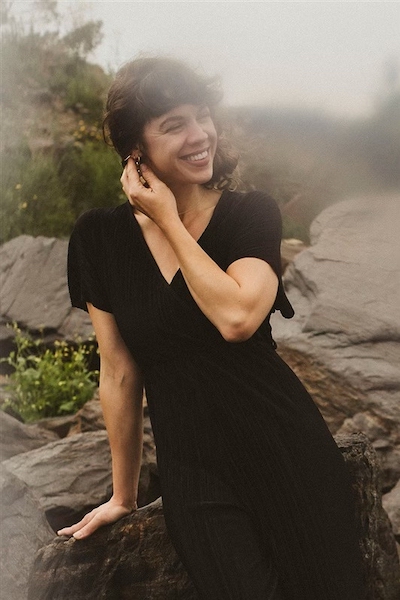
Susan O’Neill photo by DeeDee Morris
Susan O’Neill Prizes Collaboration and Resonance For Now In a Minute
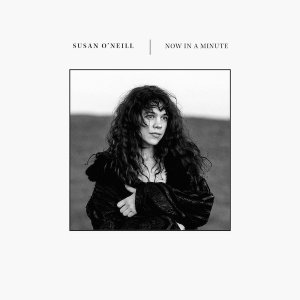
Irish singer/songwriter Susan O’Neill released her first solo album earlier in the autumn, following upon a solo EP, and it’s been part of a bigger touring cycle that now hits its next leg by heading to Australia. Now In a Minute also follows her 2021 collaborative album with Mick Flannery, In The Game. The new songs are varied in sound and texture, and often quite personal in origin, while remaining universal in mood and atmosphere. While there are hints and flashes of older traditions, the music is also strikingly modern in its experimental aspects and intimate vocal style.
While this approach to composition could have come from a number of angles for O’Neill, it turns out that community-based performance in choirs and bands forms the underpinnings of her musical worldview. A connection to landscapes and locales also fuels her imagination. I spoke with Susan O’Neill while she was on a brief break at home in a small town setting before starting to travel and perform once more. We discussed her collaborative background, touring styles, local landscapes, and chasing down the needs of a song.
Americana Highways: I see that you had a collaborative album recently. Can you tell me a little about how working with other people has contributed to your creativity?
Susan O’Neill: It’s an interesting thing to muse with a little bit. In some senses, songwriting comes from a personal place. It’s lovely then when you can find the right person to fuse it with. I went to music college, I began in choirs, I played in brass bands. It was always community-driven. It was the band that taught me how to play music. It was the choir and the band that had me hearing this collective sound in this whole room, this collective cacophony of texture. I remember, as a kid, thinking, “Something else is happening here.” I wasn’t playing just to play.
You can practice on your own, but as I’d begin to progress and share it, I would notice that I’d begin to feel chemically different. I would come to practice in one mood, and it was altered leaving, always. I became aware at the age of 11 or 12 that it was shared music. I couldn’t put it into words, but I knew it was something powerful. We did practice three nights a week, for two hours a night, which, for a young person is a big commitment. I was enamored by the process of that, and that led very naturally to the road of working with a techno band in Ireland, called King Kong Company, to working with a traditional musician, Sharon Shannon, who I collaborated with and sang with, then the collaborative album with Mick Flannery, and Irish singer and songwriter. Every one of those collaborations have been so different from each other.
The most recent album was with friends who I met in college, and we had lots of different people. We had people come in and help us with that. It’s always been a kind of team effort for me, the social aspect, and sharing something. The tweaking it and honing it results in something better than I could have done on my own.
AH: You’ve been touring a huge amount in a relatively short time. How have you tackled that and found time for yourself?
SO’N: I know that a lot of musicians who I’m surrounded with these days are hanging out backstage drinking ginger and lemon tea, and we’re discussing philosophy! I remember seeing in documentaries that there was a much more debaucherous aesthetic happening back in the day. That seems to be changing, maybe it’s just for me. Being mindful and a bit more controlled is “in.” [Laughs] I hope.
AH: I think that’s fair. I’ve heard from American musicians that their relationship with touring has changed, particularly post-pandemic. A lot of people are making more conscious choices about these things and coming up with their own way that works for them.
SO’N: I find that exciting. We have to take the pros with the cons in terms of how the internet has shaped how we consume and experience music, how we seek it and search for it. The live show has become this really precious thing. That the internet can never replace what we do. The most high-end stream can’t bring about a fraction of the goosebumps and the chemical change that you get from being in a room with people. In a way, the live show is the human thing that can never really be altered or taken. However, I think there are so many demands now on what musicians need to be, in terms of being content creators, in terms of how much less money is given to the artist via streams, that you have to do an awful lot of touring to make that viable.
How much of that is making a very wholesome life viable? There are other creative ways, like thinking in terms of song placements, to make it viable. I see people doing all these different things now, and some of them are to my taste, and some of them are not. But I really value this kind of choice, that it’s not this one old model where you sign here, publish here, tour here. There are gorgeous venues around Ireland, but there are also bookshops, and churches that run things every now and then. I think we’re really tuning into this. We’re so overwhelmed with advertising and marketing that our BS detectors are constantly going off, so I think the authentic experience of being in a room with people who are truly loving music is turning into everything. Artists are here for people who appreciate them and want to come.
AH: I love non-traditional venues and thinking in terms of where music can happen. There’s a lot of creativity in where music is happening now. I think that needs to be part of the story, bringing music into life more.
SO’N: That is it! Music is a part of our culture and who we are. If you look back at some old Irish events, and even in the States, in older cultures, songs were incorporated into daily life, whether it was work songs, songs of praying, lament songs. It was about the expression of the soul. During lockdown, I took my trumpet into a cave, and played in there, with the reverb, and made a video of it.
Since then, our national broadcaster was doing a series on the caves, and there was a musical aspect. They asked me if I’d go to a cave to record. They picked this beautiful, reverberant limestone cave, five minutes from where I live, actually, and I went and played. I ended up singing an impromptu song, and it felt like I should, since it was all about being inside the rock, and part of it. There was something about it that felt like it was one of the most important gigs I’ve done! This is the one that has resonated. Has anyone sang in these caves in the past couple hundred years ago? That stuff gets to me. It’s an offering of praise to the land. It’s like some form of praising ritual.
AH: That is wild! I see in your video for “Bright Eyes” that you bring in the local landscape. There’s definitely an old-school feeling, with stones piled up, and animal skulls. It feels neolithic.
SO’N: Something like a song, or a sound, make these things more approachable. Yes, there used to be a horned god for years before the catholic church deemed horns to be evil. There are any numbers of cycles always changing and reversing, so I like to put suggestions and hints about these things. I’m always wary about saying anything too certain about it. I do think it’s important to make suggestions, and for me there’s a beautiful area within art where you can hint at things, without trying to change anyone’s mind. You’re just saying what you believe, softly, and I think that leaves a lovely space for other people to interpret as they need to. So I’m open to textural oldness, like land, and bone, and stone.
AH: I was thinking about the song “Bright Eyes” and why it works with that style of video, and I thought of two things: The percussion feels older, almost like it’s made of wooden sticks, and then there’s the choral, layered vocals. Even though those are just suggestions of older things, they make an impression and a mood.
SO’N: I think that is true of that song. The songs were both played live, and we tweaked them also. I also put in a box banjo and played the dulcimer very lightly on the chorus. So there are hints of these things. The background vocals are close, in three parts, and there’s a crackly texture to them, even though the main vocal is quite crisp and clear. The background vocals were made to sound old, just as an attempt to fuse an old thing and a new thing at the same time.
AH: I wonder if it’s easier to bring these elements in because you aren’t using traditional song structures from folk music. There’s more room for adding things in here and there.
SO’N: I like that idea. In junior school, before college, I actually came across this amazing contemporary composer who had roots in Count Clare. His name was Gerald Barry, and he had this really intense piece that was almost abrasive. But what was interesting was looking at the form, it went A, B, C1, D, E, C2, and there was a G that never belonged anywhere else.
I like the idea that a song can decide that, and that those forms can be changed, always considering that the listener and musicians playing are getting what they need from it. I’m very conscious of that, what elements need to come in to support texturally, what’s being said lyrically. It’s kind of like a game to play to see what will work. You think one thing will work, then you got to record it, and it doesn’t! Which is fine with me. A full day’s work will often go in the bin. When you have all these other musicians involved, it can be a real challenge and a test, both to your abilities, and to your pride around your abilities. That will contribute to your success.
AH: Sometimes powering through with something that’s not working is exactly the wrong choice, I’m sure. But it’s hard to know.
SO’N: And then abandoning it is hard, as well. Sometimes you have to go the longest way, then learn it hardest at the end. That song, “Bright Eyes” took a while before I could get it to sit right. Maybe that’s why I’m saying this. We ended up needing to speed up the chorus a little bit. Everything else stayed the same. But it had to be bumped up to make the rest of it make sense. It was so close!
AH: I can kind of hear that. I feel like the chorus pulls the energy together for the song. I know people who have had songs that sat for years, then something caused them to change the genre, and suddenly it was the right song.
SO’N: That’s beautiful.
AH: I know you’ve been playing some of these songs live. Has that brought any new thoughts or feelings about them?
SO’N: We’re actually in the middle of a tour [in Ireland] at the moment. Then, in November, we go to Australia. There are talks about the US and Canada following that. It’s all just starting off! The songs are being well received, though. The songs have changed, yes. When I finish a song in the studio, it’s a picture. I put on a different dress and accessorize them differently every night. There are some that we play closer to the album, for example “Malachi.” But things change because they need to change.
Thanks very much for chatting with us, Susan O’Neill! Find more details here on her website: https://susanoneill.ie/