


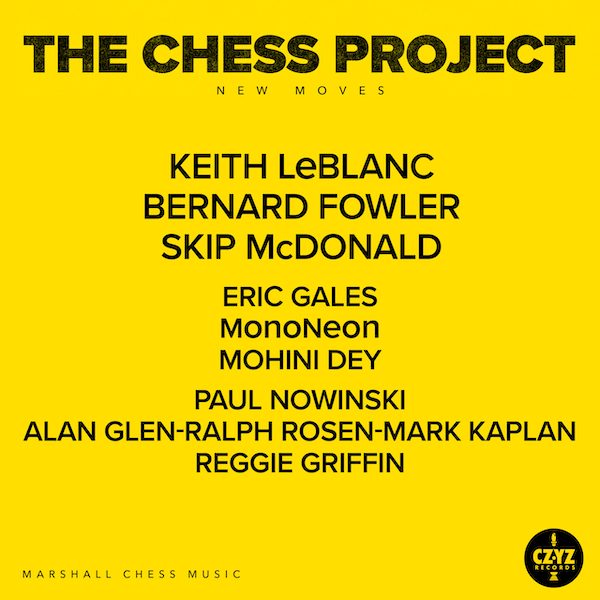
The Chess Project – New Moves (CZYZ Records)
No matter your opinion of the blues, where it originated or whether acoustic is more legitimate than electric, there’s no denying that it’s one of the most misaligned genres of them all. Bottom line is, it’s a most tired category and this release – which will likely offend the most ardent of blues aficionados strives to breathe fresh life into the old masters. Whether or not New Moves is a successful attempt is up to your ability and willingness to open a few doors. Praise for that.
There’s no argument that Chicago’s Chess Records is, and was, one of America’s greatest blues labels – having focused on recording the music that other labels would not. Blues, gospel, R&B, soul and early rock & roll – mined by brothers Leonard and Phil Chess (whose actual surname was Czyz) after Leonard’s purchase of Aristocrat Records. This current project is helmed by Leonard’s son, Marshall Chess, who briefly ran things after his father’s death in 1969, staying on after the label was sold to GRT before finding success with the Rolling Stones Records imprint. Referring to the prestigious Chess catalogue as his family’s music, this is an overt attempt to reinvent and reinterpret for a new audience (you may recall Marshall’s attempt to rework Muddy Waters career with Electric Mud, tailored for a changing, more rock-leaning audience as more traditional blues had fallen slightly out of favor).
However, the key to this transformative release is found in its title – New Moves. Marshall and his son, Jamar, have teamed up with the (sadly, late) Keith LeBlanc who has created his own supergroup made up of guitarists Skip McDonald (Little Axe, Grandmaster Flash, Paul Nowinski (Keith Richards, Patti Smith, Mohini Dey (young Indian up-and-comer) and MonoNeon (Prince, Ne-Yo) sharing bass, Reggie Griffin (Chaka Kahn, Kenny Edmonds) on keyboards, Alan Glen (Jeff Beck, Peter Green) and Ralph Rosen (Bruce Katz) on harmonica, Mark Kaplan on tenor sax – all tied together (quite masterfully) by singer Bernard Fowler (Rolling Stones, Bootsy Collins, Phillip Glass, Herbie Hancock). Blues explorer/guitarist Eric Gales (Santana, Gary Clark Jr) also sits in on two tracks.
LeBlanc – who has worked with a dizzying array of artists: Tackhead, Grandmaster Flash, Nine Inch Nails, Little Axe and the Sugarhill Gang – could have gone anywhere with this production. Legal troubles scuttled plans to sample from the original Chess tracks, planning to blend them with fresh – and original – instrumentals. Hardly a concern on LeBlanc’s hands. Whereas this project could conceivably gone anywhere, given this collective’s ability to mine raw blues, rock, jazz, rap, reggae, hip-hop and dub (!), LeBlanc, with executive producers, Marshall and Jamar, have turned in an exciting hybrid beyond any traditional description – while still holding true to the original masterpieces in so many ways.
Beginning with Stan Lewis’ “Boom Boom Out Go The Lights,” first recorded by Little Walter and reinvented by the likes of Pat Travers’ with his pumped up rock version, LeBlanc, Rosen, McDonald and Nowinksi completely remodel what was once a relatively gentle – albeit threatening – R&B single, turning it into a slippery, sleazy romp complete with deep, funky beats, scorching levels of harp and a standout, authoritative vocal by Fowler. Each track features phenomenal instrumentation, fiery solos and – always – the inventive vocals of Fowler and the always-arresting percussion of LeBlanc.
But, how to approach Howlin’ Wolf’s Chess debut, “Moanin’ At Midnight”? With absolute confidence, of course – Fowler’s voice approximating Wolf’s intimidating howl atop Glen’s fat harp, attaining a higher-pitched prominence through samples and processing. Mix in McDonald’s darkly dangerous guitar chords with elements of wah-wah, the walking bass of Nowinski and the fat drumbeat of LeBlanc, plus congas – all blended together in a soulful stew of funk.
Sonny Boy Williamson II’s “Nine Below Zero” proves an instant album highlight as the end of “Moanin’” segues into that same fat drum sound, wah-wah guitar and Rosen’s sweet-sounding chromatic harp – each helping to redefine the original’s ‘urban blues-harp style’ with a damp and dirty groove, recalling something the Isley Brothers might have come up with in their later years. Fowler’s impassioned vocals – arriving on multiple levels – connect the innovative work of these four players, ultimately underlining the icy chill of the lyric.
Muddy’s upbeat cover of Sonny Boy’s “So Glad I’m Living” attains new heights as Glen’s powerful harp work joins McDonald’s tougher guitar sound (layered with gently-bent notes and atmospheric leads) as Fowler’s wolf-howls and hum-along accompaniment atop an always-funky backbeat breathes fresh spirit into the already uplifting song, ending on the longest hummed note in Guinness Records® history. Contrast this with the full-on assault on Howlin’ Wolf’s tale of trouble in “Tell Me.” Simple country blues is transformed into a more aggressive mix of crisp drumbeat, heavy harp squalls and a stellar jazz-bass workout by MonoNeon as Fowler turns Wolf’s “trouble is knocking” lyric into a full-fledged hook of a chorus. The dual guitars of McDonald and Gales take turns stinging the groove with tasty leads as a synth effect eventually transports the track far into the ozone.
Each and every track is given new life, using enough of the originals heritage to keep the project honest. Even Rosco Gordon’s ’52 single, “Booted” (which rocketed to #1 on the Billboard R & B chart) benefits from the addition of Mark Kaplan on tenor sax while Fowler delivers on a slinky call-and-answer crowd feel with the lyric and McDonald’s expressive wah-wah drips with added emotion. Likewise, Kaplan’s sax stays behind to help pilot the sway of Memphis Slim’s haunting “Mother Earth,” keeping it firmly in the R&B camp where it scored so well back in ‘51. Nowinski’s elastic workout on acoustic bass join LeBlanc’s energized elements of percussion, completely redefining the notion of down-tempo.
As noted, the highlights on The Chess Project are endless – always surprising and remarkably inspired. Any doubter might fast-forward to the band’s version of Little Walter’s “High Temperature” and feel the carpet pull away from beneath your feet. Skip McDonald’s nasty slashes of guitar chording join Rosen’s larger-than-life harp blasts as Fowler double-tracks the vocals atop an always tight drumbeat, brassy high-hat sample and what sounds to be a didgeridoo, rethinking the very depths of passion.
And you haven’t even gotten to “Smokestack Lightning” yet.
Find the music of The Chess Project right here: https://orcd.co/newmoves
Discover the YouTube Chess Records Tribute Channel:
https://www.youtube.com/channel/UCb9bioVsB0lPBkMOWTKzHFw