



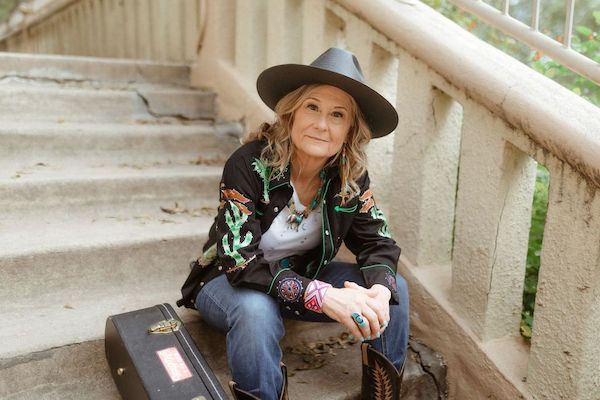
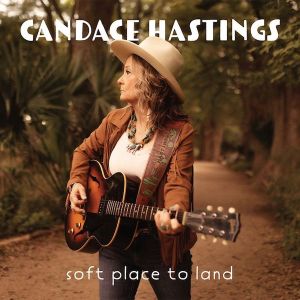
Candace Hastings has a new album coming out later this week on June 18, comfortingly entitled Soft Place to Land. Her songs are easy, old style country songs with a twang, strings and an irresistible vocal sweetness. She writes of simple times and simple human truths, distilled to their essences. Here and there are a highly unique smattering of jazz piano and smoky tones. Candace is a Texan, and writes in light of the big wide desert landscapes. The album was produced in Dripping Springs, Texas by Pat Manske and features Lloyd Maines on pedal steel and dobro in the mix, which lends an infused layer of authenticity to the affair.
We had a chance to chat with Candace about her music, her inspirations and the recording process for the album.
Americana Highways: Did you go into this planning to make an album and writing with that in mind, or did the whole thing come together more organically?
Candace Hastings: I’m not sure I have the attention span to go into an album project and write thematically to that project, although it sounds like a fun venture to try. For me, each song is a moment of truth in my life or the life of someone else. Soft Place to Land is a collection of songs I’ve been performing live for the past few years that just started to group together musically and thematically. They are songs that resonate with me and, more importantly, with my live audiences.
AH: What background information can you give us about the album? Were there any particular inspirations behind it?
CH: My life has a lot of moving parts, but I try to live as simply as I can between the seams of the world’s chaos. Spending time in the high desert of West Texas, near Big Bend, always inspires me to write.
Life there cuts out the noise. When you look at the stars in the desert, you realize humans aren’t as significant as we make ourselves out to be. That might seem terrifying, but for me, it helps me quiet the world’s chatter and listen. That feeling anchors the album’s title track and the search running through these songs, the search we all have for a soft place to land.
AH: What kind of themes run through the songs across the whole collection?
CH: As disparate as the songs might be, each one deals with human complications, imperfections, contradictions, and ultimately, hope and belief. It’s okay to be complicated. It’s okay to be human and make mistakes. It’s okay to hope for something different. And underneath all of that, there has to be truth.
I was doing some volunteer work in a women’s prison recently, and one of the women commented, “They’ve taken away everything from us here except our word. If we don’t keep our word, we have nothing.” I feel this way about this album. I’ve kept my word. Every song on this album tells the truth.
AH: Which songs are standout tracks to you and why?
CH: Asking me to pick out standout tracks is like asking which child is my favorite. But I’d love to highlight a sleeper track on the album called “I Was That Woman.” It’s a ’90s-country, bold-woman song that goes beyond the usual country “someone did someone wrong” storyline. It’s about real love, complicated relationships, and the moment a woman decides exactly where her line is.
When the speaker realizes that the person she loves is still entangled with a former lover, she says, “Don’t you put your boots under my bed, if you haven’t said goodbye to her just yet… ’Cause I was that woman long ago.” With that dramatic pedal steel and the iconic, reverbed-tom lead-in to the chorus, you can feel her gathering her nerve, and you know she’s about to set things straight.
AH: Talk to me a bit about the recording process. Who did you work with in the studio, and what were the sessions like? How was the vibe, and how did the songs come together?
CH: I recorded the album at the legendary studio The Zone in Dripping Springs, Texas. I think it’s a testament to Mike Morgan, who owns The Zone, that even though they’ve worked with the most revered musicians over the past 30 years, they treat everyone with respect and care. I’ve been fortunate to record both of my albums there under the production of Lloyd Maines and Pat Manske, with Keith Davis and Pat Manske co-producing “Call Your Mama.”
Some songs spoke for themselves, such as the minimalist “Horses I Left Behind.” On the other songs, I was lucky enough to get great musicians like Chris Gage on piano, Glenn Fukunaga on bass, and Dennis Ludiker on fiddle to add to the instrumentation. And of course, Lloyd was the maestro, playing lead guitar, mandolin, pedal steel, and dobro.
Every day I went to the studio, I stopped by the Shamrock gas station in Wimberley on the way to get breakfast tacos to bring to everyone. Here’s an exclusive tip: Pat Manske’s favorite taco is the “Dirty Hippie.” You’ll have to visit Wimberley to find out what’s in that one.
AH: How has the creative process in general and your songwriting specifically — both music and lyrics — changed and morphed through the years as you’ve grown as an artist?
CH: I remember Dolly Parton saying in an interview that songwriting is her first love. I am the same way. I’d love to live a life of writing, just hiding out and writing, but that’s not realistic. We are put on this earth to connect and share our art and creations, and Dolly is wise enough to understand that.
Now I take my songs out, test them, and get a sense of whether a song should remain just one of mine or if it has the potential to connect with another human. It’s okay if the songs don’t connect, but they probably won’t make it to the recording studio.
At some point in my career, I finally got over myself when I realized that performing my own songs was never really about me. It’s about the way I can make people feel. So I’ve matured by remaining inward-facing as I write, while also being outward-facing in performing those inward-facing songs.
AH: How would you describe your music to someone who is not familiar with it?
CH: My music is pure, melodic, old-school storytelling. I’m not someone who does vocal gymnastics. I’m more of a cozy fire on a cold night or a last dance to an old country song on the jukebox.
My music moves across Americana, from country to swing to Indigenous folk and back again. My dear friend and Texas-treasured songwriter Adam Carroll has an album called Let It Choose You, about letting the songs choose you. That’s what I do.
AH: Do you find inspiration in different or unique places? What kinds of things typically inspire you to write songs these days?
CH: I live in San Marcos, Texas, just south of Austin, where on any given day, you can be sitting in with amazing A-list musicians who gave up the Austin glitter for the Texas Hill Country grit. And down the street from my house is Cheatham Street Warehouse, where on Wednesday nights you can test your mettle, where back in the day George Strait and Stevie Ray Vaughan had weekly residencies and Robert Earl Keen played for pitchers of beer. There is always someone better, wiser, or more seasoned sitting right next to you. That keeps me humble, and it keeps me writing.
I don’t really look for inspiration to write. I find the ideas and lines just roll out from things I see or hear every day, without discrimination. I gather them together and piece them into songs. I always have four or five songs in progress at a time.
AH: You’ve collaborated over the years — on your recordings in the studio, performing live, co-writing, etc. What does working with other artists mean to you, and are there standout collaborations that are special to you? What made them special?
CH: I love working with other artists, especially co-writing, because other writers bring perspective to an insular process. One of my favorite collaborations was co-writing a song called “Life Without a Plan” with my dear friend, Scottish songwriter and artist Louise Higgins. Louise spends a lot of time in Marathon, Texas, and I was there for my birthday. We put a bottle of tequila in front of us and had a long talk about our lives lately, and how making plans hadn’t worked out for us so far, so maybe living life without a plan — “no destination, no promised land” — would be a better plan.
We finished the song and the bottle that afternoon, and “Life Without a Plan” might just be my next single. At least that’s the plan.
AH: Do you plan to do any touring around the album or do you have an album release show planned? What can fans expect from your live show these days?
I’m currently working on the details of an album release show in late June or July, so stay tuned to my website, candacehastings.com, for the latest details on all my shows. I play wineries to beer joints, house concerts to bbq festivals. You never know where I’ll show up next. And audiences can expect to find an honest, human experience that they’ll remember.
Thanks very much for chatting with us, Candace Hastings!
You can find Candace’s album here: https://ffm.to/ml892eq
Enjoy our previous coverage here: REVIEW: Candace Hastings “Soft Place to Land”