





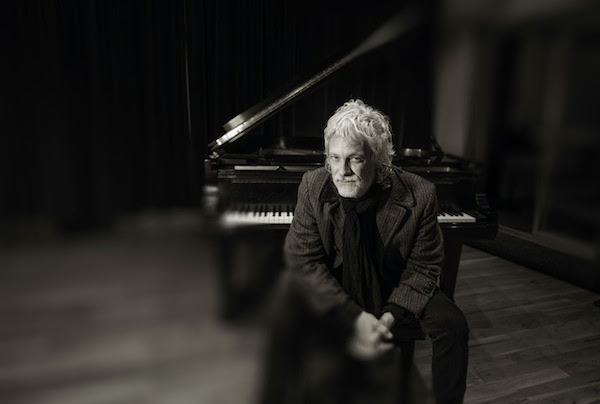
Scottie Miller photo by Layne Kennedy
Scottie Miller Builds a Song Cycle With Hello Pain Backed By The Budapest Scoring Orchestra
Singer/songwriter and pianist Scottie Miller released his new solo album, Hello Pain, on May 29th, 2026, having just come back from Australia where he was touring as Ruthie Foster’s keyboardist. While Miller loves to try new things on his albums, this one marked a specific development because it became a collaboration with orchestrator Cierra Alise Hill and the 52-piece Budapest Scoring Orchestra seeing it through to completion. It also became what may be Miller’s most confessional work to date, making it both his most personal album and the one with the largest cast of any of his studio albums. The result is a very interesting atmosphere of emotional directness lifted by dramatic and dynamic orchestration.
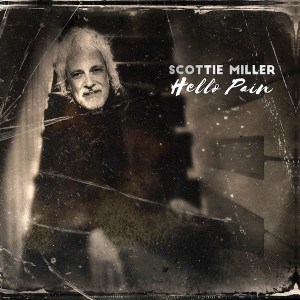
Miller has previously released 13 albums and two books, and even ventured into spoken-word projects, but that has been built on his recovery of the past 18 years. When this album came around, also found himself flat on his back with a broken vertebrae from having moved his piano, and considering the broad sweep of the end of a long term relationship. These factors conspired to encourage him to embrace vulnerability in order to overcome any writer’s block hanging around. While the songs took shape in the very same order that we hear on the album, forming a veritable song cycle about a difficult journey into a personal rebirth, Miller also had an overwhelming and seemingly impossible idea, to bring an orchestra to the tracks. That’s a very tall order for an independent artist, but the stars aligned for Hello Pain. I spoke with Scottie Miller about this surprising journey, and the emotional world of the album.
Americana Highways: I understand that you sometimes do solo performances, like you recently did on the road in Australia. What needs to happen to adapt your original studio songs for just piano and vocals?
Scottie Miller: Every configuration is different, and I do play solo piano vocal shows, and I do play duo shows with my violinist and arranger, Cierra. Then, I do trio gigs with drums and upright bass, and up to quartet if I add violin back in. So, when you break it down to the essence of solo piano vocal, it goes back to how I write the songs that I perform and record. It’s cool in that sense, because that’s where they were born. It doesn’t take a whole lot of reconfiguring or anything. It’s just a different presentation. Some people like it more so than bigger productions. I really enjoy it because I feel the freedom to move around. I have complete freedom, so it’s cool in that way.
It also depends if I’m on a piano, or on a keyboard, because especially with this new orchestral album, I might bring up string samples, or bring up some cool mellotron to bring in half-way through the songs, with some cellos or violins. That’s fun in a solo environment where people aren’t really expecting it, and I can do that really subtly with pedals. It’s wide open.
AH: It sounds like you’ve already played some of these new songs solo.
SM: I have been doing some little experimental pieces over the past nine months, just to say, “Hey, this is what we’ve been working on! This is what’s coming up!” Because we’ve been working on this album for nearly three years. So in my local community of the Twin Cities, people are aware of how long we’ve been at it. We are really in the final stages, because we have CDs in hand, and I’m going to pick up the vinyl after talking with you!
AH: Congratulations!
SM: Thank you! The official release in May 29th, but the big album release show will be August 1st at the Parkway Theater here in Minneapolis, because of timing, scheduling, and I’m bringing a small orchestra with me.
AH: Can you take me through the timeline of writing these songs, and the stage when you might have shown the songs to Cierra, and bringing in the collaboration with the orchestra later in the game, I’m guessing?
SM: Yes. Nearly three years ago was when I started dipping my toes in, wondering what the next album was going to be. I was feeling a little stuck after my last release, Carnival Cocoon, which was a spoken word collection. I told myself, “Find your truth and just write it.” Some doors really opened when I started doing that, just writing my thoughts as I was feeling them.
I was going through some physical pain from fracturing a vertebrae in my back moving my piano down the hallway, and a breakup from a long-term relationship. I was in a lot of physical and emotional pain, and all of a sudden, Hello Pain came out. I was speaking my truth as I was feeling it, whether vulnerable, or fearful. I took it and I ran with it, so I was feeling really good about the integrity behind it. It’s just real. Then, I’d get excited when a tune would get finished musically and lyrically, because they were beckoning for orchestration.
I started doing orchestration digitally at home with sampling and software. I started composing string parts and percussion, and broadening the direction of the material. I was creating demos that were really quite huge-sounding. I definitely knew that I wanted to try to get a larger scale orchestra to do this with real human elements, but I didn’t know how I was going to pull it off, because that is an expensive venture.
HA: At that point, you must have been thinking, “This is the best and the worst dream ever for this album. How?”
SM: You nailed it, yes.
AH: Because once you’ve thought of it, you can’t unthink it, right? But it seemed impossible.
SM: That’s where I was starting to freak out because now I was dead set on large-scale orchestration, but I felt like it would never happen. I reached a point where I just kind of let go of all of that, which is not very easy for me to do. But I let go, and tried to have some chill and confidence. I said to myself, “Everything is going to work out in your best interest, the way that it needs to. Just relax.” I let it go, and started to investigate how much it would cost to use the Minnesota Orchestra, and how much it would cost to use Budapest.
I was on the road with Ruthie Foster, and a friend and fan of mine got in touch, saying they had a musician friend who told them how expensive it could be to record an album, and she knew what we were trying to do, an orchestral album. She basically said, “I’d like to help.” I thought she meant a hundred bucks or something. I already had a business plan, and long story short, she helped us cross the threshold of the orchestra funding, and blew all of our minds. I still get chills because I can’t believe the extent of the kindness of strangers.
With that door wide open, I went back to Cierra and said, “We’re going to go big now.” We ended up with forty strings, ten winds and brass, and a few more. Once we had the green light, Cierra really moved into her full-blown arranging. I’d get all my composition into the best form I could, and I’d get it over to her where she’d clean it up, embellish, and enhance, because she’s really the master of orchestration. Budapest came to me through a friend and big local arranger who had worked with them before. The studio where I’ve recorded before, Wild Sound, had already recorded with Budapest remotely online. We got the scores, and notation, and Cierra did an amazing job of everything being clean and ready for them. They came in in a four or five hour session, and knocked out the entire album. We had them on monitors and they had us on monitors. They do soundtracks, Netflix films, and movies, but also try to be accessible to indie artists like myself. They try to fit that budget so an artist without a major label could do it.
They would play along to our scratch tracks of piano, vocals, upright bass, and drums. The time was mapped out.
AH: Did they need full sheet music from you all?
SM: Yes, and Cierra created the scores to perfection. They all had to be sent in advance and proofed. I think that we sent them to them on Friday night, and we had the session with them the following Tuesday morning. [Laughs]
AH: Wow! That’s incredible.
SM: I didn’t know how this was going to go.
AH: And you were watching them on video?
SM: Yes, we were live with them on video. They’d run a take, and we’d pause for a minute, and the control room engineers would come back to us and say, “Okay, we’re ready for your comments now.” Then, I would jump on and say, “Oh my god, it’s wonderful!” They would listen and watch us on their monitors. We’d say to maybe take their time on a particular passage, and let it hang a little longer. There was nothing major. If anything was a little out of tune, they’d have different passes.
After the sessions were done, within about an hour and a half, I had all those recordings sent to me via Dropbox.
AH: That is crazy! That is so fast!
SM: Yes! I would’ve loved to go in person, and many people do, but it just wasn’t in the cards because of timing, touring, and expense. And because Wild Sound Studios had experience doing it remotely, everybody was really prepared.
AH: We can see the orchestra playing on your videos for some of these songs that have been released. Is that all from the same session?
SM: Yes, we have footage of the entire session. We picked the title track and “Awake and Willing” because those are really strong ones, to me. “Hello Pain” is the focus of Side 1, if you’re looking at the vinyl, and “Awake and Willing” is the nemesis of Side 2, where you’re getting into reemergence. You’re reemerging in life, in love, in hope, and finding balance. There’s a song on there called “Balance” where you’re finding your balance in life.
AH: You’re already getting into something we should talk about, which is that looking at this whole album as one piece is very rewarding. This album is a cycle, with one arc, and one narrative. I can tell that just by looking at it, and listening. This is long-form storytelling, with an emotional perspective. To me, it was a rebirth story.
SM: Thank you. Yes, when I listened to the test pressing of the vinyl, story-wise, and sonically, I thought, “Whoah!” This was my first vinyl, actually, and this thing was meant to vinyl. You usually mess with song order at the end, and I went through a few different ideas, but then I ended up going back exactly to the order in which I wrote it. It was totally in order.
AH: That’s crazy! I love it.
SM: I know, it’s crazy. I’m glad that you felt it was a cycle, since that’s what I ended up going with.
AH: The chronology makes sense because it’s like the psychological stages that a person has to go through. I’ve listened to some of your other music, and I feel like the sound of this album is a bit different, not just because it’s orchestral. It feels more contrasting between highs and lows, and also more meditative. That big vulnerability on the vocals and the slowness seem distinctive. Do you feel this was all going to be different?
SM: Yes, I was feeling it, pretty early on, and even questioning it in the early days. I was wondering, “Is this too vulnerable? Is this self-indulgent?” I grappled with that for a little while, but I dismissed it as my truth. I don’t think that you can lose when you’re expressing your truth. To me, that’s everything about art, good, bad, or indifferent. If you’re baring your soul, then you’re doing good. What else could I do? I let go of it, and said, “Here we go! I’ll lay it all out there, what the hell?”
On the album, I talk about my time in recovery, and seeing patterns in relationships. It is very vulnerable, but that is okay. I’m kind of about transparency. I’ve been in recovery for over 18 years, and that’s a big part of my life and working with others who have been in recovery, or have mental health issues. But the story of this album, more than any other of mine, is revolving around that, and I’m speaking about it. This album is speaking about it, and you can’t hide from anything.
AH: I feel like some of those things are there and apparent in the songs, but I also feel like there’s enough room in the songs that it invites the audience in. That first track, “Just Checking In” sounds a little bit like your previous work, but it becomes more confessional as it goes, and loosens up. I think that’s a great intro to the song-cycle.
SM: It definitely has more of an Americana vibe, and a happy little bounce to, but the really the sentiment is really pretty dismal, “I’m just checking in on you, but I think you’re probably doing better than me.” It makes me chuckle when I play it live. It’s very true that the song may relate, more than any other, to some of my previous recordings. But you’re right, my poetry release was a major left-turn from the Blues and Blues-Rock stuff I had been doing. And certainly, with this album, another major left or right turn. But I’ve done that before.
I had a release called Home, which was released primarily as a DVD of a live home concert, though it’s also out digitally. That one had strings, as well, so I feel like I’m taking a little bit of a full-circle back to that. It has to do with all my classical influences and love for classical music. As an independent artist, I’ve always produced by own records, though I’d love to work with a producer, but for that reason, I have such a variety of music, but I’m proud of that. That leaves me with albums that do cross a broad spectrum.
Thank you for chatting with us, Scottie Miller!
Find more details here on his website: https://www.scottiemiller.com/