





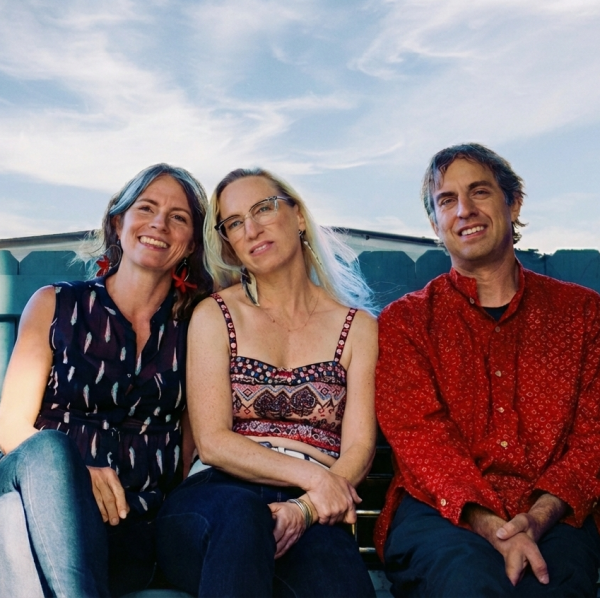
Anya Hinkle of Tanasi on Forging Their Sound and Challenging Herself as a Guitarist

The Asheville, North Carolina-based Worldgrass trio Tanasi released their debut self-titled album in early May, the product of many years of friendship and shared professional experiences that galvanized into a new project. Made up of Billy Cardine on dobro and slide instruments, Anya Hinkle on vocals and guitar, and Mary Lucey on vocals, upright bass, and clawhammer banjo, Tanasi draws on all the members’ experiences in traveling the world and exploring new sonic elements in their own work.
While you’ll notice a theme of love and positivity in many of the songs on the album, the choices that Tanasi makes in terms of sound are surprising and entertaining, veering as easily into Indian classical elements as into bluegrass virtuosity as into folk accents. The band are currently on tour supporting the album, and are thrilled that their new team-up has brought them to familiar local venues they’ve known for many years, as well as introducing them to new audiences further afield. I spoke with Anya Hinkle, who also tours internationally and releases albums a solo artist, about the genesis of Tanasi, the identity the group have formed, and about how playing this new music has led to her growth as a guitarist.
Americana Highways: It’s really interesting to me that you’re bringing traditional music from Appalachia into international traditions. I’d love to hear how that came about for Tanasi.
Anya Hinkle: Absolutely. I’ve known the Cardines for many years, but we didn’t start playing music together until seven or eight years ago. Mary and I started singing together and playing mostly Old Time music. That’s kind of where we all come from, bluegrass music. Billy has done a ton of work with more bluegrass-oriented acts. But he became really interested in Indian classical music, and actually spent a lot of time studying that with his teacher, Debashish Bhattacharya. In our video for “Give Me Love (Give Me Peace On Earth),” he’s playing this instrument that’s a 22-string dobro, basically, that’s a cross between a dobro and a sitar. Billy became very interested in these sounds. I think that’s been a huge influence, and you’ll hear that a lot on this record.
Essentially, we just branched out, just kind of accidentally, because of our travels. With Billy, it was India, and he’s travelled to Nepal to do some work. He’s very interested in Hawaiian music, and is recording an album right now of traditional Hawaiian music with some greats. He’s the most integrated in terms of world music sounds, but we’ve all travelled quite a bit. I tour in Japan every year, and my in-laws are all from Japan. I’ve spent the past twelve years or so becoming pretty embedded in the music scene over there and collaborating with Japan artists. We all have this awareness and interest in other types of music, but we are all so tied from the music that we came from, it felt natural to try to integrate it.
None of us have had conventional careers. We’ve all put a lot of importance on travel and discovery. We’re excited to share the idea with other people.
AH: I can see from looking at your careers that each of you has been on your own path, but this collaboration seems to fill a gap for all of you. You also all seem very self-motivated to learn and develop as artists and students of music.
Anya Hinkle: I never thought I’d be a solo artist. I always thought I’d be in a bluegrass band, and I was for many years, with Dehlia Low, and Tellico. When I left those projects, I did a few of my own solo records. That’s kind of how Billy, Mary, and I knew each other, is because they were backing me up. You’ll hear both of them on both Eden and Her Borderlands and Oceana.
We were touring all over the world together, and they clearly are talented artists in their own right. We decided that it would be nice to combine forces and have more of an emergent sound. We already knew that we could play music together as a trio. We knew that we could get along, which is kind of huge. At this point in all of our careers, bands have come and bands have gone, and it’s about: Can you work with these other people, in terms of lifestyles and personalities? It just works really nicely for where we all are in our lives, so I’m grateful for that.
AH: What’s it like to play this music together live as Tanasi? Is it hard to choose a setlist?
Anya Hinkle: We do things that are connected in some way to Western North Carolina. We do some old time music, but giving it our own voice. I do some flatpicking and sing. We are pulling all these influences from throughout our careers into our stage show. I think that’s important to do because we are establishing what we do at the moment.
AH: It sounds exciting, but I’m sure it’s also a lot of work.
Anya Hinkle: We’re a good team, and we have a good team so that we can spend time being ready to play. We have to make sure that we make time for the creative part, and I think that can be the challenge.
AH: I think anyone who’s focused on touring these days has to spend a lot of their creative time on that with the uncertainties and expenses of travel. It’s a brave proposition these days, but I’m very happy that you all are committed to that.
Anya Hinkle: I feel like we’re all lifers in this, but the goal with our music has always been somewhere beyond traditional career goals. It’s so hard to hit any kind of target for all the reasons that you just said. There’s so much uncertainty in this world. The only thing is just to commit, and to do the thing. Then you look at your watch and “Geez, it’s been twenty years.” You just keep going.
AH: Another plus side of that is that there are things that you can only gain from doing it for a long time. I follow a lot of musicians who are in their 70s and 80s and I feel like I gain a lot from their knowledge and wisdom. People deepen in their art over time, and it’s getting harder to do have that.
Anya Hinkle: That’s a good perspective. There has to be a way to make it work, and sometimes there are external factors, but on its own, music is very hard to make work. It takes a toll on more than just your bank account. Just today, I was talking with a fan who’s been supportive for over a decade, close to two, and they are going to host a concert for us. Those are the kinds of things that are so meaningful. Those people who are receiving what you do, it means so much.
This project, Tanasi, is also getting me onto some stages that I never thought I’d get to play. We’ll still be playing in peoples’ back yards and getting up on hay bales, but to be able to get up on the RockyGrass stage, to do Strawberry Music Festival in California, those are big stages. I didn’t know I’d get to do that at this part in my career. It’s cool to see things opening up so that we can reach more people. That kind of support really buoys us up and inspires us to keep making more music. We’re grateful for those opportunities. We’re already planning for next year. This album, hopefully, will help support all of that.
AH: That’s so cool to hear. I also heard that you all got an endowment for this album, the USArtist International grant, which is unusual and great to hear.
Anya Hinkle: I think the National Endowment for the Arts writes the check at the end of the day, but it’s a program that’s routed through Mid Atlantic Arts. They support bands and musicians going overseas to play at international festivals. We had put a tour together in France and were able to get funding for that. It was wonderful to have help with all the fees and costs to get overseas. It really made it possible to do. The fact that it’s such a competitive grant program means it was a real feather in our cap. It just, in a single award, shows who we are. It was super helpful. The Worldgrass concept also fits well with an international grant.
AH: I’m so glad that it worked out for you. When you recorded this album, was it done all at once? You all have each recorded a lot, so you had options, I’m sure.
Anya Hinkle: Billy is a fantastic engineer, and he’s engineered a lot of albums for other people as well. He’s got a great studio there as well, so it made it easy for us to record. It took some time to decide to get everything recorded, and we did some overdubbing, so it took a while. It might sound crazy, but we were still overdubbing things a year later. We just had that ability. We could keep tinkering from it for a long time. It developed over a long period, and it was a good way to record an album because we really learned the songs through recording them.
We’d be listening, and say, “Maybe it would be more dynamic if we really switched up this guitar rhythm here.” Or, “Instead of bass, maybe this song needs banjo.” We could really listen, and that shaped our live presentation of these songs, to be able to listen that closely. Recording should be a learning process. That’s how you get better. It was nice for us to hear something, learn something, and say, “I think I could make that better, now that I understand that.” Usually, in the studio, it’s too expensive to go back in and change things. For us, it helped really tighten the songs up, and tighten up the arrangement.
AH: I think it makes sense that it took a while for you all to put together this first album because you are kind of inventing your sound with it, and who you are. Do you think you’ll move faster on the second album?
Anya Hinkle: I don’t know how we’ll do the second album, though we are already talking about. One difficult thing about recording in this way is the levels can be different on the songs, and that can cause chaos in the mixing, so it would be nice to get that more streamlined. But I know that we’ve gotten better throughout this project.
Speaking for myself, regarding my guitar playing, this project has pushed me beyond anything I’ve ever done. I learned a tremendous amount. I’ve been playing in a lot of different kinds of tunings, playing with a lot of different strumming patterns, a lot of different voicings. It’s just a trio, so that’s a lot of pressure on the rhythm sections. When I hear myself now, versus when we were getting started two years ago, I can really hear my progress, which is exciting.
AH: Is there something that you want to call out on this album that you think of when you think of your progress? Something that you are particularly proud of?
Anya Hinkle: There are a few compositions of Billy’s that are pretty technical, pretty challenging, a few of his instrumental tunes. One, in particular, is called “The Fif.” It’s in 5/4 and has a lot of Indian classical music influence. There was a lot of learning that went into that song for both Mary and I. That’s a pretty out-there tune! I remember, the first time I heard that tune, thinking, “How can I even approach this?” I ended up approaching it with an Irish guitar style that I kind of picked up through working with John Doyle on my Oceania album and all the Irish musicians who I met through that. I had started going to Irish guitar camps and fiddle camps. I guess all that Irish music got me interested in applying some elements to this instrumental. That’s kind of an unusual route to approach that song.
AH: That’s interesting because there are some theories about links between Celtic and Indian music, because there are links between Celtic languages and Indian languages, too.
Anya Hinkle: They are both kind of droney. I didn’t know about that, though!
AH: I think “Pickin’ in the Pines” is another pretty complicated piece, but maybe since that’s more traditional in sound, that’s more what you’re used to.
Anya Hinkle: It is, but that’s one where we brought in an extra instrumentalist for that tune for the recording, a fiddle player called Julian Finale, who’s phenomenal. We did work on that song a lot! It’s pretty driving, and a lot of fun, and one that I feel like I’m still learning how to make dynamic. If Mary’s on banjo, Billy’s on dobro, and I’m on guitar, I’ve got a lot of work to do! That’s always something I’m learning, how to hold the band without a bass, and just a guitar. How to figure out different tunings and capo positions to cover the bass territory. That’s kind of where I’m heading with my guitar: How I can drive it as much as possible?
AH: I thought that your version of “Many Rivers To Cross” was also very soothing, and very honest, even if it can’t always be very upbeat.
Anya Hinkle: The first LP that I ever bought, that The Harder They Come record [by Jimmy Cliff]. Everybody’s heard that song. It’s not so unique, but I loved it. Then, Hurricane Helene happened [in Western North Carolina]. Billy and Mary’s place is way up in the mountains and got washed out. They were kind of trapped up there for a week and had to hack themselves out. I had a huge tree on my house. We didn’t have power, we didn’t have a phone, we didn’t have running water for almost two weeks. It was a really intense time. With everything that’s happened since then, Asheville is changed from it.
There are a lot of people who are still having a hard time, and looking at the landscape, it’s going to take a long time. It’s one of those things that has come around in terms of its meaning for us, personally. When I sing that song, now, I think about those things. That’s not why I chose the song, originally, but somehow I knew that it would be relevant. I love singing that song with Mary. There’s definitely times when I get on stage and have a hard time singing that one, and I don’t know why. It just gets me every time.
Thanks very much for chatting with us, Anya Hinkle. More information is available here on her website: https://anyahinkle.com/home and on the Tanasi website here: https://billycardine.com/tanasi