



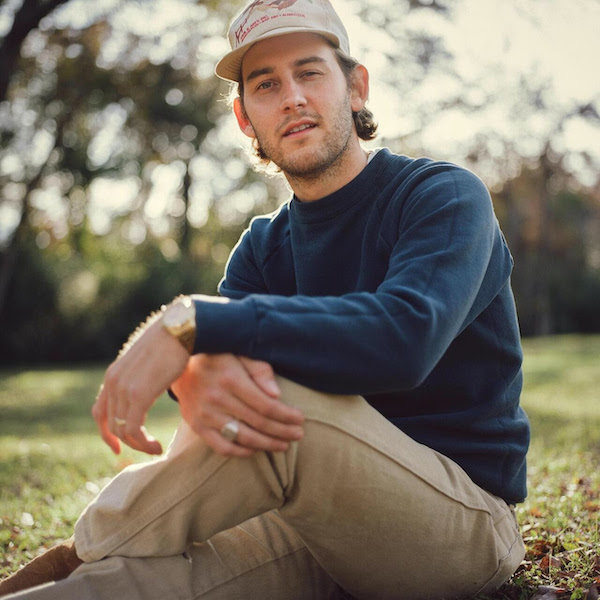
Thomas Csorba photo by Austin Leih
Thomas Csorba Slows Down For Magical Moments on Tender Country
Texas-based singer/songwriter Thomas Csorba will be releasing his third studio album, Tender Country, on May 22nd, 2026, and his collection will be the first to be released by the newly launched label Turtlebox Records, run by longtime friends of his. There are other “firsts” that mark out this album, including Csorba taking the helm of production for the first time with this effort. You might also say that these songs represent the first time that he’s officially eased up the pressure on the gas and intentionally tried to document his young family’s life through a series of vignettes aimed at capturing magical moments.
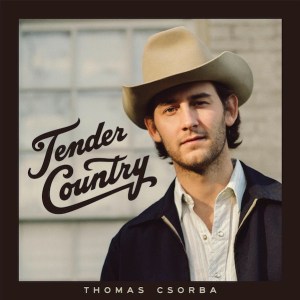
The new album follows Csorba’s 2024 release Windchimes and his self-titled debut album in 2020, but it also forms a continuum with his EPs, like From The Jordan, which seem to test the waters on even more personal, direct, and celebratory songwriting. While Csorba was gearing up for a string of shows in Massachusetts in late April, I spoke with him about making Tender Country, finding ease in the studio, finding inspiration in daily life, and teaming up with Turtlebox Records.
Americana Highways: When did you record this album? Is it something that still feels immediate, or has a little time passed?
Thomas Csorba: I feel like we made this record so quickly, and we did. Most of this tracking happened just in a couple days there, at the studio, in May of 2025. The recording itself didn’t take long, and was really fun, and quick, since I’m lucky to have some great studio musicians, and we did a little bit of overdubs with fiddle and pedal steel. We did those ten songs in two days!
AH: That is super-fast. Are the musicians ones who you’ve worked with on your previous records?
TC: Most of them, yes. I did the record at this place called Niles City Sound in Fort Worth. It’s where I did my last record. This time, I spear-headed Production, which was a little new. What that meant for me was a lot of craft on the front-end, a lot of forethought in terms of what I wanted the arrangements to be like. That meant pulling all the right references and assembling a team. That meant being in the studio, being comfortable with the guys enough to say, “You’ve got ten minutes to go outside and smoke, because we’re starting the next song.” I don’t feel like the first time I was in the studio, I felt the freedom to speak up in that way. But certainly there’s been some personal, and professional growth around how I want to run the session and how I want things to go. There was a flurry of things that made it all go pretty quickly, and made it feel effortless.
AH: That sounds ideal! A lot of people want it to be like that.
TC: I’m grateful for awesome co-writers, who I worked on these songs with, and being able to run everything. It’s a gift to be around people who I can trust that much. And they are on a much higher level than me! I’m just the song guy. They are pulling references in their mind about what kind of bass line Don Williams’ bassist would’ve played. I know what it feels like, when it’s right, but these guys actually know the ingredients. I claim to have produced this record, but it was certainly a group effort with these wonderful musicians.
AH: I’m delighted to hear that you produced this record. I’m aware of the scariness of making that decision, but I know that it’s a creative challenge. However, I didn’t know that you Produced it when I first listened to the album, and I can tell you that I thought the Production quality was very high. It just sounds great!
TC: Thanks! Robert Ellis played on the record, and he’s a producer himself, so certainly some of these guys have their own perspective. These guys know what they are doing, and might say, “I think I want to put piano on this song.” It was collaborative.
AH: Given that it was your first time acting as producer, it would have been tempting to be fairly authoritarian about it, but being open to collaboration produced great results.
TC: These days, I’m realizing that things are a lot less “make or break” than I thought they were. There are two sides to that coin. On the one hand, I believe so much in everything that we do, especially as I’m raising kids, and making music, and doing all these things. Everything has the chance to be sacred, and everything can be a magical moment, even washing dishes. But then, on the other hand, I’ve certainly let go of the pressure on so much of my output. I think that shows up on this record.
I’m saying, “I’ve got guys around me who I trust, and I’ve got songs that I’m really proud of. Let’s just go in, and whatever our instincts are, with these sonic guardrails, it’s going to be really cool.” There’s certainly a letting go, and I feel that across so much of my life. I’m letting go, but I’m still recognizing the small things as worth remembering. That’s kind of the tension that I feel on this record.
AH: I feel like that attitude or frame of mind might have helped with the songwriting on this album, too. I think on these songs, you’re letting yourself say things that otherwise might be edited out or thrown out. There’s a kind of ease to the details and the colorfulness of the imagery that you’ve brought in. It feels conversational, like sitting with someone on a porch. But that’s actually a very charming approach, which makes an emotional connection.
TC: That’s a really interesting point. When I was 16, 17, 18, starting to make records, I felt like I really had something to say to the world, and maybe to convince somebody of something. Fast forward about ten years, and here I am with a lot more responsibility, in a place where I see myself more as a witness and a documentarian. I don’t think my goal, or the utility of my music anymore, is to change somebody’s mind, though maybe it will make the listener see the world in a different way than they did before. You always want that.
But it feels less pointed towards an end-goal, and more like, “Let me just document what’s going on, because I think these little moments are pretty magical, as mundane as they may seem.” My kids and grandkids get to hear these songs someday! That’s much more where my head is at when I’m writing a song these days, so it’s cool to hear that it comes across.
AH: I don’t see it as radically different from your previous songwriting, either, you just take your foot off the gas a little. There’s an effect that the songs might remind people of things that they already know, but it’s useful for them to remember.
TC: That’s just like all the greats. John Prine does that. Dawes is one of my favorite bands. These are shows you laugh at, you cry at, and being able to show that breadth is important to what we do as artists.
AH: It must have been very emotional to write these songs. I feel like maybe all of them have that component. I know you have “Little Green Apples,” which is a cover, but it’s an amazing fit on the album.
TC: I love that song. The first version of that song that I heard was a Tony Joe White version. Maybe that most closely sonically fits what I tried to do with mine. There’s a Roger Miller version that’s acoustic, and subtle. Then there’s a version by O.C. Smith, and that recording went to the Billboard in the 1960s. That recording is much different, but cool. To see a song adapt, and change with those who have sung it over the years, it’s cool to throw my name into that. It certainly fits the imagery, too. It’s such a fun song to sing.
AH: Was there something specific you had in mind about your interpretation? When I hear your version, it does sound a little 60s to me, but actually more 70s in terms of sound.
TC: I don’t take too much credit for that. In the studio, we kind of created a space, and a playing field for that song. We could have played any song, and they could have made it fit on this record. We could’ve played “What’s Love Got To Do With It?” And it would’ve worked. But that song is crazy. It’s certainly not a modern hit, though it was in the late 60s. Some of that writing is very sharp. It takes a second to get the jokes. I really love songs like that.
AH: I think people need to be a little crazier in their songwriting. You go to some surprises places on the song “Bigger Wheels,” for instance. It has the whole sweep of a person’s lifetime, really.
TC: Everything but a hearse. I should’ve written a fourth verse with that!
AH: You can always do a longer version twenty years from now if you’re feeling grim. I thought it was neat how you start talking about the old car, and listening to Country music, which comes full circle.
TC: The “cashing a paycheck” line was fun. I wrote that one with a buddy called Jon Bauman. We wrote it very quickly, and it came very easily, and it was funny. When my wife and I had our first kid, we were walking through our neighborhood in those first few weeks. Everything was very touchy, since we were being careful with the baby. We were walking down the sidewalk, pushing our new stroller. This dad came up on his bike next to us. He had one toddler strapped to the backseat of his bicycle, and he’s got another kid on a trailer behind, and another kid on a bike next to him. It was just this scene.
He slowed down and looked at us. I said, “How’s it going?” He said, “The wheels just get bigger!” I thought, “What a line!” It’s so true. One of my kids is now almost four, and he’s graduated from the little scooter to learning how to ride a bike. They are the mile-markers along the journey of growing up. It’s pretty special. We shot some really fun music video content for this song. We rented a big old monster truck. It’s pretty ridiculous! That’ll come out with the record in May.
AH: I wanted to make sure to ask you about teaming up with Turtlebox Records for this album, since I understand there’s a long personal history there. That’s a cool development.
TC: It was a seamless fit. It’s funny, because in our world here in Texas, everybody knows about Turtlebox. But it’s a humungous market. Anybody could buy one of these speakers, from the Golf world, to the music world, to me. I’ve got one of their smaller speakers that’s magnetic, and it attaches to my fridge. In some ways, they are the end of the distribution change.
Then, personally, I grew up with these guys. One of them was a guy who, in high school, I spent my summers with. I was there building knives with Jonathan while they were in the back yard Maguivering turtlebox speakers. Will, one of the founders, his mother was my third-grade teacher. Another founder, I sang at his wedding when I was in high school. So it’s a wonderful alignment of goals to contribute to peoples’ lives. I don’t want to take too much credit, but I’ve been trying to convince them to start a record label for a while now. It’s a good, smart move for them.
For me, the deal is very artist friendly, and they have a cool distribution platform to help get my music into places that typical press and marketing doesn’t usually reach into. It’s a gift. I got to go out recently and play at a little charity golf tournament they were sponsoring. It’s just fun to be part of a team that’s so music-forward. This is actually very collaborative, and I think that’s a testament to their values, and their love for music.
Thanks very much for chatting with us, Thomas Csorba. More information and details are available here on his website: https://www.thomascsorba.com/
Enjoy some of our previous coverage here: Interview: Thomas Csorba Brings Us Songs ‘From The Jordan’ As A Meditation On Love