






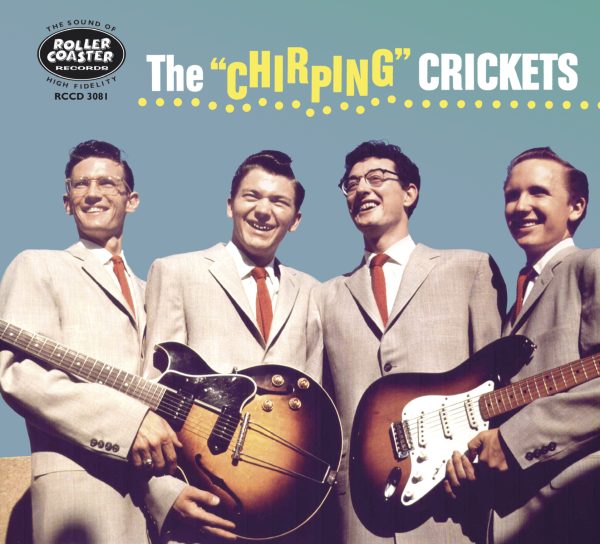
Buddy Holly and his band released The “Chirping” Crickets, on Nov. 27, 1957, about 14 months before he perished in an Iowa airplane crash. The record, their debut, turned out to be the only album they would make together.
But what an album it is. Among the tracks on this LP are the chart-topping “That’ll Be the Day,” which Holly wrote with his drummer, Jerry Allison, and producer Norman Petty. Here, too, are two other classic big hits, “Maybe Baby,” a Holly/Petty co-write, and “Oh Boy!,” by Petty and songwriters Sonny West and Bill Tilghman. (Note that the extent of Petty’s contributions to these and other tunes is disputed.)
A fourth number—“Not Fade Away,” credited to Holly and Petty—also became a rock standard. The Crickets’ version, released as the flip side of the “Oh Boy!” single, didn’t chart, but the song has since been covered by umpteen artists, including the Rolling Stones, the Grateful Dead, and Bruce Springsteen. Also on the program are other well-known gems such as “I’m Looking for Someone to Love” and “Tell Me How.” Even the relative obscurities, such as renditions of Roy Orbison’s “An Empty Cup (and a Broken Date)” and Chuck Willis’s “It’s Too Late,” radiate Holly’s magic.
All 12 of the album’s tunes have been reissued many times on assorted anthologies since his death, which makes it particularly surprising that truly fresh versions of them have recently appeared in an album from England’s Rollercoaster label. The company first issued these versions on a 2023 CD and is rereleasing them now in a “collector’s edition” that features the LP’s original UK cover art and a 36-page booklet with rare photos, detailed discographic information, and several essays. They include a lengthy history of the LP by Holly biographer John Beecher, notes on each track by Allison, who assisted with this project before he died in 2022, and an essay by Rollercoaster’s audio engineer, Chris Hopkins.
What makes this label’s edition of the album noteworthy is that it delivers the music in three new ways, all well worth hearing. First up is a remixed, remastered version of the original mono LP that features significantly improved audio.
After that, we hear the same remastered tracks, but this time in stereo—and not the “rechanneled” or “reprocessed” simulated stereo of yore. As Hopkins explains in his essay, he used a new artificial intelligence technique to de-mix the elements of the original mono recording and employed those elements to create a genuine stereo mix while also removing extraneous noise and improving equalization. (Producer Giles Martin used this technology for some tracks on the Beatles boxes that have appeared in recent years.)
The third, most revelatory version, is also in stereo, but with backing and harmony vocals excised via the de-mixing process. These vocals, including ones on nine tracks by a trio called the Picks, were overdubbed on the 1957 recording by Petty. He and the Crickets’ record label felt they would make the music more radio friendly. But Holly and his band reportedly didn’t approve of the embellishments, which were uncredited on the original album. According to Beecher, the group considered them “obtrusive.”
With the backing vocals removed, the performances sound decidedly different and arguably better. “Oh Boy!” is a prime example. Without the overdubs, which permeate this number, the record seems edgier and has more of a rockabilly feel. Also strikingly different are the dubbed and undubbed versions of “Rock Me My Baby.” The one with the Picks singing backup sounds like a pop studio production, while the band-only track seems rawer and closer to what you’d hear if Holly and his band were playing live in your living room.
Granted, it would in most cases be overkill to issue new stereo, mono, and undubbed versions of a nearly 70-year-old LP that is already widely available. But The “Chirping” Crickets isn’t just any album. It has influenced countless musicians over the decades, and its songs have been savored by millions of fans. If you’re one of them, you’re bound to love the way those tunes have been enhanced for this release.
Also Noteworthy

Sky Smeed, Live at the Rock House. After hearing the intimate one-man show preserved on this 10th album from Sky Smeed, you’ll wish you were in the room when it was recorded. Live at the Rock House, which features a concert at a small venue in southwest Missouri, marks the Kansas-based folkie as a first-rate performer in the tradition of John Prine, Tom Paxton, Jesse Winchester, and Guy Clark.
The singer, songwriter, and guitarist throws in a few lighthearted toe-tappers, including “Chicken of the Trees,” “Smoke and Spice,” and “Bumper Sticker,” all of which are good fun. However, he’s at his best and most original with moody ballads about love and life, among them “Hanging On,” “I Don’t Know What to Do,” “Nine to Five,” “Lunker Bass,” and “Keep Rolling On.” Also excellent is the album’s sole cover, Bob Dylan’s “Don’t Think Twice, It’s Alright.”
“Turn the lights down low and pour another bottle of wine,” Smeed sings at one point. Yeah, and play this album.

Daphne Roubini & Black Gardenia, Whisky Scented Kisses. While we can no longer hear new music from mid-20th-century jazz vocalists such as Billie Holiday, this album from Vancouver, Canada–based Daphne Roubini and her five-member band is the next best thing. Roubini’s silky vocals convey intimacy, and her quintet’s understated accompaniment—featuring trumpet, flugelhorn, guitar, bass, and sax—strikes just the right note.
Their exquisite set, which focuses on the joys and sadness that can accompany an intense romance, includes three covers: Irving Berlin’s “This Year’s Kisses,” which Holiday once recorded; “You Leave Me Breathless,” from Nancy Wilson’s catalog; and “There’s Always Tomorrow,” a recently unearthed 1950 composition by a songwriter named Mimi Marlowe Jaffe. Roubini and her various collaborators wrote the remaining six tracks, including evocative, beautifully arranged standouts such as the title cut, “Minor Mood,” and “Am I Crazy.” All of them could be mistaken for old classics.

Asher Brinson, Midnight Hurricane. If you listen to this bluegrass album before reading about the artist, you’re in for a big surprise. The record, which predominantly features the performer’s indelible original compositions, is on par with recent releases from genre veterans like Ricky Skaggs, but the first-rate singer and guitarist, Asher Brinson, is all of 16 years old. You can credit some of the album’s polish to its many seasoned guest artists, but these players wouldn’t be on board if they didn’t hear evidence of major talent in this North Carolina-based kid, and that evidence is omnipresent.
Brinson’s 11-track program includes eight self-penned numbers, among them the title cut, which he wrote with his producer and mentor, Christopher Henry, and which incorporates mandolin by Sierra Hull and tenor vocal by Lindsay Lou. Also on the menu are a cover of Billy Strings’s “Seven Weeks in County” and two traditional tunes, “Black Mountain Rag,” which features flatpicking guitarist David Grier, and “Cattle in the Cane,” one of three numbers with Sam Bush on mandolin.
______________________
Jeff Burger’s website, byjeffburger.com, contains more than four decades’ worth of music reviews and commentary. His books include Dylan on Dylan: Interviews and Encounters, Lennon on Lennon: Conversations with John Lennon, Leonard Cohen on Leonard Cohen: Interviews and Encounters, and Springsteen on Springsteen: Interviews, Speeches, and Encounters.