





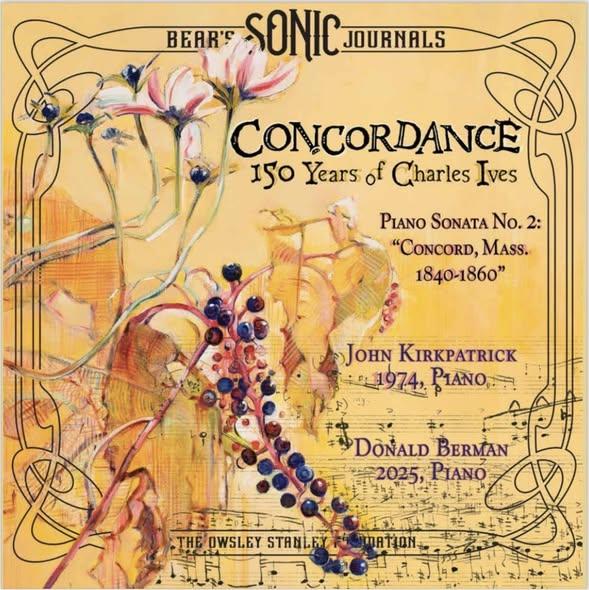
“Concordance – 150 Years of Charles Ives” Piano Sonatas – 2 CD Set
This is different, since the showcase is not mainstream-oriented but more for aficionados of classical music. Oh, but that’s European music, not Americana. But it’s Americana in spirit, since it was not written by a European composer but by Grammy Award-winning composer Charles Ives — a Connecticut son (1874-1954).
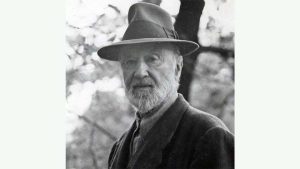
Ives was a modernist composer (largely ignored during his lifetime) but regarded as an American original. His music’s been cited by musicians/composers like Henry Cowell, Aaron Copland & Lou Harrison (considered contemporaries of Mr. Ives). Charles Ives experimented; his tonal imagery included hymnal tunes & what’s considered traditional songs. He incorporated melodies from sources such as the town gazebo band at parades, fiddlers at Saturday night dances & hoedowns, patriotic melodies, sentimental ballads & music made famous by well-known writers like Stephen Foster.
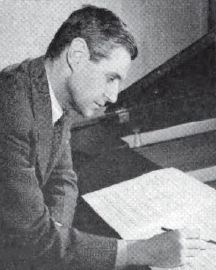
Ives’ influence was far-reaching. The late musicians Frank Zappa & John Cage cited Ives as influences on their own works. The late Grateful Dead bassist Phil Lesh (producer with Owsley Stanley on Disc 1 – 38:26) mentioned Ives as an influence. Jazz musician Albert Ayler mentioned Ives in a 1970 interview. This 2-CD set, Concordance – 150 Years of Charles Ives – Piano Sonatas (Dropped March 17/Owsley Stanley Foundation) starts with a live recording of the late pianist John Kirkpatrick performing at the Marin Veterans Memorial Auditorium (March 7, 1974). This includes piano sonatas No. 2 “Concord, Mass” 1840-1860 with 4 movements: (I) Emerson (II) Hawthorne (III) The Alcotts (IV) Thoreau.
Disc 2 (79:54) showcases pianist Donald Berman in Concord, MA (February 8, 2025). This has 8 pieces, the same 4 “Concord, Mass” 1840-1860 movements as above. Then 4 additional pieces as Concord Legacy: Other Transcendentalists. These are of varying length. These, too, are well-played. I find clarity throughout these recordings. Nothing to diminish the richness of each note played.

I found in both John’s & Donald’s early playing (though not all) a somewhat noirish quality & have a theory that Henry Mancini may have absorbed some of Ives’ musical grip on dramatic tonality. I thought it was evident in some parts of the Mancini soundtrack to “Experiment In Terror.” The piano creates an atmosphere & a mood with beauty & creepiness. It surfaces again in David Sanford’s “Underground” on Berman’s showcase.
The sudden addition of a “popular” type melody surprises a listener & disarms their ears. Are the notes friendly? Foe? That same feeling of wondering whether you should trust something or not. This feeling is in Ives’ “Emerson.” Discordant yet an underlying melody runs like a subterranean cold stream beneath the composition. It has chilling undertones, but a subliminal warm beauty lingers. If nothing else — clever composing. Both sets are captured well, but it’s all piano – so there’s little “color” to the composition as a performance piece. John Kirkpatrick (a little more fluid with a deft touch) & Berman (a little more forceful with finesse) are both fine, accomplished pianists. They navigate Ives’ musical terrain with exceptional skill.
In John’s “Hawthorne,” a sample of being “surprised” by the preliminary chaos, having a sudden intrusion of a popular melody of a bygone day, is inserted. The chaos in a blender with melodic notes, coupled with some sensibility. Oil & vinegar. Salt & chocolate. Sugar & spice. Ives knew it would work.
“The Alcotts” — the most accessible melody is almost a lullaby. Beautiful. Something Randy Newman or Tom Waits would throw randomly into a sad, dark, tragic song.
The packaging is impressive. A 112-page hinge-scored perfect-bound hardcover full-color book with 2 CDs, detailed essays & liner notes about Charles Ives & the recording is professional. The Owsley Stanley Foundation suggests that if you’re a discriminator expecting pristine sound, this isn’t it. I didn’t find it lacking. But it’s an unvarnished historical artifact that requires patience & an open mind. We’ve sat through & enjoyed vintage jazz & blues recordings that didn’t sound like polished studio recordings – because they weren’t. Some Robert Johnson blues recordings were made in a hotel. This set was produced for release by Pete Bell & Hawk. John Kirkpatrick & Donald Berman’s music samples are available on YouTube.
Charles Ives B&W image courtesy of symphony.org/public domain. John Kirkpatrick B&W Public Domain. Donald Berman color image courtesy of Webb Chappell. CD @ Amazon + Barnes & Noble & https://owsleystanleyfoundation.org/landing/ & https://charlesives.org/ives-man-his-life