




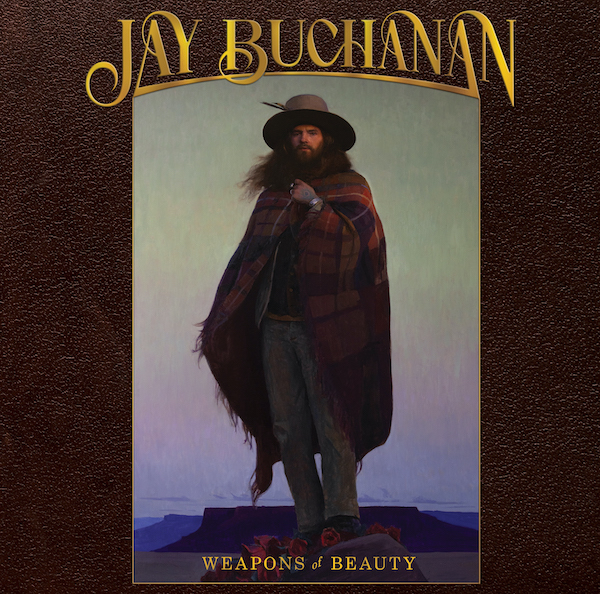
Jay Buchanan Weapons of Beauty
Jay Buchanan has built his reputation on force. As the lead vocalist of Rival Sons, he’s long been associated with volume, swagger, and forward motion. Weapons of Beauty, his solo debut, moves in the opposite direction — and the result is a record that feels powerful in entirely different ways.
It’s an album that trusts voice, phrasing, and emotional weight more than volume or bravado.
Rival Sons’ music is loud, kinetic, and unapologetically physical blues-rock. In that setting, Buchanan’s voice is propulsive, driving songs forward with urgency and conviction. That history matters because it shapes what a Buchanan solo record was expected to be — which is precisely why this one feels like a reset rather than a reprise.
Weapons of Beauty is preoccupied with endurance, the quieter work of staying present through loss, doubt, and uncertainty. These songs are about reckoning, not redemption. They’re attentive to the cost of survival and to the fragile grace of choosing to continue. Even at its most intimate, the record resists confession, favoring hard-earned perspective over self-exposure — a worldview summed up neatly in Buchanan’s repeated hope “to make it right,” even when certainty remains out of reach.
Weapons of Beauty places Buchanan comfortably among contemporary Americana artists who value restraint and emotional power over volume. These songs share DNA with writers like Gillian Welch and Neko Case, artists who trust precision, control, and emotional honesty to do the work. Buchanan favors patience over momentum, letting songs unfold without adornment and treating grief, faith, and endurance as things to be lived with rather than dramatized.
“Caroline” functions as an emotional and thematic anchor for Weapons of Beauty. Set against spare, unhurried accompaniment, the song frames grief not as rupture but as something carried forward, day after day. Buchanan writes with a novelist’s eye for how loss settles into daily life — nights that bleed into mornings, a life reshaped around absence rather than closure. The central image is quietly devastating: “my hands make the shape of yours in mine / and they refuse to hold onto something new,” a line that captures devotion without sentimentality. Even the song’s darker turns — vengeance imagined, faith tested — arrive without theatrics, as thoughts a person lives with rather than acts they perform.
Where “Caroline” dwells in private loss, “True Black” turns that grief outward, asking what remains when mourning hardens into taking stock. The song carries the same emotional weight but redirects it toward questions of responsibility — how a life is measured, what damage lingers, and whether repair is still possible. Grief here isn’t something to be survived so much as something that reshapes the speaker’s sense of obligation, pushing the album outward, toward a broader meditation on cost, consequence, and the hope, however tentative, of making things right.
That sense of focus is no accident. Weapons of Beauty was written during a period of self-imposed isolation, much of it conceived in an underground bunker in the Mojave Desert, and recorded in a stripped-down, largely live studio setting that favors feel over finish. Buchanan lets phrasing, silence, and emotional pacing do the work, producing songs that feel fully realized without ever feeling overworked.
The supporting musicians reinforce that focus, as does Buchanan’s choice of producer. Buchanan works with producer Dave Cobb, whose work with artists like Chris Stapleton and Jason Isbell has helped define the modern Americana landscape, alongside J.D. Simo on guitar, Brian Allen on bass, Chris Powell on drums, Leroy Powell on pedal steel, and Philip Towns on keys. The playing throughout favors texture over ornament and patience over push, while Cobb’s production keeps everything exposed and unvarnished. Nothing competes for attention; everything serves the song.
Buchanan’s reading of Leonard Cohen’s “Dance Me to the End of Love” arrives with the emotional weight of a closing statement, even though it isn’t the album’s final track. Sung without ornament or irony, it feels less like reinterpretation than acknowledgement — an affirmation of love as persistence rather than romance.
Although the Cohen cover feels like a natural stopping point, the title track that follows it pushes back against closure. “Weapons of Beauty” asserts intention, framing art not as escape but as a way of staying engaged — songs and words as tools for survival. “Give me the songs to sing in the fight,” Buchanan insists, recasting creativity as resolve rather than release. After an album spent sitting with grief and uncertainty, the final offering isn’t comfort so much as commitment.
Weapons of Beauty succeeds because it chooses focus over scale. This isn’t a solo debut designed to declare independence or stretch outward, but one that narrows its frame and deepens its attention. Rather than expanding on the power and reach of Rival Sons, Buchanan pares things back, trusting restraint, patience, and emotional clarity to carry the weight. The authority he finds there is quieter and harder won, but it feels durable. This feels like the right way for him to begin.
Find more information here on his website: https://www.weaponsofbeauty.com/
Mark Pelavin, a failed retiree, is a writer, consultant and music lover living, very happily, in St. Michaels, MD. His newsletter, A Feather in the Wind, is at https://markpelavin.substack.com/.