






Tommy Womack Invites You To Rock Out and Live a Little
Indie Rock singer/songwriter Tommy Womack recently released his 9th solo album, and this time around, he changed up his usual pattern by coming to New York to work with producer Eric Ambel at Cowboy Technical Services. It was such a winning combination for Womack that he’s never looking back. Part of why this experience was so meaningful for him is that the album, Live a Little, captures his punk rock background in Government Cheese, and leans into his first love of rock ‘n roll in a way that’s dear to his hears, but doesn’t limit his genre explorations. The album is a mixture of gentle and heavier elements, or as Womack calls it, “light and dark.”
For his songwriting, Womack draws on life experiences, of which he’s had many at this point, particularly in music. He ruminates on hard subjects and handles them with some seriousness, but also doses of humor. Sex, aging, funerals, and his own bad temper are all on the table as subjects, but also the real grief of separations and losses that seem to be piling up in the music world right now as we say goodbye to songwriters who have shaped our lives. Out of that perspective, and the energy of rock ‘n roll comes Live a Little. I spoke with Tommy Womack about his new experiences making this album and the texture of his life, past and present, that he weaves into his songs.

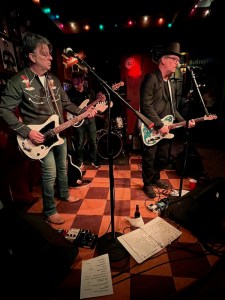
Americana Highways: I’m happy to hear that you worked with Eric Ambel on this album, and even had a launch show together with some of the people who played on the album, in New York.
Tommy Womack: In Manhattan, yes. That was the debut of a lot of the songs. A great gig. Eric drew a good crowd, because he’s Eric, and they really liked me! It was perfect. The musicianship was off the charts, and it was far and away the best New York audience I’ve ever had, because New York audiences are tough. It’s hard to impress them. It’s harder to make them laugh, but I was making them laugh. I could see us doing that exact thing again. I don’t want to do anything different with the next record that I make than I did here. I want to play with the same guys, God willing. If it ain’t broke, don’t fix it! I don’t want to be some artist who wants to change direction every time. I don’t want to make no soul album, or reggae album! I want to make another rock ‘n roll record, exactly the same way as this one.
AH: You didn’t want to do hip-hop or electronica next?
TW: Well, I do want to do hip-hop next, and I have my hip-hop name chosen. It’s “T-Wiggy.” I’m thinking of getting a license plate that says, “T-Wiggy.”
AH: That’s a quality name. Name is important. This is your ninth solo album. How did you usually record your solo albums before this new experience of working with Eric? I assume you did that in Nashville, where you live.
TW: Every record except a couple of the Government Cheese albums in the 80s, and every solo record I’ve recorded, certainly, and several of the Government Cheese records, have been recorded in Nashville. There were only two or three singles done outside of Nashville.
For some reason, that I can’t put my finger on, this record sounds like it was recorded in New York. It doesn’t sound like it was recorded in Nashville. The songs and arrangements are not that different, but something about it sounds like it was recorded in New York, and I like the change! And a lot of other people like it, too. And that’s why I’m going to come to New York to do my next one.
AH: I know what you mean, though it’s hard to articulate. There’s a little bit of edge, and a little bit of glint to it, to me, even though Eric is so good at keeping things organic. The softer side of things is there, and it feels very human, but there’s a little bit of edge that pops, to me, and that feels like New York.
TW: He has a mastery of both dark and light. The first song on the record is a serious rocker. The second song is the complete freakin’ opposite. It’s a very soft acoustic ballad. We were able to go from song number one to song number two because of his excellent mixing, which is as good on acoustic guitar songs as it is on electric guitar songs. He’s simply amazing. And we’ve become good friends. We watch Buffalo Bills games together over the phone.
AH: [Laughs] I heard that the mixing and mastering was very fast on this album, and I was surprised because of how diverse the songs are on the album, but that speaks to the excellence there.
TW: We didn’t have to do much to them. The songs were kind of mixed enough already. We just had to get in there and do some touch-ups. Everything was mostly mixed as it was, and consistently mixed in the same way, so that the songs mixed together.
AH: I loved the mix of more rocking song and the softer songs here, since I like both kinds of music. And there’s a throwback here, too, to Government Cheese, right?
TW: Yes. There are a couple songs about Government Cheese in there. “Speed, Weed, and Alcohol” and “Underneath The Water Tower Again” are about Government Cheese. I had a song called “Underneath The Water Tower” with Cheese back in 1987. It was of a frustrated guy, whining a lot, sitting underneath the water tower, which is kind of a dominant feature in Bowling Green, Kentucky, where we’re from. I never liked the lyrics on it. I thought they were too much like Morrissey, whine, whine, whine. I wanted to write the song with lyrics from a man who’s 40 years older now. It turned out real good. And none of the other guys gave me any shit about it! And it’s a franly better song now. And “Speed, Weed, and Alcohol” was Government Cheese’s diet.
AH: “Underneath The Water Tower Again” is a very sweet song, to me. It’s earnest, direct, and celebrates a place and time, and also who you were at that time. I think we can become kinder to our past selves as we get older, and kinder in general.
TW: Yes, I’ve noticed that. I used to have a terrible temper, but I don’t remember the last time I threw a fit. Back in the late 80s, Government Cheese opened for Foghat one night. And I brought out my big, heavy Mesa/Boogie amp, and I was excited to use it. Then the amp blew on me, and I was furious. I started throwing lighting tresses on the ground. The guys had to calm me down.
Somebody loaned me an amp. I was pissed off the whole gig, I was pissed off all through Foghat’s set. That was then. A couple years ago, I played a club in Bowling Green called Tidballs, and my amp blew, again. I said, “Anybody got another amp? I think this one’s messed up.” And that’s about as het up as I got about it. There’s tons of shit like that now. Every day is something. Granted, I’m on enough psych meds to choke a mule, nothing really bothers me. The only thing that bothers me is being in a business that is tinged with melancholy. Because a lot of what I do, and Eric does, is reminiscent of another era. Rock ‘n roll is no longer a force for social change. It’s just a genre. That’s one thing you have to live with.
The second thing I have to live with is that I’m considered Americana, because anyone who sings with a twang in his voice is considered Americana. The genre goes from Gillian Welch to Neil Young and Crazy Horse. I’m going to be classified as that, but I’m playing rock ‘n roll. I’m going back to my first love. I realized one day when I got in the shower, that on my jambox, I wasn’t playing my Jason Isbell record, which is very good, or my Lucinda Williams record, which is very good, or any of my Steve Earle records.
I was playing The Clash, AC/DC, The Pistols, and The Stones. I thought, “If I hear another song about a train in the key of G, I think I’m going to shoot somebody! Possibly myself.” I can turn on my positive attitude about it if I go to see a band that’s Americana, since I appreciate it more live. People are going to say I’m Americana, when I’m not, and they are going to say that I live in East Nashville, which I don’t. I don’t correct them, because it’s cooler to live in East Nashville, than to live in the suburbs of Nashville, in the south, which I do.
AH: Well, I don’t know if I was too young or what, but when I grew up in Tennessee, I think I was before East Nashville. It’s just Nashville to me. But you have a long history there. You have deep roots.
TW: From the rock scene in Nashville, starting in 1985, I am one of the very few survivors who are still playing. There are some. There are some others who are still playing, but we are few and far between. That has mellowed me out, or helped me accept certain things. Like “Don’t sweat the small stuff,” as they say, and it’s all small stuff.
AH: When I listen to these songs, all of them have ideas that I can see might be things that people just don’t say out loud, and you talk about them, so I can see how that could help people. You give an outlet to those thoughts and feelings. Like two of the songs on this album are about funerals. “I Guess We’re At That Age” suggests that this is all the time, even though we don’t talk about.
TW: When we’re in our twenties, and thirties, and forties, it’s like something we don’t have to deal with much of the time. But now that I’m at my age, which I guess is the same age as my contemporaries, they are dropping like flies! I don’t have enough fingers to count up how many are gone. I can’t believe Todd Snider is gone. Because of my psych meds, I don’t cry. I don’t grieve like normal people.
I still expect Todd Snider to be playing in Cleveland. Then I remember that he’s dead. I can’t believe that my old manager, Mary Sack, is dead, Prine’s dead, Peter Cooper is dead. There are so many people who were close friends, and that’s hard. With that Song, “I Guess We’re At That Age,” everyone is assuming that it’s about Mary Sack, and I don’t want to discourage them in that, but it’s really about a funeral for a dear friend of mine, in Bowling Green. That’s the incident which the whole song came from, except there wasn’t a casket, there was an urn on the table.
AH: The relationship in that song is detailed, and that’s what brings it home. I think it’s hard to write a song about funerals. I think it’s hard to write about death. We seem to put up barriers about it. But the personal cuts through that. It’s so real.
TW: Yes. I write a lot of reality. But I have palette-cleansers, too, like “Horny Mormon.” Or the song off my last record, “A Little Bit of Sex, Part 2.” Government Cheese had a song called “A Little Bit of Sex” that I wrote in my 20s, and was cheating on my girlfriend on the road, and all the recriminations, but “A Little Bit of Sex, Part 2” is the story of perspective. It’s about a 59 or 60 year old man, where “rock ‘n roll” is a losing cause, “My good old friends come around, stand for the first song, then sit back down!”
Thank you very much for chatting with us, Tommy Womack. More information is available here on his website: https://tommywomack.com/
Enjoy Tommy Womack’s review of Todd Snider’s send off, here: Show Review: Todd Snider Send-Off at Eastside Bowl Dec 16 and some of our previous coverage here: REVIEW:Tommy Womack “Live a Little”