


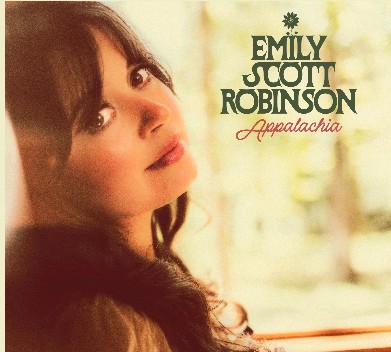
Emily Scott Robinson Appalachia
On Appalachia, Emily Scott Robinson’s clear voice rings out with grace, passion, and power. Both as a singer and as a songwriter, she has rarely sounded more grounded, making this album feel less like an artist getting better over time and more like someone working at a new, higher level.
That assurance comes into focus immediately on “Hymn for the Unholy,” the album’s opening track. Robinson sets aside her usual guitar accompaniment and sings alone over a bare organ, her phrasing loose and unmetered, as if feeling her way into the song in real time. The music follows rather than leads, gradually layering percussion and bowed strings. The effect is intimate and disarming, less a performance than an act of discovery.
Robinson respects life’s uncertainties, writing about plans abandoned, faith unsettled, and the humility of recognizing how little control we actually have. “There’s so much we have no hand in, but look how hard we try,” she sings in “Hymn for the Unholy,” a line that doubles as a mission statement for the album. The comfort here comes not from certainty, but from the work itself, from the idea that not knowing what comes next can bring freedom rather than signal failure. That perspective feels shaped by a childhood she has described as “soaked in Southern music and church,” where belief and doubt often sit side by side rather than cancel each other out.
That sense of openness is not an accident. Appalachia was recorded over five days at Dreamland Recording Studios in upstate New York, a former church whose creaking floors and vaulted ceilings still carry the hush of a sacred space. Robinson has a true partner in her producer, Josh Kaufman, a member of Bonny Light Horseman whose production work has also shaped records by Josh Ritter, Craig Finn, and Bob Weir. Together, Robinson and Kaufman favor feel over finish, allowing songs to unfold at their own pace. Silence becomes part of the arrangement, and the studio’s natural acoustics lend the music patience and presence rather than polish.
That sense of companionship deepens on “Time Traveler,” one of the album’s most devastating and generous songs. Written about Robinson’s grandmother as dementia loosened her grip on the present, the song treats memory not as something lost but rearranged. Robinson resists sentimentality, observing instead how time collapses—how joy, trauma, and tenderness coexist when chronology no longer holds. “There’s a darkness in our DNA, some fraying strand,” she sings, before extending the song’s quiet grace: “So if you wanna fly away sometimes, I understand.” The melody moves gently forward without forcing resolution, allowing the song’s emotional complexity to land with full force.
Appalachia is the work of a mature songwriter hitting her stride. Robinson’s earlier albums—particularly Traveling Mercies and American Siren—established her as a writer of uncommon clarity and emotional intelligence. Those records leaned more squarely into contemporary Americana songwriting. On Appalachia, that skill set remains, but it has been absorbed into something older and steadier. The songs feel less concerned with making a point than with being useful.
Musically, Appalachia reaches further back than most contemporary Americana records. Robinson draws from older Appalachian and Anglo-American folk traditions—songs shaped by use rather than authorship, built to be carried forward rather than claimed. Her writing recalls the moral steadiness and communal purpose associated with Jean Ritchie, the Kentucky-born singer who carried Appalachian ballads and hymns into the modern folk revival, and Hazel Dickens, where melody serves memory and endurance more than self-expression. That lineage continues into the present in the quieter, tradition-minded work of Rhiannon Giddens.
That ethic is reinforced by the album’s collaborators. Alongside Kaufman’s restrained, intuitive production, fiddler and cellist Duncan Wickel provides much of the album’s quiet motion. Harmonies from Lizzy Ross add warmth and intimacy, while a duet with John Paul White, best known as one half of the Civil Wars, brings a weathered gravity that suits the album’s themes of endurance and love marked by time. Released on Oh Boy Records, the label founded by John Prine and now run by his widow, Fiona Prine, Appalachia fits comfortably within a tradition that values humanity over spectacle.
All of that care comes into focus on “Appalachia,” the album’s title track and quiet center. Written in response to the devastation Hurricane Helene brought to Western North Carolina, the song resists both anger and false reassurance. Robinson frames catastrophe through the lens that defines the album as a whole: what matters is not what can be controlled, but how people show up for one another when control is lost. “Appalachia” understands place not as scenery but as responsibility. Robinson treats the region less as an idea than as a web of lives bound together by weather, history, and care, where endurance is measured in small, ordinary acts rather than moments of heroism. “We’ll dance with sorrow, tuck the children in,” she sings, grounding disaster not in spectacle but in the daily work of staying present.
Appalachia doesn’t reach for catharsis or spectacle. It trusts quieter virtues: attention, patience, and care. These steady songs feel at home in the same places they were shaped by—rooms where people gather, listen, and keep going.
Find more information here on her website: https://www.emilyscottrobinson.com/
Enjoy some of our previous coverage here: Interview: Emily Scott Robinson: Learning Music the Honest Way
________________
Mark Pelavin, a failed retiree, is a writer, consultant and music lover living, very happily, in St. Michaels, MD. His newsletter, A Feather in the Wind, is at https://markpelavin.substack.com/. Mark can be reached at mark@markpelavin.com.