


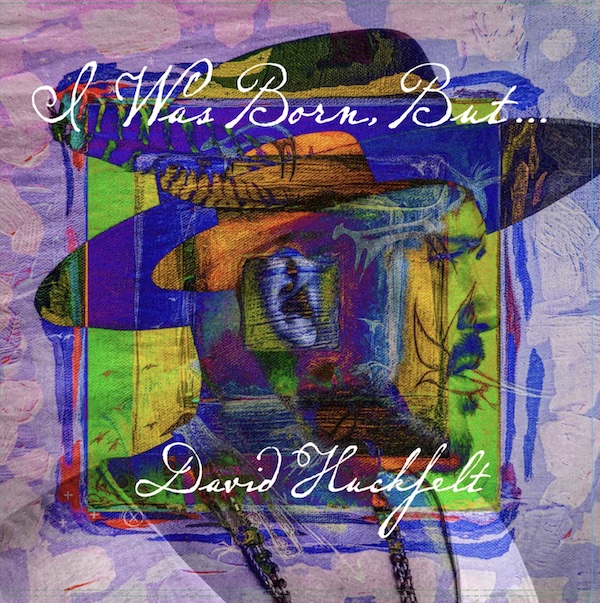
David Huckfelt I Was Born, But…
Americana music—and folk music more broadly—is as much about inheritance as it is about originality. What gets handed down, what endures, and what still feels worth singing matter.
On I Was Born, But…, David Huckfelt leans fully into that idea, offering fifteen songs he didn’t write but somehow owns. These songs—from Bob Dylan, George Jones, Warren Zevon, Keith Secola, and others—are presented not as tribute, but as something meant to be carried forward.
What Huckfelt’s choices here have in common isn’t a particular sound so much as a shared toughness. These are survival songs—songs meant to be sung through trouble rather than simply about it. That thread runs from Dylan’s slow, watchful unrest to George Jones’ hard-earned resignation, from Zevon’s battered humor to Secola’s clear-eyed resolve. Huckfelt treats them less like heirlooms than like tools—songs that still know how to be useful when you need them.
That mindset shapes how the record sounds. I Was Born, But… was recorded largely live, and it carries the feeling of people in a room listening to one another. Huckfelt doesn’t force his voice forward or try to stamp the songs with personality. Instead, he lets them open up at their own pace, settling into “Changing of the Guards” (Dylan) or “The Race Is On” (George Jones) as if feeling out where the center of gravity really is. The band follows suit—pedal steel, harmonica, rhythm section moving easily, without fuss or flash.
That attentiveness is built into the way the record was made. Recorded full band, live, over two days at Dust & Stone Studios in Tucson and produced by Gabriel Sullivan, the sessions ran without rehearsals or lyric sheets. The core band—anchored by former Bob Dylan drummer Winston Watson—plays with the confidence of musicians who know how to listen as well as play. Connor “Catfish” Gallaher’s pedal steel and dobro, Thøger Lund’s bass, and Sullivan’s shifting presence on baritone guitar, synths, and percussion give the songs room to breathe rather than dressing them up. Appearances by harmonica player Tom Walbank and singer Billy Sedlmayr add texture without breaking the spell. Nothing here feels rushed or precious—the performances sound allowed to arrive fully formed.
That approach matters most with songs as familiar as Dylan’s and Zevon’s, which can buckle under too much intention. Even when Huckfelt turns to songwriters whose work has been covered endlessly, he avoids the obvious entry points. His Dylan and Zevon selections aren’t greatest-hits gestures, but songs that still carry some risk—less familiar, less resolved, and therefore more open to interpretation. Huckfelt’s “Changing of the Guards” avoids turning the song into a statement, letting it stay unsettled and alive. Zevon’s “Stop Rainin’ Lord,” meanwhile, sheds its usual edge and lands as something closer to a plainspoken plea. In both cases, Huckfelt sidesteps reverence and ends up somewhere more grounded.
Just as important, the album doesn’t stop with the obvious songwriters. Songs by Pieta Brown and Howe Gelb sit comfortably alongside the giants, not as curiosities, but as equals. One of the pleasures of a record like this is being led toward artists you may not know well—or may not know at all—and Huckfelt clearly values that kind of listening. Inheritance here isn’t about narrowing the circle; it’s about widening it.
That widening instinct shows up again when Huckfelt turns to Bo Diddley’s “Who Do You Love?” Rather than leaning into swagger or spectacle, he treats the song as something closer to ritual—rhythmic, communal, and elemental. Placed alongside folk standards and singer-songwriter confessionals, it reinforces the album’s larger claim: inheritance belongs to whatever songs still hold up when passed hand to hand.
That perspective isn’t accidental. Huckfelt has long operated at the porous edge between authorship and interpretation, treating folk music less as a genre than as a way of working. He has written that covering songs is “a way to show deference and respect to the lineage of bold souls who blazed the trail you now pass upon,” adding that it requires “a little homework on your own unimportance as the hero of your own tale.” That sensibility runs quietly through I Was Born, But…, which feels less like a detour from original songwriting than a natural extension of it—an album grounded in attention rather than assertion.
Across the record, Huckfelt lets the songs move at their own pace, giving them room to breathe rather than pressing for effect. “Changing of the Guards” carries a sense of forward motion without urgency, while Gordon Lightfoot’s “Early Morning Rain” is slowed until its emotional center comes into focus. Elsewhere, J.J. Cale’s “Any Way the Wind Blows” and Tom Petty’s “Two Gunslingers” settle into an easy, lived-in groove. The throughline isn’t style so much as approach: Huckfelt never seems interested in improving a song, only in standing inside it long enough to hear what it still has to say.
Records like I Was Born, But… matter because they push back against the idea that everything has to announce itself as new. In a musical culture that often rewards novelty for its own sake, Huckfelt reminds us that some songs endure simply because they keep meeting us where we are. This album doesn’t argue for the past. It argues for listening—and for carrying forward what still holds up.
Find the album and more information here on his website: https://www.davidhuckfelt.com
The album was produced by Gabriel Sullivan and David Huckfelt with additional production by Jeremy Ylvisaker; engineered by Gabriel Sullivan and Brian Joseph with additional recording by J.T. Bates; and mixed by Adam Krinsky with additional mixing by Brain Joseph. It was mastered by Huntley Miller.
Musicians on the album are David Huckfelt on vocals and acoustic guitar; Winston Watson on drums and percussion; Catfish Gallaher on pedal steel, electric guitar, and dobro; Thoger Tetens Lund on upright and electric bass; Gabriel Sullivan on baritone guitar, synthesizers, and percussion; Tom Walbank on harmonica and vocals; and Billy Sedlmayr on vocals and spiritual advice. Additional musicians on the album are Jeremy Ylvisaker on electric guitars and backing vocals; and J.T. Bates on drums, percussion, electronic percussion, and piano.