




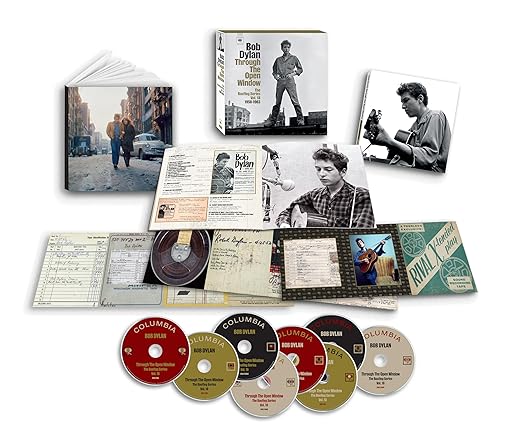
Though Bob Dylan’s Bootleg Series began in 1991 and has embraced well over 50 discs, it is only now, with its 18th volume, that it is getting around to the first chapter of its subject’s story. And what a chapter it is.
Granted, the period covered by Through the Open Window: The Bootleg Series, Vol. 18, predates much of Dylan’s finest work. And even the great stuff here (of which there is plenty) often appears in demos, outtakes, home recordings, and nightclub and coffeehouse performances that lack the relative polish of his famous studio LPs. But this package, like the rest of the Bootleg anthologies, isn’t intended to be anything like a best-of collection. Instead, it aims to dig beneath the surface and hold a magnifying glass to Dylan’s creative process.
This eight-CD set does that as well as anything in the series. Its 139 tracks include 59 previously unreleased performances and another 37 that are extremely hard to find elsewhere. It comes with a well-illustrated 124-page hardcover book that incorporates discographic information and lengthy notes by author Sean Wilentz.
Disc One begins with a few very early Minnesota recordings. In the oldest, from 1956, a 15-year-old Dylan amateurishly but enthusiastically mouths the words to Shirley and Lee’s then-popular “Let the Good Times Roll.” There’s also a 1959 performance of a rudimentary self-penned obscurity called “I Got a New Girl.” (“Well, I got a new girl, she says she’s my one / But my new girl, she won’t come home / Come on now, baby, say you’ll be mine always / And I’ll be your one for eternity.”)
Of the 40 songs on the first two CDs, all but seven date from 1961, and only 10 are Dylan originals. This was a time when he was busy soaking up folk and blues influences, so we hear covers of tunes by artists such as Woody Guthrie, Rev. Gary Davis, and Blind Lemon Jefferson. Some are collaborative efforts with Dylan’s Greenwich Village folk contemporaries, including Carolyn Hester, Dave Van Ronk, Jim Kweskin, and future Blues Project guitarist Danny Kalb.
Can you detect hints of greatness in these recordings? Mostly just in retrospect, though Dylan does project a large personality and, on one of the few originals (“Talkin’ Bear Mountain Picnic Massacre Blues”), a sense of humor.
On Discs Three and Four, all from 1962, original material becomes predominant. These are still early times, however. Banjo player Bob Yellin introduces Dylan to one audience as “a fellow who’s been around the New York area for about a year. He also performs in various coffeehouses.”
More than half the songs that ended up on Dylan’s eponymous debut LP are on these two discs, including early versions of “You’re No Good,” “Man of Constant Sorrow,” “Fixin’ to Die” (a duet with Van Ronk), “Gospel Plow,” “Baby Let Me Follow You Down,” “See That My Grave Is Kept Clean,” and the record’s two originals, “Talkin’ New York” and “Song to Woody.” Also featured are a handful of covers of songs by artists such as Hank Williams, Jimmie Rodgers, and Robert Johnson, and more early samples of Dylan’s humor (“Talkin’ John Birch Paranoid Blues” and “I Shall Be Free”).
Finally, there are examples of the sort of political material that Dylan frequently wrote at the time but would soon stop composing. These include “The Death of Emmett Till,” “Let Me Die in My Footsteps,” “A Hard Rain’s a-Gonna Fall,” and “Blowin’ in the Wind,” which, he informs an audience, “ain’t a protest song or anything like that, ’cause I don’t write protest songs.”
Also here are two snippets from Dylan’s radio conversation with Cynthia Gooding, in which he tells tall tales about the six years he claims he spent with a carnival. (You can find a transcript of the whole interview in this writer’s book, Dylan on Dylan: Interviews and Encounters.)
Discs Five and Six, all drawn from 1963 recordings, feature more of the protest songs Dylan claimed he didn’t write, among them “Oxford Town,” “Who Killed Davey Moore,” “Masters of War,” “Only a Pawn in Their Game,” and “Blowin’ in the Wind,” the last two of which are from a SNCC voter registration rally in Greenwood, Mississippi. There are outtakes from The Times They Are a-Changin’, including some with significant lyrical changes, plus performances recorded at the Newport Folk Festival, the March on Washington, and Forest Hills Tennis Stadium. Dylan duets at the latter venue with his then lover, Joan Baez, who introduces him to the audience as “a phenomenal young man.”
The box culminates with Discs Seven and Eight, which feature a remix of an entire Oct. 26, 1963, concert at New York’s Carnegie Hall. Dylan talks more to the audience here than he does in later years, and while his repartee isn’t polished, he radiates charm. His songs, moreover, are frequently stunning. They include such future classics as “With God on Our Side,” “Masters of War,” “When the Ship Comes In,” and “Boots of Spanish Leather,” which he describes as a number about how “when you can’t get what you want, you have to settle for less.”
Just two years before this concert, only 53 people had been willing to pay two dollars each to see Dylan perform in Carnegie Chapter Hall, a small rehearsal room. Now, he was appearing at Carnegie’s main venue, thrilling a sold-out crowd of thousands with an all-originals 19-song set. Dylan had traveled a long way in a very short time. As we now know, he would travel a whole lot further in the years ahead.
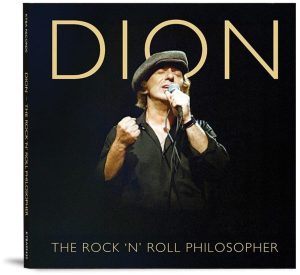
Dion, ‘The Rock ’n’ Roll Philosopher’
Dion DiMucci possesses one of rock ’n’ roll’s greatest voices, but in recent decades, he has largely eschewed that genre in favor of religious music and, later, the blues. Work on a newly issued memoir prompted him to revisit his rock roots, however. The result is The Rock ’n’ Roll Philosopher, an album that shares the book’s title.
The CD includes eight new recordings and an equal number of tracks sourced from older LPs. Among the latter group are excellent versions of three early hits—1961’s “Runaround Sue,” and “The Wanderer” and 1962’s “Ruby Baby,” all of which first appeared on 2003’s New Masters CD.
The new recordings offer a mix of rockers and ballads and incorporate fresh compositions as well as reinterpretations of old favorites. Together, they show that, at age 86, Dion’s vocal and creative strengths remain fully intact.
Highlights include a scorching new rendition of his “King of the New York Streets”; “Serenade,” which weds Tom Waits’s “San Diego Serenade” to a Dion song about faith; and “New York Minute,” a doo-wop-style evocation of the moment he first met Susan Butterfield, his wife of more than 60 years. There’s also an emotional, recently recorded reading of “Abraham, Martin and John,” Dion’s Top 5 hit from 1968, that he calls his favorite of the dozens of versions of the song he has recorded over the years.
Like his other recent albums, this one features several luminous guests, among them guitarists Mark Knopfler, Joe Bonamassa, and Sonny Landreth. Also here, playing guitar on Dion’s “If You Wanna Rock ’n’ Roll,” is Eric Clapton, whose essay in the accompanying booklet calls the song’s author “a genius singer, writer, musician, and healer.” Amen to that.
______________________
Jeff Burger’s website, byjeffburger.com, contains more than four decades’ worth of music reviews and commentary. His books include Dylan on Dylan: Interviews and Encounters, Lennon on Lennon: Conversations with John Lennon, Leonard Cohen on Leonard Cohen: Interviews and Encounters, and Springsteen on Springsteen: Interviews, Speeches, and Encounters.