


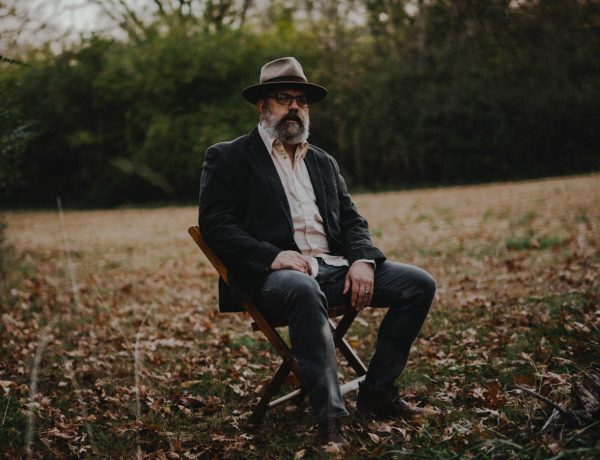
Afton Wolfe photo by Joshua Black Wilkins
Afton Wolfe has a newly released album named after the lesser know constellation Ophiuchus, which, according to astrologers, may have more of a relationship to those born in December than is currently being considered. The album contains meditative songs on very relatable human experiences. We had a chance to chat with Afton about inspiration from the cosmos, meditation, ancient Babylonians, and philosophical probing into sound waves and more.
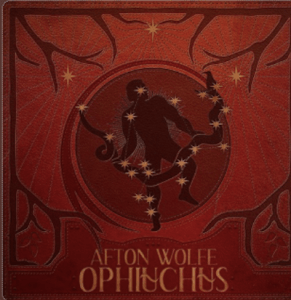
Americana Highways: In the ever-morphing world of AI, you’ve headed light-years in the other direction to make a record that pays tribute to classic eras with inspiration from the eternal power source, the cosmos. Ophiuchus, your enigmatic, adventurous new 13-song collection melds soul, blues, country, jazz, rock, folk and gospel into a loveletter to transcendental mediation, truly a highway to the essence of Americana. Is Ophiuchus a concept album?
Afton Wolfe: The release of the album was more conceptual than the Songs, coordinating with the sidereal path of the sun and trying to tap into the ancient reverence for the stars. The album and songs therein contain several concepts that are significant to me – forgiveness, death, war, love, and all other ingredients and complications of life.
AH: Are there subliminal sound waves only recognized by extraterrestrial beings?
AW: I sure hope so.
AH: Since the legend of Ophiuchus is not well-known, what’s the cliff-note version and why has his constellation’s inclusion in the traditional zodiac calendar somewhat contested?
AW: Well, the horoscopic view of the constellations has been based on set dates since the Babylonians almost 3,000 years ago. But we’ve learned since that the stars are moving – the celestial sphere is shifting. So, where the Babylonians set these dates is not where those constellations are anymore. In the last few hundred years, the sun has been traveling through Ophiuchus during the first part of December. Ophiuchus is The Serpent Bearer, in part based on the Greek god of medicine, Asclepius, who was born a mortal and rose to godhood because of his healing skills. Asclepius is usually depicted handling a snake, and the staff wrapped with snakes that represents medicine is his.
AH: Do you see yourself as a metaphorical serpent-bearer?
AW: Not me, personally, but collectively, I see all artists as serpent bearers at this moment in history. With artificial intelligence and the war for human attention – the most powerful force known to man, true human connection through art can possibly heal the fractures and fissures in our declining society. On the other side are oligarchs and politicians and generals and grifters who recognize the power of human attention and want to manipulate it to their own perverse ends. Those are the two effects of the snake’s venom – to heal and to kill.
AH: How much did the general consensus characteristics of each sign of the zodiac play into the lyrics or musicality of the songs?
AW: Not too much. The songs themselves are relatively self-contained entities. Obviously, putting my own attention towards this concept led me to a song about Ophiuchus itself and inspired that song. And when sequencing the album, I had the constellations and signs in mind a little, but I was more focused on the flow of the collection from song-to-song. Most of, if not all, the songs seem pretty appropriate for the sign they coordinated with – “I Deserve to Be Forgiven,” for instance, coordinated with Scorpio, and the song is about forgiving seemingly unforgivable things, and a scorpion seemingly has few redeeming qualities. “Dream Song” has an innocence about it and fit very well with Virgo. “One Million Children” is a song about violent genocide, and it coordinated with The Ram appropriately. Those are just a few examples, but I think (much like the horoscopes themselves) you can assign meaning and find a reason that the songs match the signs, but I attribute that more to magic than planning.
AH: As a Sagittarius, yourself, according to the traditional calendar, though Ophiuchus, in the 13-sign calendar, how did that influence your approach to the project’s last track, though first single released, the 7-minute magic-weaving, stream-of-consciousness rumination, “Invocation,” which features tanpura and bouzouki, instruments popular in India, West Asia and the Balkans? Was duality a consideration?
AW: Duality is always a consideration for me. The Yin and Yang are always finding and disrupting their balance, and Eastern philosophy has been very influential in my thinking for the last 10 to 15 years. But so has Western thought and iconography. And yes. I am an Ophiuchan whose been told that he was Sagittarius forever. I think opening the release with “Invocation” in Sagittarius was significant, because this is a very personal collection. I had just begun to reflect on this entire concept, and in a way, I think I was trying to invoke the Ophiuchus within myself, beginning from the Archer I’ve always assumed I was. Now when listening to it from “Ophiuchus” through to “Invocation,” I feel that I am invoking something different – something unknown but that I am still very much a part of and look forward to – the future.
AH: What’s your favorite song from Ophiuchus?
AW: That’s tough of course, and it changes. I really like the collaborative songs – “Rules of War” that I wrote with Judy Blank and “Last King of the Blues” that was cowritten with Irakli Gabriel and Hywel John. Those are two of the best songs I think I’ve been lucky enough to find and be a part of, in my opinion. “Winter Comes for Mary” and “I Deserve to Be Forgiven” have both been favorites of mine, for their personal reflections and because I had them both bouncing in my head for a long time without completing either. And then I’ve never put an instrumental out before, so I’m kind of partial to “Sphere Shift.” But, if you’re asking me today what my favorite song on the album is, I’d probably say “Crooked Roads,” which has been on a loop in my head as we approach the two-year anniversary of my lovely wife’s craniotomy. Dr. Sarah Bick is a hero.
AH: In a world of singles and playlists, why did you feel it was important to craft an album, your 2nd overall, but first since your debut Kings for Sale in 2021?
AW: Albums have always been important to me. My heroes made albums, and I recognize their trajectories and phases based on albums. Also, the prior few releases I was a part of were all songs others found before me – the David Olney tribute, a cover of “Dead Flowers” with Jaimee Harris, and before those a collection of my father-in-law’s songs on The Harvest. So I wanted to share songs I’d found, and I had a lot of those, so an album made the most sense.
AH: “Rules of War,” co-written with fellow Nashvillian Judy Blank, a centerpiece from the new opus seems like a natural progression of the sentiment of Kings for Sale. Wars have long been active on this planet, what was the impetus for the song and its nuevo-tango music video?
AW: With the ongoing conflicts that have cropped up recently, there has been a lot of discussion in news and commentary about “international rules-based order” and “acceptable” behavior while conducting war. I find that obscene and utterly indefensible. I’d been scribbling about that idea for a while. Then, Judy and I were slated to hang out and maybe try to find a song. This one was written in just a couple of hours, once Judy started messing around with an old Omnichord I’d recently purchased. The video came together after I found two excellent tango dancers in Nashville – Charles Yee and Zara Sahak, and I enlisted Little Hollywood Creative – the team of Scot Sax and Sally Jaye. Their creative vision made the video a fun experience.
AH: In a similar light is the harrowingly fervent “One Million Children,” with its scathing refrains and militaristic percussive intensity. A heavy headspace to enter. Is there any conflict that informed it? Do you have hope for humanity?
AW: Children are not culpable, but they suffer the most. That song was written shortly after Israel began retaliating for the despicable Hamas terrorist attack on October 7, 2023. The hatred in that conflict made me acutely aware that innocents were going to be disproportionately and collectively punished, and that always falls hardest on children. Sadly, it has proven to be the case as we have seen a genocide livestreamed with impunity since then. Hope is a poison, and I try to avoid it. Humanity is probably doomed no matter what. The present moment is all that exists, and it could definitely be better for most people.
AH: Are there any humanitarian organizations you support/would like to highlight?
AW: Too many to list them all. But I think the most important thing is to pay attention to our own communities. That’s why I have worked with several organizations in and around Nashville, like Second Harvest Food Bank of Middle Tennessee, Mules and More Rescue, Heart and Hands Critters Rescue, MusicCares, Room at the End and others. I tend to gravitate towards organizations that help animals and children. Not that all adults are wholly responsible for their own situations, but always moreso than animals and children.
AH: As an indie artist who’s been making music and performing since the 90s, what’s your opinion of the current music business and what are some effective avenues you’ve used to navigate newfangled apps and algorithms?
AW: The music “business” is the only reason I would ever stop doing what I do. Because the idea that this is or should be a business I find disheartening and contradictory to what I really love about music. The idea of music as an enterprise or career or any other fiduciary vehicle has sent me on spirals that I’ve barely recovered from several times. And I can’t look at it that way anymore. I think the solution for me has been to meditate on WHY I am doing this, and I’ve come to the conclusion that it’s either a mental disorder or a sacred, ancient calling. It’s probably both, but both deserve my respect and attention. Of course, I want people to connect to my music – that’s what the calling is for, so I employ whatever reasonable tools and techniques are available. There are some lines I haven’t crossed or won’t. And I certainly don’t know any secrets other than finding peace with the ego pain that comes from being in a “music business” environment like Nashville. And casting magic spells.
AH: Over the years, people have thrown around comparisons to Tom Waits, Joe Cocker, Leonard Cohen, RL Burnside and the beat poet stylings of Charles Bukowski. Who are your influences, both musical/songwriting-wise but also in life?
AW: All of those names listed have been huge influences on me. As a child of the 80s and 90s, I also have new-wave, grunge, hip-hop, heavy metal and other influences from that time in my DNA. I think some of my biggest inspirations musically are from people I don’t sound very much like at all – Fiona Apple, Björk, Nina Simone, Regina Spektor, Lucinda Williams, and other powerful female artists whose works have been incredibly factored into my own musical path. My wife inspires me with her bravery and support, and my nieces inspire me with their creativity and curiosity.
AH: Every December for the past two decades, The 5 Spot in East Nashville hosts Get Behind the Mule, a Tribute to Tom Waits that benefits local food banks, including Second Harvest of Middle Tennessee. This year is the 20th Annual, a momentous occasion. As co-host, you’ve emceed previous iterations and helped to curate the lineup this year. What can fans expect? Should people bring donations to the event?
AW: Expect nothing but great songs. Expectations are as dangerous as hope. Yes. We collect canned foods and cash donations, and we encourage everyone to help in any way they can with Second Harvest Food Bank of Middle Tennessee and the laudable work they do to feed our hungry neighbors in Middle Tennessee. https://www.secondharvestmidtn.org
AH: 2026 kicks off with your return to Tropic of Cancer Music & Arts Fest in Todos Santos, Baja, Mexico, this year with headliners Lettuce, Fruition, John Craigie, Andy Frasco & The U.N., Clay Street Unit, Cordovas, Miranda Lee Richards and La Santa Cecilia. What else is in the works for the new year as you take Ophiuchus on the road?
AW: That is still in the air. To be completely honest, releasing this album one-song-at-a-time over the course of a year, in a year which I did more touring than I have in twenty years, and doing it practically by myself (with the wonderful help of my publicity manager 18/88 Media, a cadre of distribution experts, and the inexplicable support of my friends and family) has been exhausting. I am exhausted, and my tank is empty in just about every way. And it is coming to a head, with the Get Behind the Mule tribute right on the heels of the album release, and not much rest between that, Christmas and the Tropic of Cancer Festival, I’m looking forward to a few days to turn off before starting to plan the next steps. But there are things in the pipeline – a live album, a smattering of both live and live-streaming performances, and the embryonic conversations of another concept album with some fun collaborations.
Sounds great! Thanks very much for chatting with us, Afton Wolfe! More information is available here on his website: https://aftonwolfe.com/home
Enjoy our album review here: REVIEW: Afton Wolfe “Ophiuchus”