





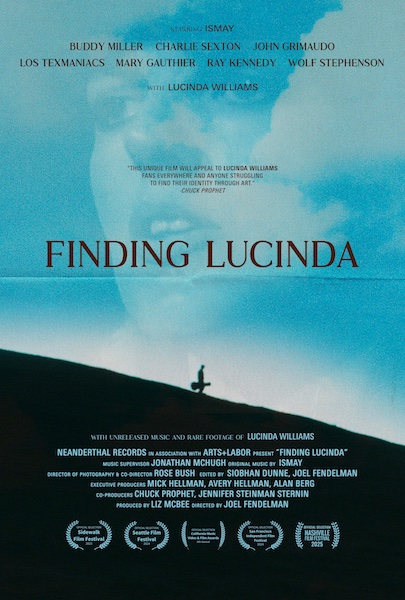
Finding Lucinda Documentary
“Why?” has always been the most unanswerable musical question for me, both as a writer and a fan. Why do we gravitate toward certain artists, but not others? Why do seemingly more talented songwriters toil in virtual obscurity while anonymous songwriting mills crank out hit after shitty hit? And why does hard work sometimes not pay off? All three of these questions come up, in some form, in the new-to-on-demand documentary, Finding Lucinda, available to stream beginning September 9. In the film (and podcast of the same name), singer-songwriter Avery Hellman, who performs under the moniker ISMAY, follows the footsteps and legacy of Lucinda Williams in an attempt to figure out if their own musical career is worth continuing. The resulting film is a deep-dive into the early days of one of the best songwriters of the last half-century, while also showing just how hard these “whys” are to answer.
Finding Lucinda begins with Hellman’s home life – working a farm – while also tying their past into Lucinda’s music; turns out, a young Hellman performed (with their father) in a cover band, and they once shared the stage with none other than Steve Earle, performing “Concrete and Barbed Wire” together. As this seems to have been a career highlight, Hellman questions the wisdom of continuing to chase music – “I think I’m afraid I don’t have enough worth it to do it” – or surrender to a “normal,” workaday life. As a sort of last stab at their dream, Hellman decides to head toward Nashville, hoping to meet their songwriting idol.
The most fascinating part of Hellman’s journey is the unexpected history and wisdom they find along their route. They meet with Charlie Sexton in Austin, and he, too, admits that he’d felt that same doubt many times early in his career. Hellman learns of Lucinda’s early Tex-Mex roots from Texmaniacs, and they visit Houston music venue Anderson Fair, where the singer originally performed as the one-named “Lucinda.” We hear a long-ago recording of Lu, an early take on “Lafayette” (later released on Happy Woman Blues), captured in 1978 at Malaco Studios in Jackson, Mississippi. We also meet musicians who have played with, and been inspired by, Lucinda, including Buddy Miller, who boils Williams’ “magic” down to, “She is so who she is.” And, in Nashville, an extensive interview with Mary Gauthier is a highlight of the film, providing an important piece of wisdom to Hellman (and to any aspiring artist) – “If you’re copying someone, you’re not saying something you’re scared to say.” We need Gauthier in some of these Nashville songwiring rooms, givin’ these kids a talkin’-to.
Nuggets like this are the reward for viewers of Finding Lucinda, but does the journey pay off for Hellman? Well, it’s not spoiling anything to say that, after visiting producer Ray Kennedy and electing not to see Lucinda play at the Ryman, Hellman does finally meet their hero. And while I won’t share Lucinda’s words to Hellman (see the film!), it’s enough to give pause to anyone considering giving up on an “inspired” career in order to cash checks. Don’t cut off your own dreams, at least not before listening to Lucinda.
Check out the trailer for Finding Lucinda here:
Finding Lucinda is available on-demand beginning September 9. For more info on ordering the film, listening to the podcast, or attending the upcoming tour (featuring screenings and live musical performances), go here: https://www.findinglucindafilm.com/
Finding Lucinda was directed by Joel Fendelman, written by Avery Hellman and Joel Fendelman, produced by Liz McBee, Marco Hellman and Avery Hellman, and co-produced by Chuck Prophet.