


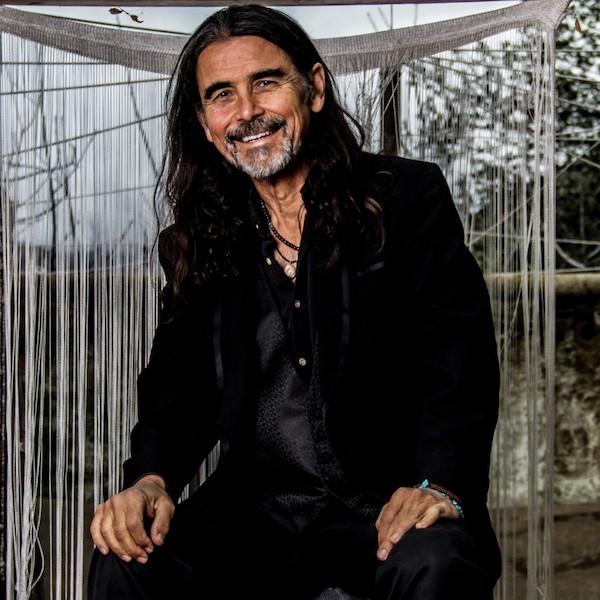
Jess Wayne photo by Mark Maryanovich

Based in Taos, New Mexico, folk, country, and blues singer-songwriter Jess Wayne recently released his album, Ancient Door, a fusion of contemporary folk, country blues, and easy jazz, all flavored with dollops of Americana.
Talking about Ancient Door, Wayne explains, “Many of the songs on this new album are about love, its loss, its pleasures, and its hope of true connection. A few are reminders from my subconscious to stay in the now, in the moment. All are meant to heal.”
Produced by Wayne, who also plays guitar and provides lead vocals, the album features the talents of Nelson Finney, aka Jupiter Skyfish, on electric guitar, Sidney Barrett (bass), Monte Williams (piano, keyboards), Jimmy “Julio” Ledezma (drums), and Jon Graboff (pedal steel), along with vocals from Jono Manson and Myrrhine Faller.
I spoke with Jess Wayne to find out more about the inspiration for Ancient Door, his influences, and his creative process.
Americana Highways: What three things can’t you live without?
Jess Wayne: Love, guitar and computer.
AH: What inspired your latest album, Ancient Door?
JW: The title comes from the last song on Ancient Door: “Come Join The Dance.” I wrote this song when I turned 70; it felt like something monumental happened. It was like I had carried a suitcase with me all my life with instructions to open on my 70th birthday. In that suitcase were all the stories about what it means to be old. What it means to make it. How my body should be feeling. And they were largely negative things, and they started manifesting. I wanted to live in the now and appreciate the beauty and love that surrounds me. In the song, I have a line: ‘Come join the dance, through the ancient door…’ and I thought this is reality; life goes on regardless of age as it always has and always ever will be and thus, we all must pass through the ancient door, the portal to the next step of living and that step can be an invitation to be joyful, to dance.
AH: Walk us through your mindset as you entered the studio to record the album.
JW: I wanted to catch a live sound, with real musicians playing in real time with each other. Feeling the vibe and weaving something new. I wanted each musician to listen to each other, play with each other, respond to each other. I didn’t want the sterility of a click track. I wanted a living, breathing song that maybe slows down in parts, maybe has too much going on in parts. I wanted to capture a bit of the energy of our live shows, but this time, it was just us listening, encouraging each other.
AH: If you were to describe your music to the uninitiated, how would you describe it?
JW: I call my music ‘Electric Bourbon Folk.’ A genre defying, hard-to-classify mix of modern folk storytelling, country folk, blues, jazz, soul, Americana, pop, and alternative country. Sometimes I say it has bits and pieces of John Mayer, Sting, Van Morrison, and Nick Cave. Sometimes I just think it is my own unique blend of singer-songwriter.
AH: What kind of guitar do you play?
JW: On the album, I played a Fender Telecaster with humbucking pickups and a set neck. I am currently playing a Fender Stratocaster Ultra II with two single coils and a humbucker in the bridge.
AH: How did you first get into music?
JW: I started very young with neighborhood hootenannies and a baritone ukelele. At the age of 11, I got my first guitar and started taking guitar lessons. By the age of 15, I bought my first electric guitar (a Gibson ES-120) and started playing in a garage band. We became a dance band and played at various high schools.
AH: What can you share about your writing process?
JW: My writing process is, shall we say, flexible. Sometimes a line comes to me in the middle of the night. Sometimes I’m just fooling around with the guitar, and I find a beautiful chord that takes me somewhere, and the words follow. Sometimes I sit down and write the first phrase that comes to mind, and the next thing, the words pour out, and I’m writing as fast as I can. Ultimately, all of the songs feel ‘received.’ I just have to quiet down enough, stop chasing the shiny penny, and let the song go where it wants to take me. Some songs happen in a day, and others over months, and sometimes fragments linger for years.
AH: Where are you from?
JW: I was born at West Point, New York. My father was in the military, and we traveled around a lot (Long Island, NY, and Munich, Germany) until I was 7. We settled in Aurora; Colorado, and I consider myself from Colorado.
AH: Did your hometown impact your music?
JW: My old hometown experiences as a young teenager playing the rock and roll covers of the day certainly did, but my current hometown, Taos, really does. There is something about Taos that makes my soul happy, and the Southwestern vibe filters into the music most notably from the kinds of musicians available and the dreamy vibe of pedal steel.
AH: Which artists/musicians had the most impact on your sound?
JW: I really like John Mayer, Sting, Van Morrison, Keb Mo, Curtis Stigers, Sade, Bruce Cockburn, Brett Dennen, Paul Simon, Lucinda Williams, and, of course, the Beatles.
AH: Did your sound evolve naturally, or did you deliberately push it in a certain direction?
JW: Just naturally. I was greatly opened up to different sounds and music when I studied at the Musician’s Institute in Los Angeles. We were exposed to all genres and encouraged to play them all.
AH: Which artists, in your opinion, are killing it right now?
JW: I’m loving Amos Lee, Ray LaMontagne, Garrett Hedlund, Lyle Lovett, Chris Stapleton, Jason Isbell.
AH: What’s next for Jess Wayne? New material? Live gigs?
JW: I’ve got quite a few more songs to record and have added several new songs in the last year. I always have one or two songs sitting on my music stand, asking for completion. And one or more floating around in my head. I’ve played over 200 gigs in the last three years, but I would like to play more. I’m looking for listening audiences – festivals, listening rooms, and house concerts. I still play a weekly gig at the Sagebrush Inn, a local Taos venue, and several monthly gigs around town. I’m looking to expand my playing to the regional area – up to Denver, Colorado; down to Austin, Texas, and west to California. Probably as a solo artist. The economics and logistics of a band are quite challenging at the moment.
Thanks very much for chatting with us, Jess Wayne. Discover more about Jess Wayne and his music here.