


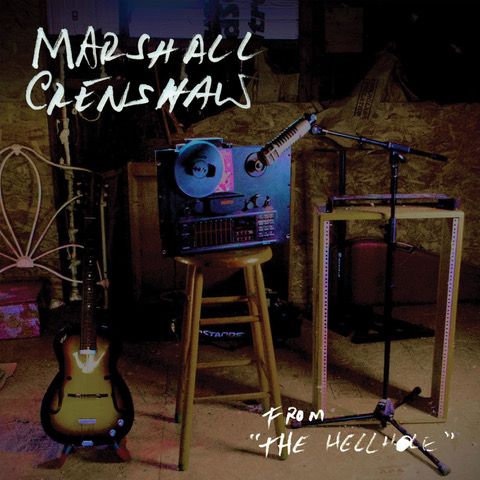
Marshall Crenshaw From ”The Hellhole” (Yep Roc Records)
There are so many of us who have idolized this man and his music since the release of his self-titled debut back in ’82 – the love reinvigorated with each subsequent release (there have been 12 since, not counting compilations). Quite a feat given his awkward beginnings as a backup cast member of Broadway’s “Beatlemania” – which debuted at NYC’s Winter Garden Theatre in 1977 (he was to play John Lennon). He eventually joined the touring version but was clearly not enjoying playing someone other than himself. To be fair, however, the Detroit-born Crenshaw had grown up on a filling diet of radio, schooled himself on guitar from age 10 and witnessed the best of live music as only Detroit can dish out. From high school bands to heading to NYC in search of his dreams, he was destined to be a musician and, when he left the cast, he focused on writing his own songs, recording them on his own 4-track and forming a band (with brother, Robert) for the NYC club scene. A resulting invite to Shake Records, he released his first single in ’81 while one of his songs (“Someday Someway”) was covered by Robert Gordon, garnering big attention for this young writer. The rest is where we came in – Warner’s first release set the stage for what was to follow, as his soon-to-be-rabid fan base – and critics – began to catch up. Later releases helmed by no less than Steve Lillywhite and T-Bone Burnett didn’t hurt as Crenshaw refined the sound he was after. The usual bumps and turns in the road were to follow as well as parts in movies (most notably playing Buddy Holly in La Bamba) and, as Crenshaw released his inner love for multiple genres along the way, notable artists were picking up his songs, spreading the word of his talent as a singer, a guitarist (among other instruments) and a songwriter.
Knighted as a “master of pop classicism”, Crenshaw’s body of work reveals a sea of influences but his is a fresh, vital sound unlike any other – kept current through maintaining a strict regimen of touring. At the same time, his entire catalogue seems to defy time and trends: from composing attention-getting soundtracks to catchy, guitar-driven pop songs crafted around memorable hooks, dynamic performances and stringent studio production.
Which brings us to this release. The “Hellhole” is Crenshaw’s affectionate name for his in-house studio where so many of his songs continue to be worked out. It’s a bit of an odds’n’sods collection – not unlike his 2015 ‘catch-up’ release, #392: The EP Collection. In fact, ten of the tracks included are resuscitated here, having benefited from fresh augmentation, remixes or an altered creative tact – as only an obsessive musician can attempt: you can always improve on what you’ve done. Some are included as they were recorded and released – for a series of Record Store Day EPs between 2012 and 2015 and some are previously unreleased.
Originally included on the EP Collection, Crenshaw has revisited “I Don’t See You Laughing Now” with guitarist Andy York and bassist Graham Maby, while Crenshaw handles everything else from deep in ‘the Hellhole.’ From its distinctive bass and snare intro, this first track has all the ingredients craved by his fan base. His ever-supple voice is supported by great guitars and layers of background vocals underlining each unmistakable hook as his always-insightful lyrics spell out a valuable lesson in karma for the modern world.
What have we here…? It’s the unmistakable piano intro (the late Rob Morseberger) made famous by Karen and Richard Carpenter on the Bacharach-David mega-hit, “(They Long To Be) Close To You” from August, 1970. Crenshaw pays serious tribute to the songwriting and arrangements of this classic. Again, released on #392, it remains unaltered. Crenshaw plays it syrupy straight while adding slight embellishments to the Carpenter’s original in the form of fat bass and meaty drums (Crenshaw), together with some extended effects towards the end. Loyal to the strings, piano, flute, horns and backup vocals, this is an unexpected turn in the Crenshaw canon.
In fairness to this co-write with the talented Dan Bern, “Driving and Dreaming” is entirely miss-able. The richly inflated beats and tasty, supplemental guitar flourishes (Crenshaw, with Jamie Saft on B3), this song seems as dark as its theme of life on the road when it’s not so fun anymore. Unchanged from its original state, it’s going nowhere in a hurry and is definitely not up to Crenshaw’s usually high standards.
Crenshaw’s lively resurrection of another moldy goldy in Rare Earth’s “I Just Want To Celebrate” is hearty fun – in turn, a celebration of a Motown classic. Originally recorded in ’14 for a charity fundraiser release, it was remixed in 2004. Recorded with a slight reverb and a punchy rhythm section, spirited guitar and wall of background vocals (all Crenshaw!) it’s a quality cover. At the halfway mark, a solo guitar and punchy drum beat slowly brings the familiar song back to technicolour, adding extra meat to the already familiar melody.
Another co-write with Bern, “Move Now” is very familiar turf and – without a doubt – the most outstanding track on this release. Last recorded as part of an EP from 2014 and included on #392, it gets a burst of guitar bordering on psychedelia – all parts played by Crenshaw. Remixed in 2023. You won’t stop humming this track.
“Made My Bed, Gonna Lie In It” serves up proof that not everything Crenshaw touches turns to gold. Amping up the guitar slightly, Crenshaw brings the usual Beatle-like blend to the harmonies but, some songs never get off the page and this is one of them. You’re easily lost looking for the hook and the falsetto isn’t something you’ll forget too soon. Again, Crenshaw plays everything while Daniel Littleton adds guitars and backing vocals. An Easybeats’ original, it was remixed in ’15.
“Walkin’ Around” retains some of the original Crenshaw magic but it, too, seems devoid of any memorable hook, despite its tough guitar sound and near-perfect vocals. Originally included on the sadly underappreciated Life’s Too Short, this demo version is all Crenshaw and his one-man-band, from 1990.
For those recalling The Move when Jeff Lynne was an up-and-coming songwriter and performer, Crenshaw retains the Beatlesque/neo-psychedelia of the original “No Time” – right down to its slide guitar (PK Lavengood), multi-layered vocal and woodwinds (Plink Giglio) of the original. Just as their A Message From the Country attempted to play counter-point to the Beatles’ White Album, this is an intriguing tidbit for those who can appreciate Crenshaw’s deep love of ‘all things Beatles’. At the same time, it hardly fits in with most of the other material. Glen Burtnick (Styx) adds guitar and vocals. Remixed in ’23.
Another Dan Bern/Crenshaw co-write, “Grab The Next Train” shares a similar guitar intro to “Move Now” and, while Crenshaw applies a lower register to his vocal here, it seems like he’s really trying to force-fit the song into his own, patented formula.…but the song just doesn’t seem to want to fit. Daniel Littlejohn adds guitar and vocals to this remix.
You might well recognize John Sebastian’s “Didn’t Want To Have To Do It”, lifted from the Lovin’ Spoonful’s ‘66 release, Daydream. Not surprisingly, Crenshaw’s pop artistry shares a similarity to the Spoonful’s uncanny ability to score hit after hit at a time when the British Invasion was rewriting the category. Like Sebastian, Crenshaw has succeeded in his ability to create cheery, melodic music that has always leaned more rock than folk – always injecting his work with sing-able pop hooks. All Crenshaw.
“Stranger and Stranger” is a soft, intimate original, accented by drums and vibraphone and little else. Its chorus rings like a bell as a heavier guitar sound lurks in the backdrop. A tasty guitar solo transforms this tight little track into an even loftier place. This is vintage Crenshaw and could easily belong on any of his releases. Remixed in ‘23, Bryan Carrott (vibraphone), Byron House (bass) and Manuel Quintana (congas/bongos) guest.
When Todd Rundgren released “Couldn’t I Just Tell You” on his ground-breaking double release, Something/Anything? from ’72, there’s little question it had an impact on Crenshaw’s approach to songwriting. The delicately-rendered guitar intro is the perfect foil to Crenshaw’s uncanny ability to clone the Toddster’s vocal. Previously unreleased (by Crenshaw), it features great harmonies and while the track is a little lighter weight, musically, than the original, Crenshaw is clearly having fun paying homage to a favourite song. Crenshaw handles all instruments while Jared Michael Nickerson adds bubble bass guitar on this contribution to A 50th Anniversary Tribute to Todd Rundgren’s Something/Anything?, released in 2022.
Another co-write with Dan Bern (and J. Ruben), this mix is previously unreleased. “Red Wine” leans heavily on drums and (exceptional) B3 (Rob Morseberger) with a side of accordion (also Rob Morseberger). While Crenshaw delivers a solid vocal, the track sounds like anyone but the typical Crenshaw fare. Maybe that was the intent – but why fix what isn’t broken? A great guitar solo helps bind the song together while the accordion adds a cosmopolitan touch.
It can hardly be a surprise to see Crenshaw cover Bobby Fuller and Fuller’s cover of Eddie Cochran’s “Never To Be Forgotten.” While Texas couldn’t be further from Detroit, Fuller’s success was built on his early melding of Buddy Holly grafted to high-energy electric Stratocaster and a full shot of infectious enthusiasm. Crenshaw retains the song’s Western-influenced guitar line, reinforced by a heavy use of background vocals. In other words, custom-made for the Crenshaw touch. Remixed from the #392 version.
The final verdict? For those who already own ‘15’s #392: The EP Collection, is this release worth owning? If you can’t get enough of Crenshaw, yes. The revisions may be minor and the new (to you) tracks are a memorable surprise. The more casual fan should jump on #392. Yet, for a deeper look into a singer-songwriter’s creative process – including an eye-opening glimpse into what transpires in Crenshaw’s ‘Hellhole’ – it’s a must-buy, however. You just can’t get too much of this vibrant, brilliant artist.
Find more details here: https://marshallcrenshaw.com
Enjoy our previous coverage here: REVIEW: Marshall Crenshaw “447″
Musicians on the album are Marshall Crenshaw on drums, bass, vibraphone, toy piano, electric piano, cowbell, percussion, guitars, and vocals; Andy York on on lead guitar; and Graham Maby on bass; Rob Morseberger on piano, all keyboards, conductor; Suzanne Ornstein on violins and viola; Lisa Morseberger on flute; Glen Burtnick on guitar and vocals; Steven Bernstein on trumpets; Jamie Saft on Hammond B-3; Daniel Littleton on guitars and backing vocals; Plink Giglio on ‘tron flutes; and PK Lavengood on slide guitar and acoustic guitar; Bryan Carrott on vibraphone; Manuel Quintana on congas and bongos; Byron House on bass; Jared Michael Nickerson on bubble bass; Rob Morseberger on Hammond organ and accordion; Graham Maby on bass.
The album was produced by the Staff at the Hellhole and recorded during 1990, 2012, 2013, 2014, 2015 and 2020 at The Hellhole, Rhinebeck NY, with additional recording at 17th Avenue Productions, The Clubhouse in Rhinebeck NY, Excello Recording, Brooklyn NY (thanks- Hugh Pool), Hobo Sound in Weehawken NJ, and at Rob’s place, Croton-On-Hudson, NY. Songs were
remixed by Eric “Roscoe” Ambel and Mario Viele at Cowboy Technical Services, Brooklyn NY, by James Frazee at Hobo Sound, Weehawken NY
Songs were mixed by Rich Pagano at High-Fidelity NYC, sometimes as a favor to Michael Shelley and WFMU, for their pledge-drive CD “Super-Hits Of the ‘70s; by Brad Jones at Alex The Great in Nashville; by James Frazee at Hobo Sound, Weehawken NJ; by Zach Ziskin and by Stewart Lerman with one song engineered by Plink Giglio.
It was mastered by Kurt Reil at House Of Vibes, Highland Park, NJ.