



Liam St. John photo by Graham Fielder
Liam St. John on Weathering Life’s Storms and Making Man of the North
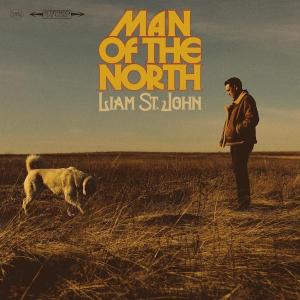
Blues and blues rock artist Liam St. John has been writing music for some time, and previously released an EP titled Believer, but on September 5th, 2025, he will release his first full-length album. Four years in the making, but bringing with it many years of lived experience through St. John’s largely autobiographical writing, Man of the North makes a statement about who Liam St. John is and where he comes from, but it also shows off a bigger band sound than in his previous more stripped-down days.
True to that aesthetic, though, the album was recorded as live as possible, keeping things as close to the human level as St. John could manage. For extra humanity, he brought in some collaborations with the likes of Molly Tuttle and Houndmouth, bringing home the big emotions of some of his tracks about leaving home and examining one’s soul. St. John has been playing a number of support slots this year with his new band, but is also diving into a headline tour which will deliver the estimable energy of the album to a live crowd, and some of those songs will be making the rounds for the first time. It’s a full-circle moment for St. John, bringing a sense of identity to his performances through his songwriting. I spoke with him from the road about making Man of the North.
Americana Highways: I know you’ve got big tour plans. Will you be playing from the new album?
Liam St. John: We’ll put a few of the older bangers in there for fans, but yes, and it’s been exciting to open a new chapter, sonically, with these songs. It’s been four years in the making with this album, but really a lifetime in the making with the subjects of the songs.
AH: Have many of these have people heard before? I know “Dipped in Bleach” has been out.
LSt.J: We re-recorded three songs from my stripped-back days, “Dipped in Bleach,” “Forefathers,” and “Devil in Disguise.” For the re-release of “Devil in Disguise,” Houndmouth jumped on that one. Other than that, we open our set with “Trouble.” And that’s a great opener that gets the energy up. We’ve had a lot of support runs this year, so our sets have been shorter, but in our headlining dates, we’ve gotten to show the audience some of my favorites, like “Stick To Your Guns” and “Falling In Love.” It’s been great to see the reactions, and I can’t wait for them to have the songs in their hands.
AH: I’ve noticed from going to shows myself that people are picking up on new music really quickly. When the bands play, the audience knows the songs as soon as the album is out. There’s not much of a lag.
LSt.J: I love that so much about this day and age, how people consume music, and how much songs mean to people. We played this festival in Texas, and I played a new song, and people were singing along. I thought, “Wow! How do they know this song?” That is the coolest thing ever. It’s beautiful. There are many upsides to social media, and many downsides, but that’s one of the upsides. People can become intimate with a song before it’s even out.
AH: Did you record the songs in batches, or over a shorter period?
LSt.J: Because I came from a stripped-back background, where everything was raw, and uncut, and recorded with one take, it was important for me to record a band-based studio album in the same way. So we actually cut it all live with a band. We did it all at The Blue Room Studios in Nashville. My friend Johnny Black produced it and Charles Yingling engineered. We recorded the EP, which was the “Believer” section of the album, in 2023. Then, we recorded the rest of the album last year in August. So we did four songs, and then the others to make up 12. We did it all with the same bands for continuity. We rehearsed together with the band for a couple of days beforehand, then we basically did each song five times and took the best take.
AH: Were you in a booth also?
LSt.J: Yes, I was in a booth so I could record acoustic and vocals with the band, and then they were all in a room right next to me, with drums, bass, and lead guitar. I could see them. That’s what I wanted to capture, a raw, authentic vocal performance, and also a band performance. I didn’t want it to be in a box or on a grid. I wanted it to feel as real as possible with this, my first studio album. I had session guys in Nashville when I recorded the album, because I hadn’t fully formed my band. I had the best players in town, so the biggest challenge was making sure they didn’t sound too good! [Laughs]
AH: You mean you didn’t want them to sound too polished?
Lst.J: Exactly, so I didn’t have a click, and let the drummer lead the charge. The rhythm section was awesome, and I just got to rock out, so that was exactly how I wanted it to be.
AH: You did some interesting collaborations, too. When you bring in more vocals on a song, it changes the feeling of it in subtle ways. On “Greyhound Bus Blues,” having a duet with Molly Tuttle, on a song that feels kind of lonely, makes it feel more universal, in a way. It suggests that a lot of people go through this.
LSt.J: That’s a great point. I hadn’t really thought about it that way.
AH: I know that it’s such a personal song, and it tells a specific story, with a lot of details in it, but by bringing someone else’s voice in, it brings more energy, and makes it feel even more emotional, I think.
LSt.J: I agree. That’s the beauty of songwriting, in general. It’s like the more honest and vulnerable you get, the more it resonates with a larger amount of people. It’s like the opposite of what you’d think. That’s a good reason to bring someone else into a personal song. I think it does broaden the reach in terms of who it’s gonna resonate with.
AH: Did you all talk about the song at all before doing it? Was it something that she felt connected to, also?
LSt. J: Yes, I think we’re both troubadours, chasing the long white line, and I think that’s where we connected on the song. We just sat down and went through the lyrics, to find where she resonated the most, and that’s how we structured the song.
AH: Is that a song that you otherwise just perform by yourself?
LSt.J: There might be a show or two where Molly turns up and sings with us, but other than that, I’ll sing it by myself.
AH: For “Devil in Disguise,” I read that this was a very intense and emotional song for you to write. Houndmouth are on that one, too, which also makes it feel more intense, almost raising the questions to a bigger, human level. I actually really resonated with the idea that if we never question ourselves, we are probably not very good people.
LSt.J: [Laughs] Yes.
AH: That’s scary because we don’t want to question ourselves, and wonder if we’re bad, but it’s a paradox since it’s somewhat necessary.
LSt.J: That was the toughest part, I guess, just being self-aware enough to step outside of myself. And to take a broader look at myself as who I am rather than who I thought I was or who I want to be. It was a painful thing to look at, given our lives, and human experiences, and the mistakes that are made. It’s just a tough thing to look at, and I think that’s why most people don’t.
AH: I come from a pretty religious background, and I think my mom did a great job with four kids, but I was brought up to assume that I was a good person as long as I was following the rules. I think it took getting a lot older for me to start asking myself, “Is it possible that I’m playing the villain in someone else’s life?”, like the song does. But I’m glad that I can do that now.
LSt.J: I grew up the same way, but I actually feel like my perspective was the opposite. I always felt like I was messing up, falling short of God’s grace, and that’s probably why I have this complex, where I’m constantly questioning whether I’m doing the right thing or not. [Laughs]
AH: But then, maybe your issue is that it’s hard for you to believe that you might be a good person! It goes the other way!
LSt.J: Yes, exactly! [Laughs]
AH: The video for that song is very cool, and it looks like it was shot up in the Pacific Northwest. Is that location basically where you grew up?
LSt.J: Yes, I grew up in Washington State. The whole album is called Man of the North for that reason. It’s kind of a love-letter to my roots, and part of that is being from Spokane, Washington. We filmed a lot of the content out on a friend’s ranch in Goldendale, Washington. It’s kind of a place that I go to retreat and re-energize, so I thought it would be a cool place to capture.
AH: It looked really cold. Was it cold?
LSt.J: It was very cold! We did it in January, and it was freezing, but there’s no place like home. Even though it was freezing, at least the air was thin and crispy, how I grew up. There’s a weight and a vibration from city to city, and I feel a difference whenever I go home, back to the mountains, and nothing feels better than where my bones belong.
AH: I think there’s a different feeling in the air near mountains, in the landscape, because sound operates differently there. I’m sorry it was so cold, but it did make for some great visuals, because everything is so sharp. And some of that footage made it into the album trailer, which was great to help show people what you’re talking about.
LSt.J: I definitely wanted to do that. It’s always a surprise to me when I meet someone who hasn’t been to the Pacific Northwest. It’s just such a beautiful place to at least visit once in your life, and experience the majesty of it. I just wanted to capture a little bit of it and share it with everyone.
AH: I feel like, at some point, writers and songwriters are going to talk about where they come from, unless they really hate it. When did it become clear to you that you wanted to go ahead and make a statement about that with this album? I know that writing the song, “Man of the North” played a role in it.
LSt.J: I’ve been writing for forever, but I’ve been intentionally writing songs that I wanted to release with “Dipped in Bleach.” That was the song that kind of put me on this path of writing about who I am, and what I come from, my past, my pain, and the roots of who I am. That song kind of started that particular journey of songwriting. But when I did write “Man of the North,” it became clear that a lot of who I am was so heavily influenced by the environment that I grew up in.
With the geography of Spokane, Washington, you get the polarities of weather. Winters are long, and summers are hot. I realized how connected I was to the city I was from, and I realized how that compares to how my mom raised me. As a single mom, she had to weather storms. It just all kind of made sense to me when I wrote the song, “Man of the North.” I have this intense personal connection and obsession with pine trees. I think I spiritually connect with them because they signify where I’m from, and I think they signify what the people are like where I’m from. I think that’s what “Man of the North” is kind of about.
AH: I think it’s cool that the song is such a specific self-portrait, and it’s about such a specific place, but people who come from challenging environments, or challenging backgrounds can relate to what the song is saying. That includes people from remote, rural places, but also people from tough environments, in some ways.
LSt.J: Yes. I didn’t want to alienate anybody, but I also have to just write what comes out of me. I’ve always seen that when I write exactly what I’m feeling that people resonate the most. I think you’re right. It’s really not about the geography of where a person is from, it’s about where they are at in life, and the storms they have to face. That’s where they are from.
Thanks so much for chatting with us, Liam St. John. More details are available here on his website: https://liamstjohn.com/tour